


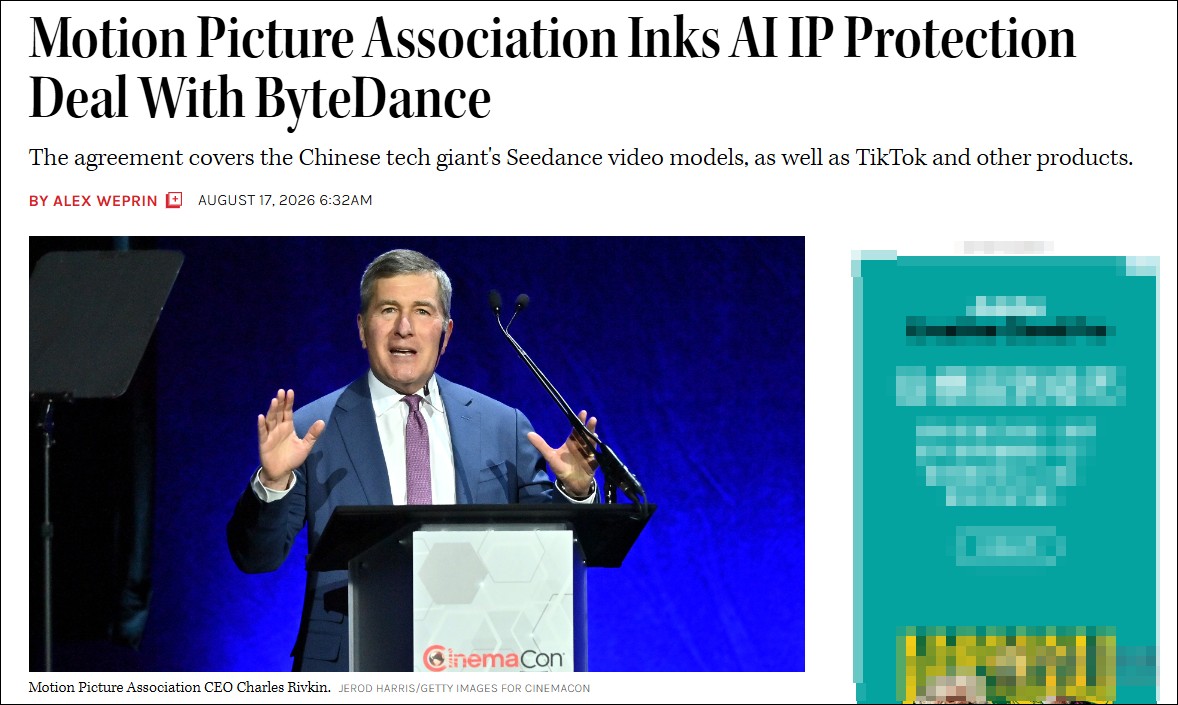
The Motion Picture Association (MPA) and ByteDance announced on August 17 that they have signed a memorandum of understanding (MOU) to establish a cooperative framework for intellectual property protection in generative AI, covering ByteDance’s Seedance video generation model, Seedream image generation model, and products such as TikTok, CapCut, and Dreamina. This is the first intellectual property agreement reached between Hollywood and an AI company, and it marks the first time the MPA has come to terms with an AI operator since its founding.
Hollywood’s Motion Picture Association Signs First AI Copyright Agreement with ByteDance
From cease-and-desist letter to shaking hands and making peace.
This agreement did not come out of nowhere. In February this year, after ByteDance launched Seedance 2.0, the MPA immediately sent a cease and desist letter, accusing the text-to-video tool of “systematic infringement” and even calling out that the model could generate unauthorized cartoon characters like SpongeBob and recreate scenes from Stranger Things. Six months later, the two sides have moved from confrontation to collaboration—a shift worth taking a closer look at.
Back on February 20, MPA Global General Counsel Karyn Temple sent a letter to ByteDance Global General Counsel John Rogovin, alleging that ByteDance was “engaging in massive, pervasive infringement of our members’ valuable intellectual property rights and must cease immediately.” This was the first time MPA had issued a cease-and-desist letter to a major AI company. At the time, major film studios had also issued their own warnings—Disney specifically flagged viral videos featuring Marvel and Star Wars characters, and the Japanese government had launched a separate investigation into anime-similar content. MPA’s allegations followed two main lines: first, on the output side, Seedance would generate recognizable copyrighted characters and celebrity likenesses upon request; second, on the input side, ByteDance had trained its models on studio content without permission.
This episode never existed.
What you’re watching was created entirely by artificial intelligence.
Seedance 2.0 is set to radically transform the internet once it launches globally.Video AI has reached a new level — in fluidity, consistency, and 2D animation quality.
This isn’t… pic.twitter.com/DrNEavqqGC
— nachos2d (@NACHOS2D_) February 8, 2026
In response to the allegations, ByteDance stated at the time that it was taking steps to strengthen protection mechanisms to prevent unauthorized use of intellectual property. It subsequently rolled out Seedream 5.0 Pro and Seedance 2.5, and both sides said in press releases that these new versions reflect ByteDance’s continued progress in intellectual property protection.
High-level officials stated: copyright is the cornerstone of the film and television industry.
MPA Chairman and CEO Charles Rivkin said in a statement: “Today’s agreement reflects our belief that copyright is the cornerstone of the film and television industry, and it reinforces our commitment to protecting creative content. Over the past few months, we have engaged constructively with ByteDance to implement meaningful safeguards on Seedance and Seedream, and this memorandum of understanding reflects our shared commitment to continued collaboration.”
ByteDance’s general counsel, John Rogovin, responded: “ByteDance respects the intellectual property rights that underpin the global creative industry. We believe that responsible AI innovation and the protection of rights holders’ interests can go hand in hand. This memorandum of understanding establishes an important framework for continued cooperation as technology evolves.”
Neither side has disclosed the specific protective measures in the agreement, and MPA has refused to reveal the details.
This is a ceasefire agreement, not a reconciliation.
This agreement primarily addresses the output side of the issue—namely, the model generating copyrighted characters and celebrity likenesses. Output filters are a relatively easy engineering problem to solve; getting the model to refuse to draw Iron Man is far simpler than resolving the core controversy over whether studio film libraries were used to train the model.
The controversy over training data is sweeping through every corner of the AI copyright war, from studios demanding that image generators disclose their training content to wave after wave of publisher lawsuits—no handshake agreement is going to resolve this. This voluntary agreement is also not a licensing deal, and studios won’t receive compensation just because their libraries may have been learned by models. The commentary sums it up in one sentence: this is a truce, not a settlement.
Hollywood’s Stance Shift
For Hollywood, this agreement sets a precedent. Over the past two years, studios have largely been on the defensive in the AI copyright wars: OpenAI’s Sora sparked a wave of unauthorized video controversies after its launch last year, and was even directly shut down by OpenAI earlier this year; the Oscars have also banned AI actors and AI-written scripts from competition. With courts unable to keep pace with the speed of technology, securing written commitments from Chinese companies is a rare piece of leverage for Hollywood.
The origins of this agreement can be traced back to a video that went viral online six months ago. That video, which was entirely AI-generated and depicted Tom Cruise battling Brad Pitt, spread rapidly across the internet, and the technology behind it was Seedance. Hollywood studios are highly vigilant about such cases involving the unauthorized use of celebrity likenesses and character content. The MPA members include seven major film and television groups — Disney, Netflix, Paramount, Sony Pictures, Universal, Warner Bros. Discovery, and Amazon MGM — which together cover nearly the entire mainstream American film and television industry.
For ByteDance, this agreement also has practical considerations. As the parent company of TikTok, ByteDance currently still holds a 19.9% stake in TikTok’s U.S. business. Maintaining a cooperative relationship with Hollywood has positive implications for both TikTok’s operations and content ecosystem in the U.S. market. Moreover, Seedance has become a key AI product for ByteDance’s investment focus, ranking alongside major players like Google in the video model space, and the company needs a stable cooperative environment to continue advancing the product.
ByteDance thus became the first major AI video developer to reach a formal understanding with Hollywood, and the MPA is sure to use this agreement as a template to pressure other competing models in the future.
Conclusion
The actual effectiveness of this memorandum of understanding depends on whether the protective measures can be truly implemented on platforms of TikTok, CapCut, and Dreamina’s scale. For ByteDance, rather than battling Hollywood in courtroom disputes where the headquarters fall outside US jurisdiction and are difficult to contend with, it is wiser to proactively sit at the negotiating table in exchange for a cooperative framework it can showcase externally. For the MPA, this agreement symbolizes studios shifting from passive defense to active rule-making in the AI era. As for the deepest knot—the film library training data—both sides have chosen to set it aside for now.
Source: KOCPC Chinese