


MiniMax Officially open-sourced on August 14. MiniMax Music 3The model weights are released under the MiniMax-Music3 Community License, with ComfyUI support available on the same day. This music generation model uses a dual-LLM architecture and can generate complete songs up to 5 minutes long based on lyrics and style descriptions, outputting 32kHz stereo audio. This marks MiniMax’s second major open-source model this month, following the open-sourcing of the H3 video model on August 3.
Model architecture: 8B Global LLM plus 0.6B Local LLM
MiniMax Music 3’s architecture differs from traditional single-model end-to-end designs, employing a Hierarchical Autoregressive architecture in which three sub-models work collaboratively:
- 8B Global LLMInitialized based on Qwen3-8B, responsible for long-range semantic and structural planning of songs, handling macro musical logic such as melodic direction, rhythmic context, and section transitions.
- 0.6B Local LLMResponsible for frame-level acoustic details, reproducing fine timbre and texture within each time frame.
- 2.4B Flow Matching plus 123M Flow-VAEIn the continuous hidden state synthesis stage, the hidden states of the two LLMs are fused, then denoised via Flow Matching, and the final audio is output through the Flow-VAE decoder.
ComfyUI’s official documentation points out that this continuous latent state synthesis approach carries more acoustic information than discrete token decoding, offering clear advantages in vocal articulation, instrument texture, and temporal continuity. The output format is 32kHz, 16-bit stereo WAV. ComfyUI also officially released a music caption rewriter skill,can automatically expand short music descriptions into structured annotations in Music 3.0 format, with the installation command being npx skills add MiniMax-AI/MiniMax-Music3 --skill music-caption-rewriterTo run ComfyUI locally, version 0.33.0 or above is required. The official also provides Comfy Cloud With cloud options, you can experience it without local hardware.
Core competency
- Complete Song GenerationSupports complete songs up to 5 minutes long, including intro, verse, pre-chorus, chorus, bridge, interlude, and outro, without losing melody, rhythm, or vocal consistency across long passages.
- Structured lyrics inputAccept labels such as [Intro], [Verse], [Pre-Chorus], [Chorus], [Bridge], [Instrumental], [Solo], and [Outro], allowing users to control the song structure.
- Fine-grained control for Structured CaptionsIn addition to natural language descriptions, it also accepts three-part structured annotations, including global metadata (genre, BPM, key, emotional shifts), vocal details (timbre, harmonies, effects), and arrangement configuration (instruments, instrumental changes across sections, rhythmic patterns).
- Expressive vocalsVocal performance is controllable down to the timbre, harmony, and effects level, with a hidden-state synthesis path ensuring clear articulation across long passages.
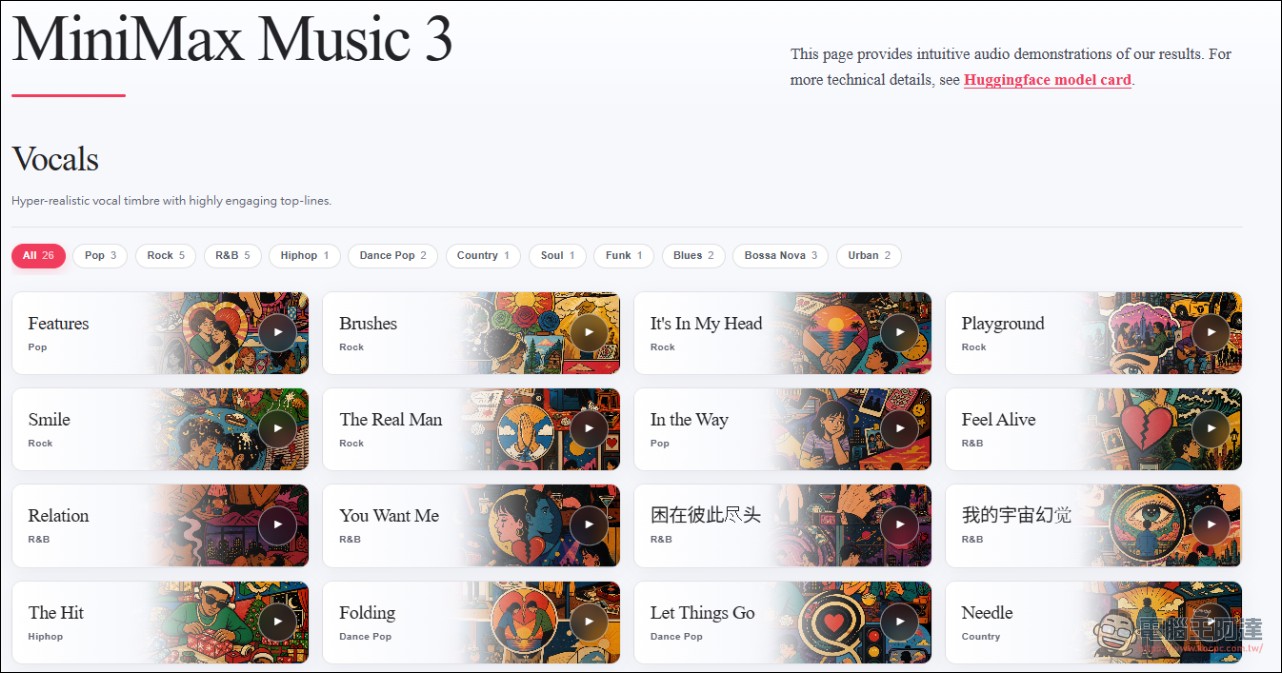
The music performance is very good, and MiniMax has also officially launched a music Demo websiteThere are 26 tracks generated by MiniMax Music 3 inside, and the quality is very high.
Licensing and Commercial Use
MiniMax Music 3’s licensing terms are quite permissive. According to the MiniMax-Music3 Community License, users with annual revenue not exceeding US$20 million (approximately NT$650 million) do not need to pay.
Hardware requirements and local deployment
MiniMax Music 3 model weights are hosted on Hugging Face (Comfy-Org/MiniMax-Music-3), and three sets of files need to be downloaded: Diffusion Model (FP16 or INT8 quantized version), Text Encoder (BF16 or INT8 quantized version), and VAE. The INT8 quantized version can run on NVIDIA GPUs with 24GB VRAM (there’s also an 8GB version, but it will be very slow).
MiniMax Music 3 – Hugging Face
Comparison with Suno
The community is actively discussing comparisons between Music 3 and Suno. X users @KuittinenPetri “It sounds like this: ‘Music 3’s sound quality is excellent, and its ability to follow complex prompts is also strong. But the vocals are a bit too tight, lacking human imperfection and emotion. I still prefer Suno v5.5 paired with a self-trained model for vocal performance.'”
@AI_EmeraldApple believes: “Music 3 is very close to Suno’s level in terms of musical diversity and creativity. The lyrics and arrangement are both good, and the only shortcoming is that the overall instrument quality is a bit muddy.” ComfyUI’s @hellorob commented: “Music 3 is currently the strongest open-source music generation model, and once the community starts training LoRAs, this model will only get better.”
Big day for open source.
MiniMax Music 3 is undeniably a state of the art open weights Music Generation model and a real alternative to Suno.
My favorite part about open weights: the best is yet to come. Once the community starts playing with the model and training LoRAs, this… https://t.co/YIAb3dtWKO pic.twitter.com/SIeWiELRJi
— rob – comfyui (@hellorob) August 13, 2026
However, some users have pointed out that Music 3 still falls short of Suno when it comes to emotional expression in vocals. Suno’s vocals are still superior in conveying emotion, especially in harmonies and background vocals. Music 3’s strengths lie in being open source, locally runnable, and supporting custom-trained LoRA for style fine-tuning—all of which are Suno something that closed-source services cannot provide.
The jigsaw puzzle of the open-source ecosystem.
MiniMax’s aggressive open-source strategy in August (H3 video model plus Music 3 music model) is clearly a bid to seize dominance in the open-source AI multimodal ecosystem. For creators and developers in Taiwan, Music 3 offers a music generation solution that requires no subscription and can run locally, making it especially well-suited for video creators who need large volumes of background music. Currently, MiniMax’s mmx CLI still uses the music-2.6-free model, and the API version of Music 3 has not yet been launched, but local execution via ComfyUI is already available for use.
Source: KOCPC Chinese