


Chinese AI startupZhipu(Zhipu AI, Hong Kong stock code 2513.HK) officially launched on August 14. GLM-5.3This new model retains the 743B MoE base architecture of GLM-5.2, achieving a capability leap purely through post-training scaling, with coding performance feeling 50% better than the previous generation and the highest scores among open-source models on multiple public benchmarks. Zhipu simultaneously announced that the full model weights will be made available for download in two weeks. This is Zhipu’s third update since releasing GLM-5.2 in June, with a release cadence matching the密集 launch pace of Chinese competitors like DeepSeek and Kimi. The core significance of GLM-5.3 lies in the fact that “Zhipu didn’t build a bigger model, but instead pushed training to the extreme on the same base,” with post-training scaling emerging as an independent technical pathway.
Zhipu releases GLM-5.3: Base model unchanged, post-training raises the upper bound of intelligence
The technical core of GLM-5.3 is “post-training scaling.” According to Zhipu AI’s official statement, GLM-5.3 and GLM-5.2 use the exact same base model, with all differences arising entirely from the post-training phase. Based on IndexShare, SAO, and the continuously evolving next-generation Slime asynchronous reinforcement learning framework, Zhipu AI efficiently advances reinforcement learning on the same base model, significantly raising the model’s intelligence upper bound (following the same approach as the official release of DeepSeek V4 Flash).
The scale of the training environment is dozens of times that of the previous generation, covering a richer variety of environment types, and the training cycle has also been significantly extended. Zhipu stated that some training tasks are equivalent to several days of continuous work for a senior engineer, and the model is required to use real computing clusters, storage systems, internal documents, and code repositories to complete the tasks. This “expert workflow”-level training approach is a key factor in GLM-5.3’s capability improvement.
Zhi Pu X official account @Zai_org posted that GLM-5.3’s parameter specifications remain unchanged: 743B total parameters (approximately 40B activated parameters), 1M context window, and 128K maximum output tokens.
Introducing GLM-5.3: Built to Code. Ready for Cyber Defense.
– Top-tier coding and agentic capabilities, achieved through post-training on the 743B base model
– A major leap in cybersecurity, setting a new standard among open modelsTech Blog: https://t.co/ekQkO83jCv pic.twitter.com/y3Y2AB0wxr
— Z.ai (@Zai_org) August 14, 2026
Benchmark testing: open-source models take the lead across the board
In its announcement, Zhipu listed multiple benchmark results, positioning GLM-5.3 as the “most powerful open-source model for programming.” The following are the key figures:
- Terminal-Bench 3.0From GLM-5.2’s 4.6 to 28.3, measuring the model’s ability to complete complex tasks in real terminal environments.
- DeepSWE v1.1: From 46.2 to 66.9, focusing on long-horizon software engineering and iterative code changes.
- Agents’ Last Exam: Improved from 23.8 to 28.5, covering a wide range of real professional scenarios with an emphasis on cross-tool collaboration.
- GDPval-AA v2Score 1,769, covering 44 professions, demonstrating an extension of capabilities from programming to professional task execution.
- Z.ai Code Bench (self-developed)Under the High setting, accuracy reaches 31.4%, surpassing Claude Opus 4.8’s top setting at 29.5%. Additionally, each task averages roughly 50,000 output tokens, whereas Opus 4.8 requires about 120,000 tokens.
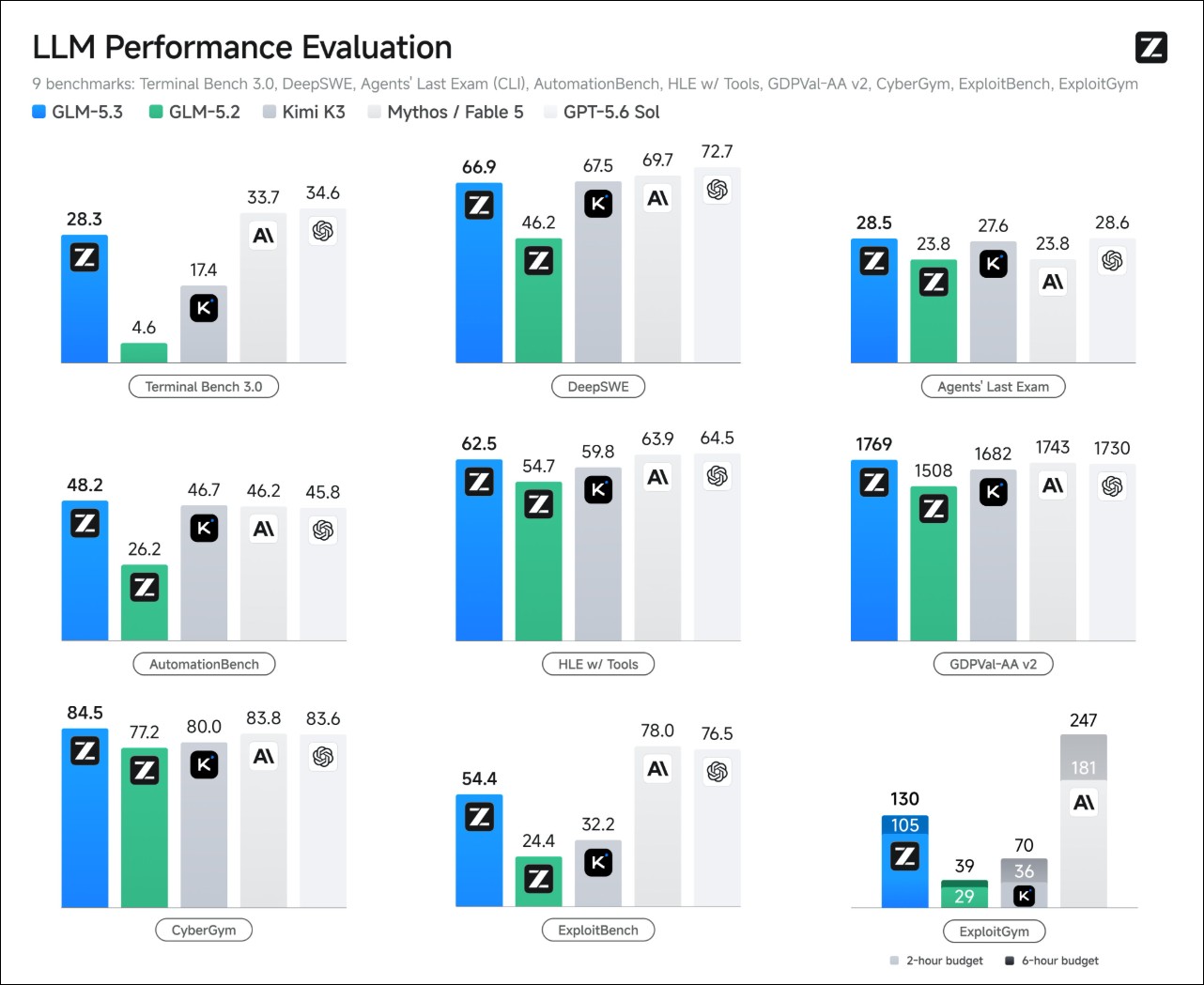
Zhipu stated that GLM-5.3’s programming and agent capabilities are “close to Claude Fable 5.” In terms of token utilization efficiency, GLM-5.3 completes tasks of the same quality with shorter execution paths, which means developers can achieve lower inference costs in real-world usage.
The Unexpected Emergence of Cybersecurity Capabilities
The most surprising new capability of GLM-5.3 lies in the cybersecurity domain. Zhipu said the ability emerged organically as its long-horizon task environment kept expanding, without any deliberate security-specific training. Since September 2025, Zhipu has invested in research in this direction, teaming up with Tsinghua University, Nankai University, and several security teams including Yunqi Wuyin, NSFOCUS, CyberKunlun, DARKNAVY, and Tencent Xuanwu to carry out intensive red-team testing and security assessments.
In white-box code review and vulnerability discovery tasks, GLM-5.3 performed on par with Anthropic’s Mythos 5. In terms of specific test data:
- CyberGymScore 84.5%, higher than Mythos 5’s 83.8% and GPT-5.6 Sol’s 83.6%.
- ExploitBenchIncreased from 24.4% to 54.4%
Zhipu stated that these security tests cover different stages of vulnerability analysis, verification, and exploitation. After initial screening and deduplication, a total of 2,436 vulnerabilities were discovered, of which 1,097 were medium-to-high severity, involving 269 items across system kernels, operating systems, browser engines, open-source foundational components, internet applications, and internet protocols. Zhipu listed several specific cases in the announcement, including vulnerabilities found in Cursor, Microsoft’s email and office systems, a nationally recognized communications app, the DNS protocol (traceable back to 1983), and products from a humanoid robot manufacturer, all of which have entered the CNNVD/CNVD disclosure and remediation process.
Three Layers of Defense for Open-Weight Security
GLM-5.3’s weights will be released in two weeks, and Zhipu cites security considerations as the reason for the delayed release. Because GLM-5.3 has demonstrated significant cybersecurity capabilities, Zhipu wants to complete deep security alignment before the weights are made public. Zhipu has designed a three-layer security framework: the outer layer is a lightweight classifier that flags and blocks large-scale abusive requests; the middle layer is an inference monitor that reviews task intent in real time during model inference; and the innermost layer is the model’s own security alignment, allowing the model to autonomously identify and reject malicious requests. The first two layers rely on the server side and will not be delivered with the weights, so deep security alignment is the only line of defense that remains effective in the open-weight scenario.
In its announcement, Zhipu acknowledged: “Vulnerability defense and vulnerability exploitation share a capability chain. The model’s ability to read large codebases, plan long-horizon tasks, call tools, and verify results can help maintainers patch holes, but it may also push an attack forward.” This statement explains why the open-weight release was delayed.
Ecology and Pricing
Effective today, GLM-5.3 is now available on Zhipu’s official coding tool ZCode and efficiency tool AutoClaw. The GLM Coding Plan is now fully rolled out to all users and open for subscription. At 13:00 today, the backend quota for all Coding Plan users will be reset, and usage credits will be restored to full. Early access is also now available simultaneously on coding platforms such as TraeWork/TraeCode/Coze, WorkBuddy/CodeBuddy, Qoder/QwenWork, CatPaw, JoyCode, and OpenCode.
As for API pricing, Zhipu has not yet announced official pricing for GLM-5.3. Referring to GLM-5.2’s pricing on OpenRouter, which is approximately $0.40 to $0.91 per million input tokens (about NT$13 to NT$30) and $1.28 to $3.20 per million output tokens (about NT$42 to NT$104), GLM-5.3’s pricing is expected to be at a similar level or slightly higher.
Conclusion
The release strategy for GLM-5.3 closely aligns with the intense competitive pace of China’s current AI industry. Against the backdrop of successive model releases such as Kimi K3 and Qwen 3 Max, Zhipu chose to demonstrate that “the same base model still holds vast untapped intelligence” through极致 post-training scaling while keeping the base model unchanged. The leaked ZCode official website page and SDK repository commit records on August 3 had already set market expectations for this release, and Zhipu’s stock price rose approximately 8% that day.
The emergence of cybersecurity capabilities gives GLM-5.3 a unique market position. Zhipu emphasizes that open-source security models allow more organizations to gain defense-grade AI capabilities rather than being locked into the services of a few closed-source vendors. The release of the weights in two weeks will be a key milestone for testing this vision.
Source: KOCPC Chinese