


Laptops, as a type of computing device, have limited battery capacity, so they typically only run at full power draw when plugged in. When running on battery power instead, they usually reduce clock speeds or power consumption to extend battery life. Tom’s Hardware recently conducted a targeted test on laptops from four major platforms—Intel, AMD, Qualcomm, and Apple—comparing performance differences between plugged-in and battery modes across each platform. The results showed a huge gap: Apple’s M5 Max saw less than a 1% performance fluctuation when unplugged, while AMD’s Ryzen AI 7 445 saw its battery-mode performance cut in half, dropping by as much as 56.25%.
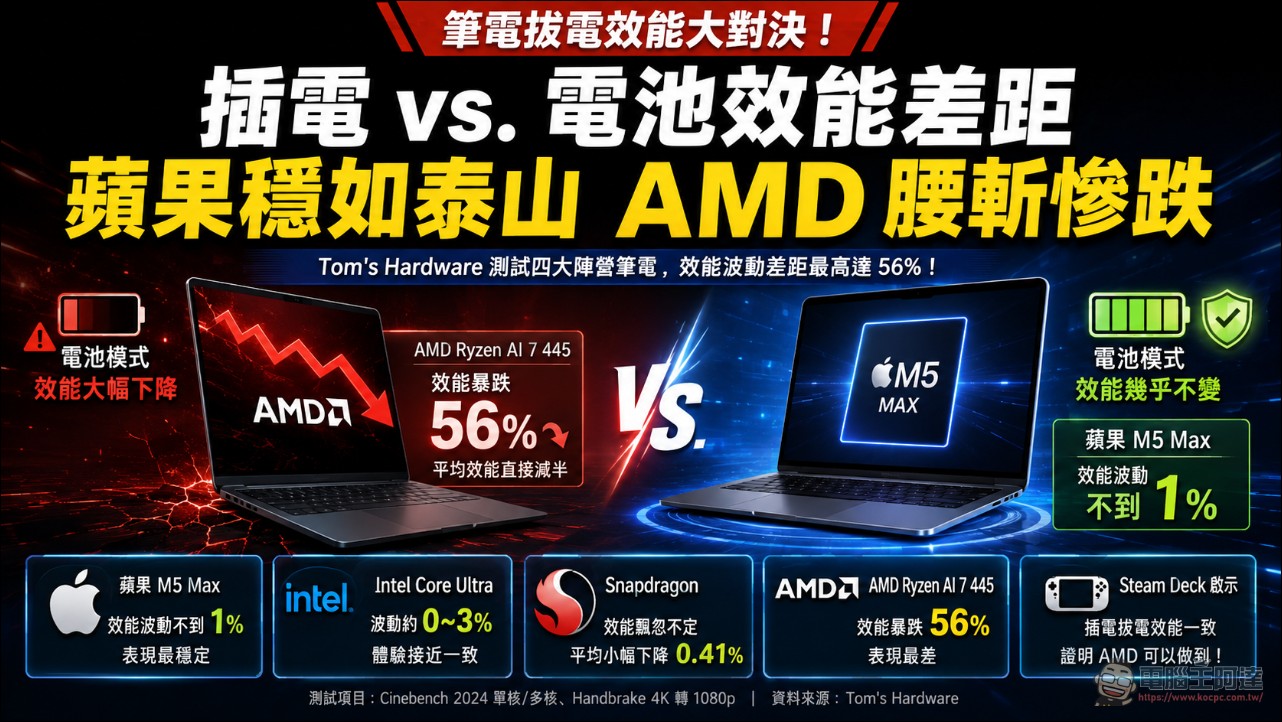
Plugged In vs Unplugged Makes a Big Difference! Comparing the Four Major Laptop Processor Camps: AC Performance vs Battery Performance
Tom’s Hardware test selected the following processors and models:
- Intel:Core Ultra X9 388H (found in the ASUS Zenbook Duo) and Core Ultra 7 258V “Lunar Lake” (found in the Lenovo ThinkPad X9)
- QualcommSnapdragon X2 Elite Extreme (powering the ASUS Zenbook A16)
- AppleM5 Max (in 14-inch MacBook Pro)
- AMDTwo Gorgon Point processors, Ryzen AI 9 465 (in the HP OmniBook X Flip 14) and Ryzen AI 7 445 (in the Acer Swift Go 16 AI)
Windows systems uniformly use the “Balanced” power mode (the default for most models), while MacBook Pro uses the default automatic power management. The test items are Cinebench 2024 single-core and multi-core scores, as well as using Handbrake to transcode 4K video to 1080p. Tom’s Hardware emphasized that the purpose of the test is to observe the performance changes of the same machine when plugged in and unplugged, rather than comparing scores between different systems.
Apple and Intel: The Most Consistent Performance
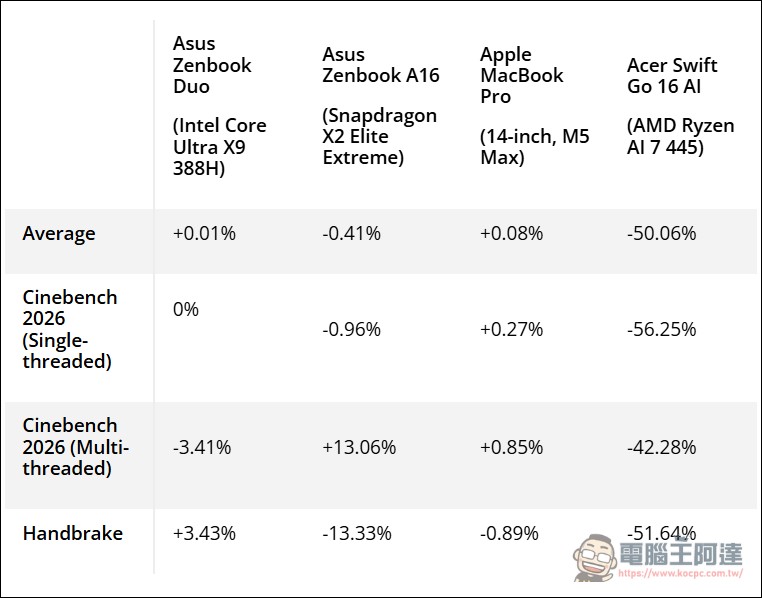
The Apple M5 Max is the most stable performer of all the test units. In battery mode, all scores fluctuated by no more than 1 percentage point: single-core improved by 0.27%, multi-core by 0.85%, and Handbrake transcoding dropped just 0.89%. There’s virtually no noticeable difference between plugged-in and unplugged operation. For a laptop aimed at creative professionals who often need to work on battery power, this level of stability is outstanding. Meteora Web’s analysis attributes Apple’s ability to control both hardware and software at the system level as the key advantage in maintaining this consistency.
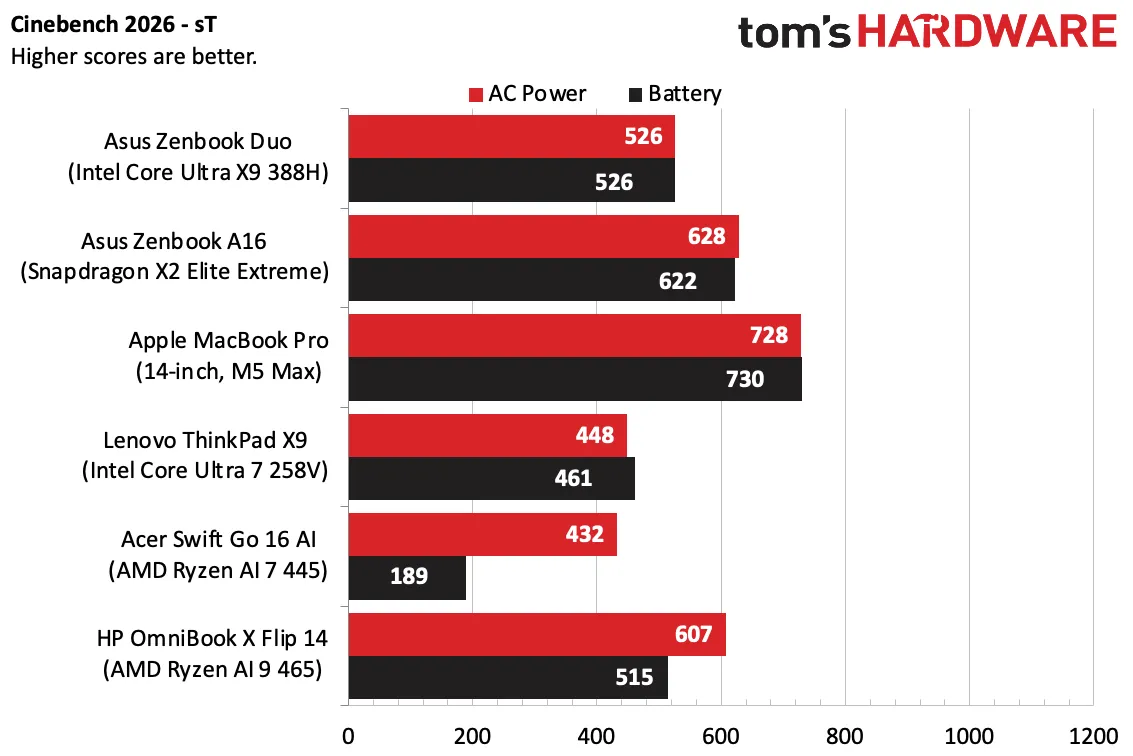
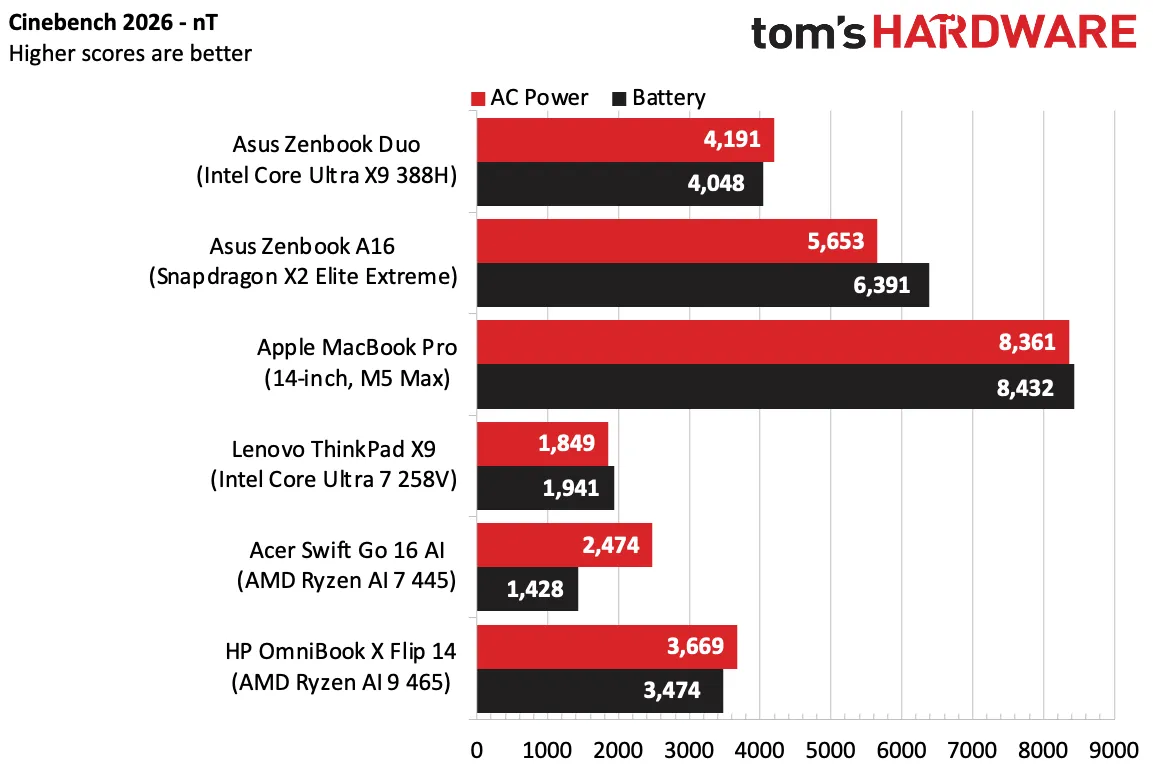
Intel Core Ultra X9 388H also had an average fluctuation below 1%, but showed about 3% swings in Cinebench multi-core and Handbrake transcoding, ranking just behind Apple. Intel’s other chip, the Core Ultra 7 258V “Lunar Lake,” was also included in testing to gauge cross-generation improvements. Tom’s Hardware noted that Intel’s and Apple’s most advanced systems deliver very similar user experiences when plugged in and on battery power. Some systems actually saw slight performance gains on battery, such as the ThinkPad X9 improving 4.98% in Cinebench multi-core testing, a trend even more pronounced on Qualcomm models.
Qualcomm: Erratic Performance
Qualcomm’s Snapdragon X2 Elite Extreme has the most erratic performance. In the Cinebench multi-core test, battery mode performance actually improved by 13.06%, but in Handbrake transcoding it dropped by 13.33%, averaging a slight decline of 0.41%. This fluctuating behavior is speculated to be related to thermal or power management optimization strategies. Tom’s Hardware’s review noted that Qualcomm’s chips “sometimes perform excellently, and sometimes leave you completely baffled,” indicating that the Snapdragon platform still has room for improvement in power management stability. However, looking at the average figures, the overall performance gap between plugged-in and battery mode for Qualcomm remains controlled within a very small range.
AMD: Worst Performance
AMD performed the worst. The Acer Swift Go 16 AI with the Ryzen AI 7 445 saw a severe performance drop when unplugged, with Cinebench single-core down 56.25%, multi-core down 42.28%, and Handbrake transcoding down 51.64%—an average score cut roughly in half. In other words, this machine only delivers about half its plugged-in performance on battery, which is a serious issue for anyone needing to run heavy workloads off the charger. The HP OmniBook X Flip 14 with the Ryzen AI 9 465 fared somewhat better, with an average decline of 5.45%, but it still lagged noticeably behind Intel and Apple in stability. Both machines run on the same AMD Gorgon Point platform, yet the gap between them is so wide that it underscores just how critical OEM tuning is.
Tom’s Hardware points out that power management strategies and firmware tuning vary significantly among different OEM vendors. Apple, Intel, and Qualcomm models inherently have better battery life, while AMD platforms are at a disadvantage in this regard. To prevent the battery life gap from widening further, OEMs generally lower power limits in battery mode, resulting in a substantial performance reduction.
Steam Deck’s Revelation
An interesting comparison during testing is the Steam Deck. This handheld, released in 2022, uses an AMD semi-custom SoC, yet it was specifically optimized for consistency between plugged-in and battery modes, with nearly identical performance whether plugged in or on battery. AMD is capable of delivering performance consistency; the difference lies in whether OEMs are willing to invest in system-level tuning. Tom’s Hardware concluded: “You don’t just need the chip to be designed for battery and performance, you also need to make sure the system surrounding the chip is optimized.”
Summary
The results of this test are very clear: Apple and Intel (especially with the Panther Lake architecture) lead in performance consistency between plugged-in and battery mode, Qualcomm has potential but is inconsistent, and AMD is the camp that needs the most improvement. For users who frequently run heavy workloads on battery power, the most reliable choice right now is the Intel Core Ultra or Apple Silicon platform.
From a deeper perspective, this test also exposes an industry reality: laptop performance depends not only on the chip design itself, but also heavily on the tuning efforts that OEMs invest in firmware, thermal management, and power strategies. Apple can achieve near-perfect stability largely because it controls chip design, system firmware, and the operating system all in-house, without relying on outside parties. On the Windows side, however, the division of labor between chip vendors and OEMs leads to inconsistent performance due to power management tuning. The gap of as much as 50 percentage points between the two AMD Gorgon Point models is the best proof of this.
However, Tom’s Hardware also noted that the overall trend is moving in a positive direction. With more user feedback and media oversight, OEMs are expected to increase their investment in power management tuning, and the performance consistency issues on AMD platforms should gradually improve. After all, the 2022 Steam Deck has already proven that solutions do exist—they just haven’t been widely applied to AMD laptops yet.
Source: KOCPC Chinese