


Xiaomi’s classic operating system MIUI officially announced that it will officially enter history on March 24, 2026. As the last two maintenance models, Redmi A2 and Redmi A2+, cease to be updated, this system that has accompanied Xiaomi for more than ten years has announced the complete end of support.
The last two models stopped updating, and MIUI officially came to an end.
Redmi A2 and Redmi A2+ are the last two entry-level models maintained by MIUI, running MIUI 14 based on Android 13. The last version update of these two mobile phones was the V14.0.44.0.TGOMIXM firmware released in December 2025, and it was officially confirmed that all support will be terminated on March 24, 2026.
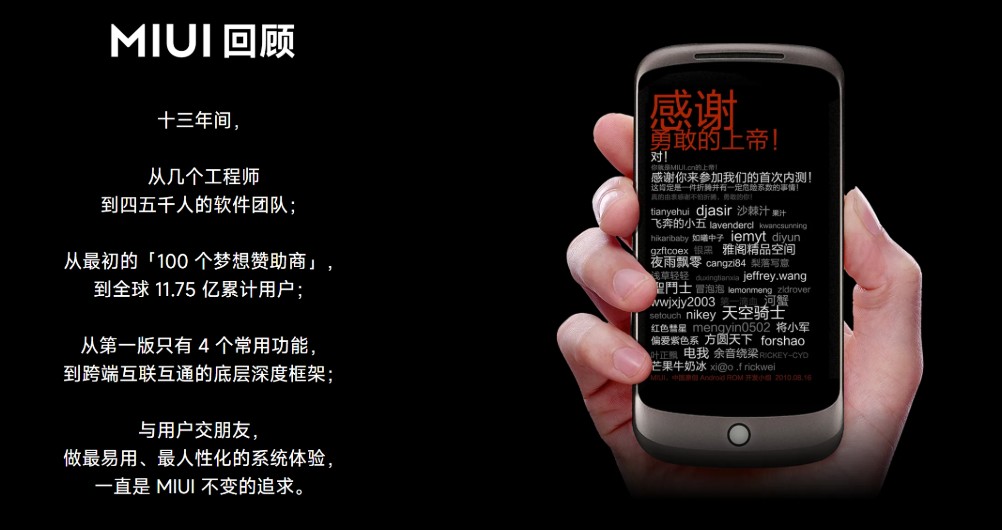
This also means that MIUI will no longer provide subsequent updates for any device (Xiaomi’s new phones now use HyperOS). This system, which once served hundreds of millions of users around the world, has officially completed its historical mission.
Looking back on the evolution of 12 years and 14 generations
MIUI was born even earlier than Xiaomi phones. On August 16, 2010, MIUI released the first version V0.8.16 on the MIUI Forum, with only 100 users experiencing it. These 100 users are called “Dream Sponsors”, and their usernames still stand in the form of sculptures in Xiaomi Technology Park.
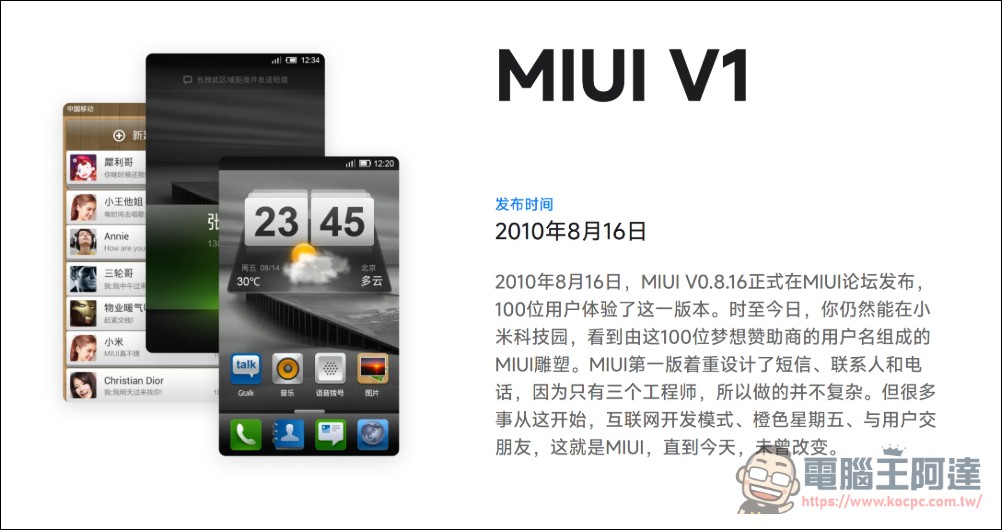
Early development (V1-V3): The original MIUI was launched as a third-party ROM for enthusiasts. At that time, it was supported by HTC HD2 mobile phones and other models, focusing on basic communication experience. V2 adds functions such as music and network disk; V3 brings the first guest mode, volume key wake-up when the screen is locked, as well as “variable lock screen” and “various themes” functions, laying the foundation for MIUI visual customization.
Service expansion period (V4-V5): MIUI V4 marks the full development of Xiaomi’s Internet services. Core services such as Xiaomi Cloud, App Store, and Theme Store were launched at this time, and the number of global users exceeded 10 million. V5 proposes a T-shaped structural design language, and pioneers functions such as night scene anti-shake, phone ring interception, and runtime permission management. Among them, runtime permissions are nearly three years ahead of native Android.
Design innovation period (MIUI 6-8): MIUI 6 brings a minimalist design style on its fourth anniversary, with more than 100 million users. MIUI 8 launches Xiaomilanting font, becoming the first mobile phone system in China to customize fonts, and adding functions such as mobile phone clones and dual-open applications. Xiaomi has also become the first mobile phone manufacturer in the world to support both bank cards and bus cards.
AI and the full-screen era (MIUI 9-11): MIUI 9 focuses on a smooth experience, with Portal and XiaoAi appearing in this version; MIUI 10 is designed for full-screen design, strengthening AI preloading and hand-feel optimization; MIUI 11 introduces a dynamic font system, a panoramic screen, and the first AI calling and earthquake warning functions. The theme store has also entered a completely free era in this generation.
Privacy and Internet Peak (MIUI 12-14): MIUI 12 is regarded as the work of the decade and introduces Miyou light cone animation architecture, super wallpaper, and three major privacy functions: flare, interception net, and invisibility mask. MIUI 13 achieves a smoothness improvement of up to 52% and brings Xiaomi Enjoyment Center. The final version of MIUI 14 deepens the collaboration between software and hardware, launches the photon engine architecture, and draws a perfect conclusion to MIUI with the interconnection concept of “people-centered, connecting people and everything”.
HyperOS takes over and opens a new chapter
On October 17, 2023, Xiaomi announced the launch of a new operating system “HyperOS” to undertake the future development direction of multi-device integration and intelligence. As the new system is gradually implemented, MIUI has also entered the final stage of its life cycle.
From the initial niche flashing system to a mature platform covering hundreds of millions of users around the world, the development of MIUI not only promotes Xiaomi’s own growth, but also affects the design ideas of the entire Android customization system to a certain extent. Many of its first-of-its-kind features are still widely used in the industry today.
The end of MIUI is the inevitable result of Xiaomi’s transformation from a mobile phone manufacturer to a “full ecosystem of people, cars and families” enterprise. As Xiaomi’s pioneering work, MIUI has not only accumulated core users for Xiaomi hardware products with its localized innovation and rapid iteration, but also redefined the local experience of Android customized systems. From MIUI to HyperOS, Xiaomi has completed not only an iteration of the system architecture, but also a strategic upgrade from single-device experience optimization to full-ecological collaboration.
Source: KOCPC Chinese