


Everyone knows now AI I am very capable in programming, but I have never thought about connecting to the motherboard. BIOS It can also be rewritten. Recently on the foreign overclocking forum Overclock.net, a player did this, using Anthropic’s Claude Modified BIOS firmware and successfully Intel The Bartlett Lake processor completed POST (power on self-test) on the consumer-grade Z790 motherboard, causing considerable concern.
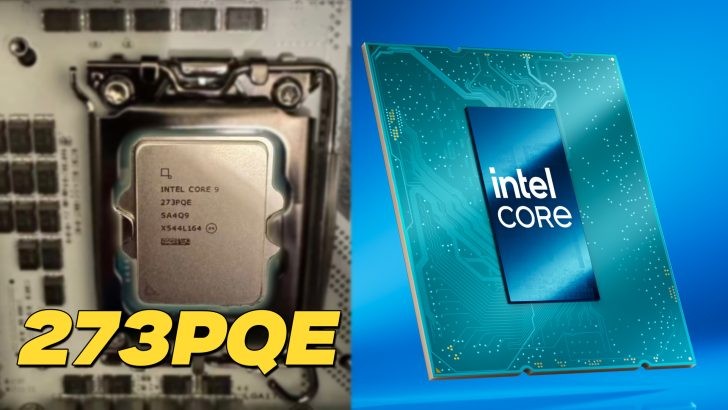
Image source:Wccftech
Bartlett Lake was installed into the consumer-grade Z790 motherboard by the player and booted successfully! Relying on Claude AI to rewrite BIOS
First, let me give you some background information. Intel’s Bartlett Lake-S series processor, codenamed Core 9 273PQE, is a processor with 12 P-Cores (performance cores), 24 threads, and 36MB cache. The maximum acceleration clock can reach 5.9 GHz and the basic power consumption is 125W. This processor is not for general consumers. It is positioned in the field of edge computing and industrial applications and must be paired with a specialized industrial-grade motherboard.
Although the LGA 1700 socket, which is the same as the 12th to 14th generation processors, can physically be installed into the consumer-grade Z790 motherboard, because the BIOS firmware does not support it, the motherboard will not recognize the CPU after it is installed and cannot boot. And a kryptonfly netizen said Overclock.net ForumSharing on the website, he successfully solved this limitation by modifying the BIOS with Claude.
The motherboard he uses is the ASUS Z790 AYW-OC, a high-end motherboard designed specifically for overclocking. In order to allow Bartlett Lake to run on this board, kryptonfly asked Claude AI to be 100% responsible for rewriting the BIOS firmware.
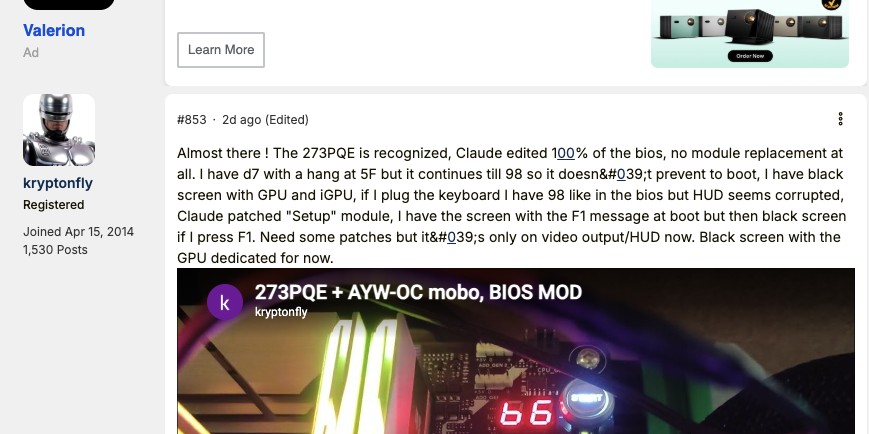
Specifically, the BIOS of the consumer Z790 motherboard lacks the microcode required by Bartlett Lake, which is the basic instruction set data of the processor. Without this, the motherboard cannot identify and initialize the CPU. Therefore, kryptonfly uses Claude AI to patch the BIOS and write the microcode required for Bartlett Lake into the firmware. The entire process does not require replacing the BIOS chip and is completed directly through software flashing.
It turned out to be really successful. The POST screen clearly shows the name of the processor “Core 9 273PQE”, which means that the motherboard has correctly identified this Bartlett Lake processor:
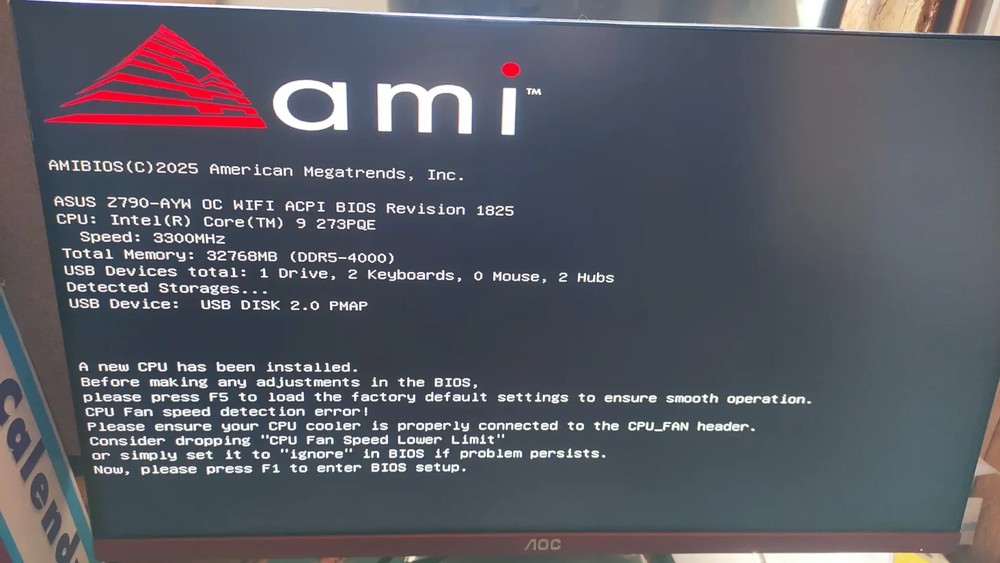
Image source:Overclock.net
But that’s it for now. According to his follow-up addition, when trying to press F1 to enter BIOS settings on the POST screen, the screen goes black directly and cannot enter the operating system desktop:
Although this experiment looks cool, we still have to remind everyone that there are certain risks in modifying the BIOS firmware by yourself. If there are any errors in the modified BIOS, the motherboard may become completely unbootable and become a useless board. High-end motherboards like ASUS Z790 AYW-OC can be rescued because they have dual BIOS or USB BIOS Flashback functions.
Source: KOCPC Chinese