


Gemini’s “Personal Intelligence” service, which was first launched in the U.S. market earlier this year, today (15th) Google Taiwan announced that it is officially open to Taiwanese users. The core concept of this feature is simple: let Google’s artificial intelligence assistant no longer only understand “world knowledge”, but can further integrate the user’s personal data to provide truly tailored assistance.
Connected with the Google ecosystem, Gemini becomes a dedicated assistant
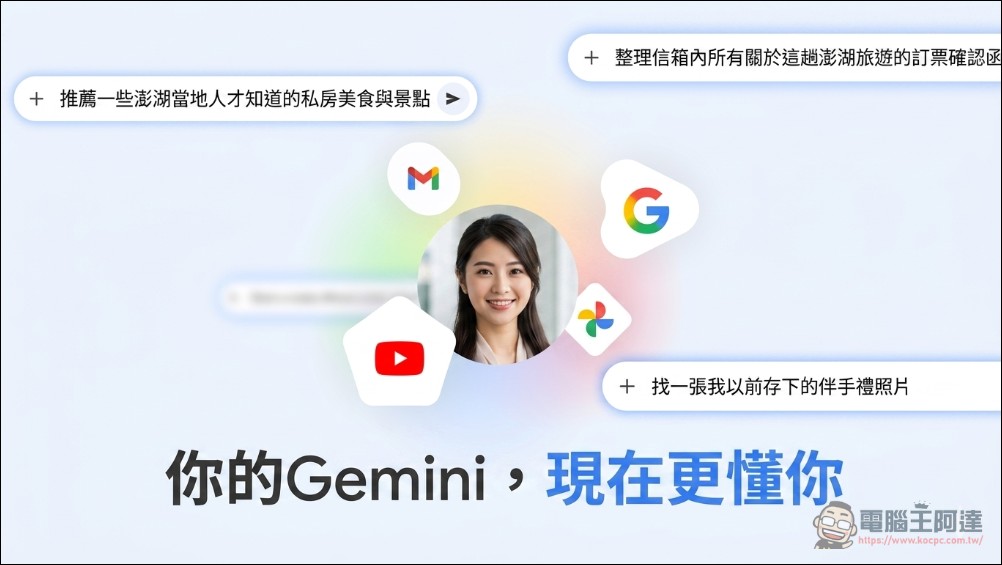
“Personalized Smart Services” securely connect information from popular applications such as Gmail, Google Photos, YouTube and Google Search, making Gemini a user-specific and powerful assistant. Users can authorize Gemini to access data from these services with just one click.
Google pointed out that this feature is not simply data concatenation, but has two key capabilities. One is the ability to logically reason across complex information sources and understand the connections between different applications; the other is the ability to accurately extract details from specific sources such as emails or photos. By combining the two, Gemini can provide responses that are more relevant to individual needs across multiple formats such as text, photos, and videos.
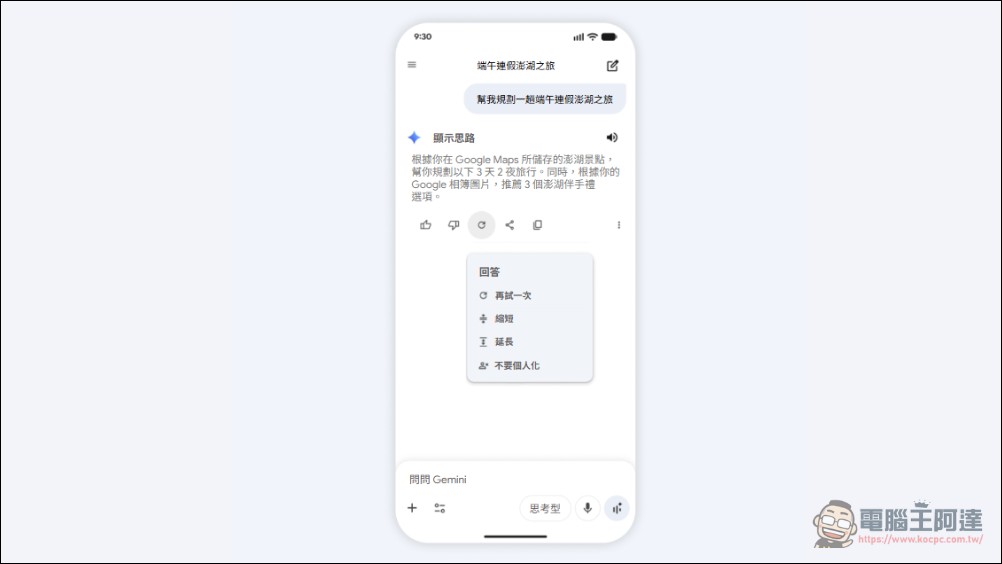
For example, when a user is planning a trip to Penghu during the Dragon Boat Festival holiday, they only need to ask Gemini a question, and it will automatically sort out the hotel reservation and flight confirmation letters received in Gmail, combine them with photos of scenic spots tagged in Google Photos, and travel videos they have watched on YouTube, and finally generate a complete itinerary and personalized recommendations. The entire process does not require the user to switch back and forth between multiple applications.
Privacy first: off by default, users have full control
Since AI is required to read Gmail and photo albums, privacy concerns cannot be avoided. In this regard, Google particularly emphasizes that “privacy” is a core premise in the development process of this feature. Specifically, the function of linking applications is turned off by default in the settings. It is up to the user to decide whether to enable it, and it can be turned off at any time. Once enabled, Gemini will only access the linked data when responding to specific questions or performing specific tasks, and the data is already securely stored in Google’s systems. Users can enjoy a personalized user experience without uploading sensitive data to external servers.
Another important design element is transparency. When Gemini generates a response, it will mark or explain what information it draws from which link sources whenever possible, so that users can verify it themselves. If a reply is found to be incorrect, the user can correct it on the spot, for example by saying “Remember, I prefer a window seat”, and Gemini will remember this preference and adjust subsequent responses. In addition, users can also regenerate unpersonalized versions of specific conversations, or use the “temporary conversation” feature to have a general conversation without personalization at all.
In response to the data training controversy that has attracted public attention, Google has also made it clear that Gemini will not directly use users’ Gmail inboxes or Google Photos to train models. Google will only use limited information for training, such as specific prompts entered by users into Gemini and responses generated by the model, in order to continuously improve the quality of the service.
Google also has protective mechanisms in place when it comes to handling sensitive data. Gemini will try to avoid proactively making assumptions about sensitive information such as health, but the system can still help discuss this type of information if users ask questions.
Gradually open, giving priority to subscribers
“Personalized Intelligence Service” will be rolled out in phases to the personal Google accounts of qualified Google AI Plus, Pro and Ultra subscribers starting today, and is expected to be gradually extended to free general users in the coming weeks.
The activation method is quite intuitive: if the user sees the trial invitation on the Gemini home screen, they can go to “Settings” → “Personalized Intelligence” → “Linked Apps” to select the Google services to be connected, including Gmail, Google Photos, and YouTube. Once enabled, it can be used on the web, Android and iOS devices and supports all models in Gemini.
From “universal” to “understanding you”, the next battlefield for AI assistants
What’s noteworthy about the timing of Google’s launch in Taiwan is that competition in the personalized AI assistant track has intensified in the past six months. Anthropic’s Claude, Microsoft’s Copilot, and OpenAI’s ChatGPT-related functions are all evolving in a similar direction: who can more securely integrate users’ personal data while providing a more accurate customized experience has become the key to success for each system-level AI assistant.
Google specifically emphasized this time that the launch of personalized smart services is a function that responds to “the most urgent needs of users.” Whether this experience can truly be implemented in the daily use situations of Taiwanese users, rather than just a marketing promotion of laboratory specifications, will be the focus of follow-up observation.
Source: KOCPC Chinese