


In the past, it was not that easy to draw 3D architectural design drawings by yourself (like my brother who built a house), especially the genuine licensing fees of thousands of dollars a year for AutoCAD and Revit should be able to deter many people. Now this money may be saved. Recently there is a product called Pascal Editor It is an open source project that puts a complete 3D building editor directly into the browser. No installation or registration is required, it is completely free, and the code is all open source on GitHub. This tool developed by the Pascal team has recently sparked heated discussions in the AEC (Architecture Engineering and Construction) community and has accumulated more than 13,100 stars on GitHub.
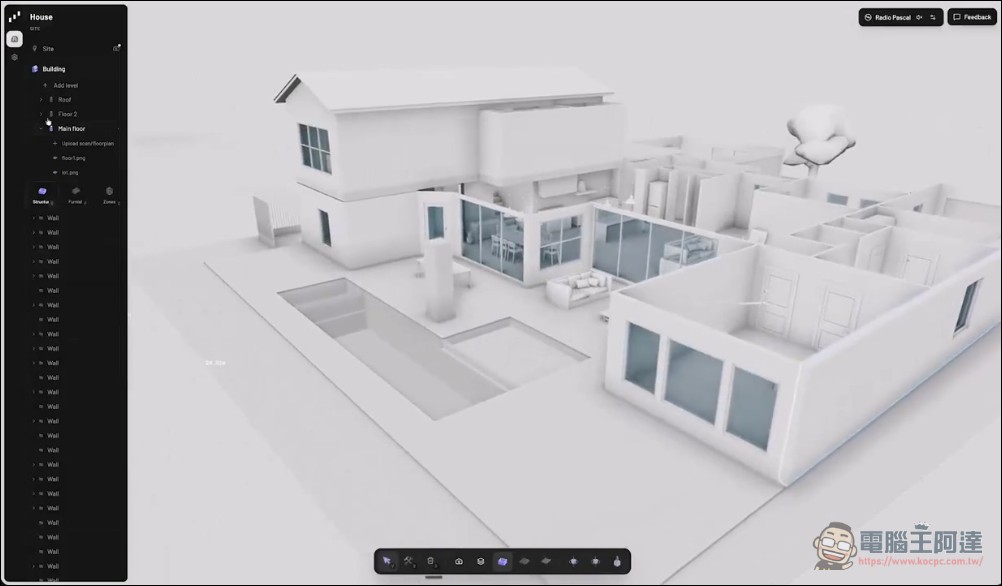
Run completely in the browser: The performance revolution brought by WebGPU
The most amazing thing about Pascal Editor is that it runs entirely in the browser. In the past, a smooth real-time rendering experience with 3D modeling tools like these almost necessarily required native applications. However, the Pascal team chose a new generation of React Three Fiber + WebGPU technology combination to allow the GPU to directly participate in rendering operations, making the speed almost close to that of desktop software.
this guy literally just dropped a full 3D building editor that runs 100% in your browser 🤯
no autocad. no yearly license.
100% FREE and open-source.
app + repo in 🧵↓ pic.twitter.com/P7xa6uecD0
— Charly Wargnier (@DataChaz) April 14, 2026
In terms of technology stack, Pascal Editor is built on a fairly modern foundation: the front end uses React 19 with Next.js 16, 3D graphics uses Three.js’s WebGPU renderer, and state management uses Zustand with the Zundo intermediary layer (providing up to 50 steps of undo/redo functionality). Geometric Boolean operations are handled through the three-bvh-csg library. The entire project uses Turborepo to manage the monorepo architecture, and Bun as the package manager.
Pascal Editor official website
Core functions: from empty land to complete building
Pascal Editor supports the complete architectural modeling process. Users can create structural elements such as walls, floors, ceilings, and roofs, and then place interior design objects such as doors, windows, lighting fixtures, and furniture. The project organizes data in a hierarchical structure of “Site → Building → Level → {Walls, Slabs, Ceilings, Roofs, Zones, Scans, Guides}” and uses a flat dictionary instead of a nested tree structure to store nodes.
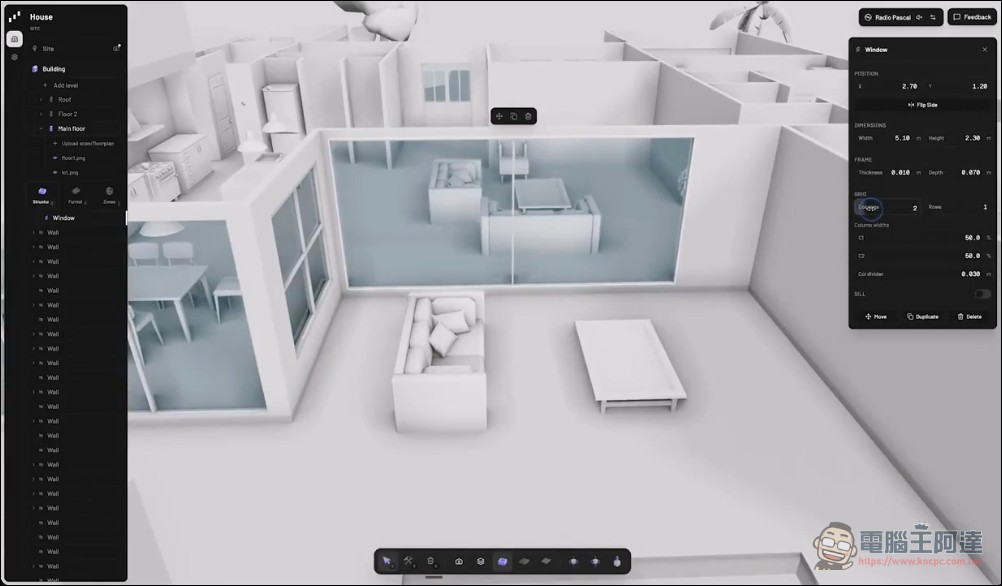
There is also ingenuity in the management of multi-story buildings. The editor provides three visualization modes: stacked, exploded, and solo level, allowing users to switch between different perspectives. In addition, it also supports the import of 3D scan data and 2D reference images, making it easy to use existing spatial measurements or floor plans as the basis for design.
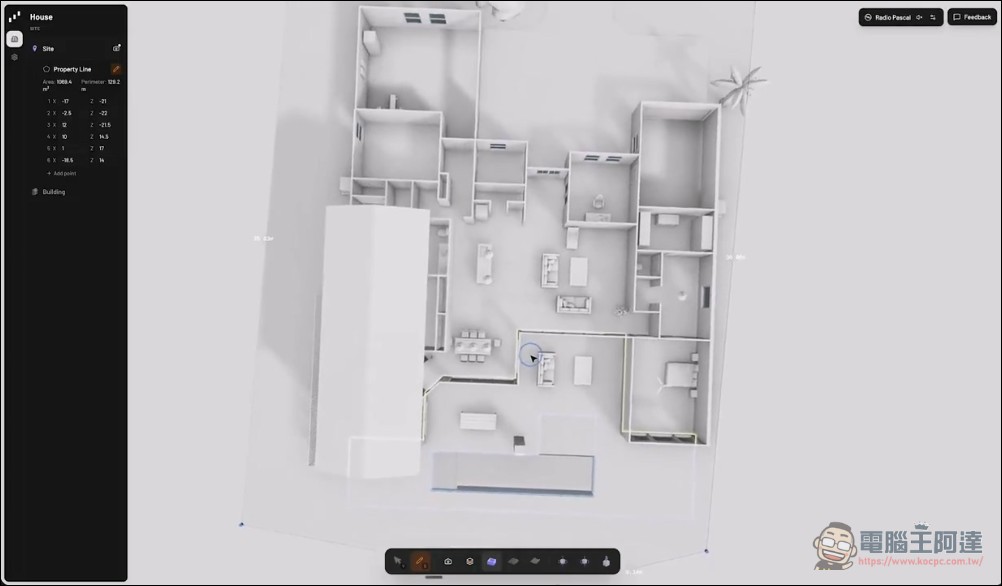
All data is stored in the local browser using IndexedDB. There is no need for a server, no account registration, and no data will be uploaded to the cloud. This is particularly friendly to privacy-conscious users.
AI blessing: Generate the first draft of a house in one sentence
Pascal Editor is not a CAD software in the traditional sense, but incorporates the concept of AI-assisted design. Users only need to enter a natural language description of their needs, such as “villa with swimming pool” or “two-story family house”, and the editor will generate an initial 3D model as a starting point for design, and users can then adjust the details.
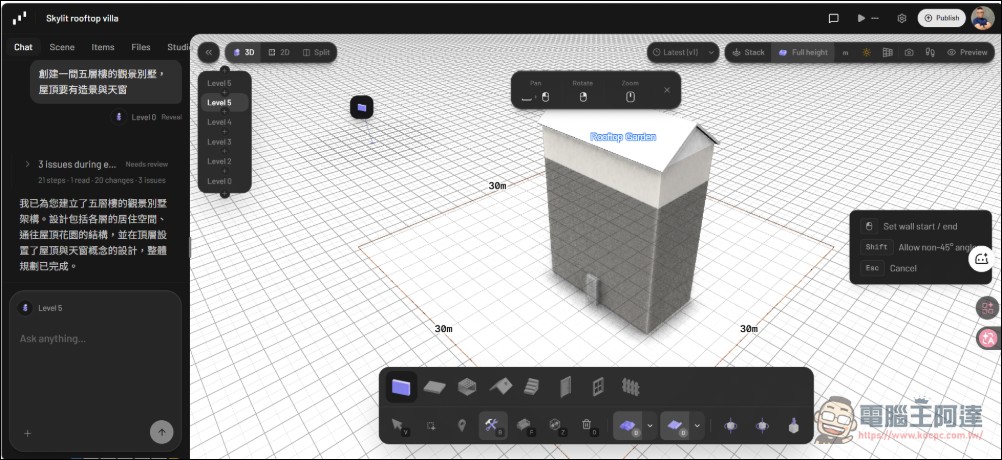
This design makes Pascal Editor a very friendly “rough drafting tool”, especially suitable for architects or owners who need to quickly verify space concepts. For ordinary users who want to plan their own home decoration, the threshold has also been significantly lowered.
Community co-creation: sharing, forking and Fork culture
In addition to personal modeling, Pascal Editor also has built-in project sharing and community interaction mechanisms. There is a “Featured projects” selected project display area on the official website, where you can see community works such as “Pixu House 3D”, with interactive indicators such as the number of views (such as 4,891 times), the number of likes, and the number of Forks.
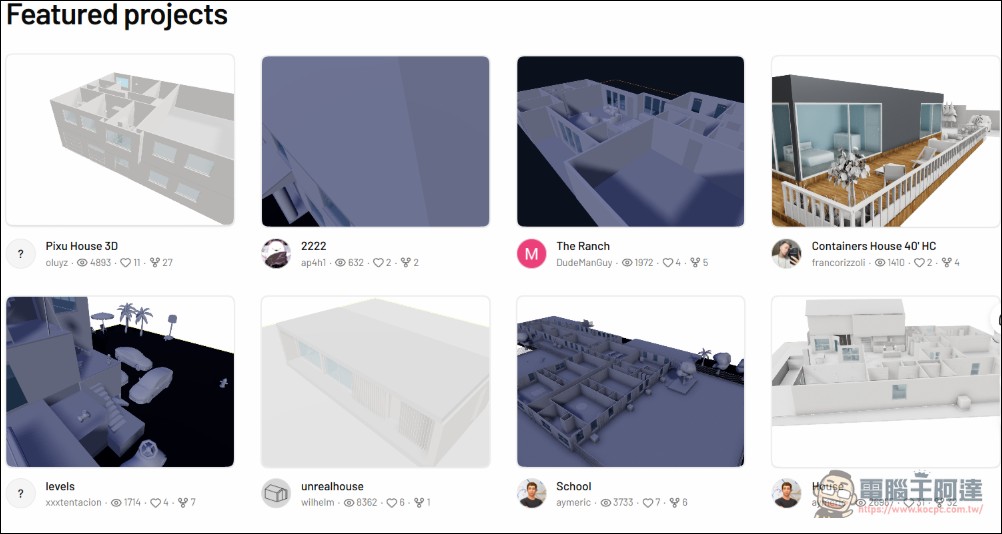
The Fork function is borrowed from the concept of GitHub. Anyone can copy an existing project as a starting point for their own design and then modify it. This model allows designs to be version managed and collaborated like code, and also helps learners improve their design capabilities by observing excellent works.
The entire project is split into three suites: @pascal-app/core is responsible for node structure, scene state management and geometry generation; @pascal-app/viewer handles 3D rendering, camera control and post-production effects; apps/editor is the actual UI components and editing tools.
State management uses three independent Zustand stores to separate concerns: useScene manages scene data and CRUD operations, useViewer handles selection status and display mode, and useEditor is responsible for tool switching and panel preferences. The rendering system uses a registry pattern. Various elements (walls, floors, furniture, etc.) process their own geometry generation logic through independent systems. When the nodes change, they will be marked as dirty and recalculated in the next frame.
Open source licensing and development status
Pascal Editor is released under the MIT license, which means that anyone can freely use, modify, and commercialize it.GitHub It has accumulated 13,100+ stars. At the same time, developers have begun to create derivative projects based on Pascal Editor, such as plug-ins such as ComfyUI-PascalEditor that integrate it into AI workflows.
New imagination for architectural design tools
For a long time, the high licensing fees for professional architectural design software have kept many creative and demanding individuals and small studios away. The annual fee for the standard version of AutoCAD is about US$2,680 (approximately NT$85,700), and the annual fee for Revit is about US$3,185 (approximately NT$101,800), which is really unaffordable for non-professional users. Although Pascal Editor cannot completely replace these professional software in terms of functionality, it demonstrates a new possibility: through modern Web technology, complex 3D architectural modeling tools can be popularized in a low-threshold way of “opening a web page and using it.”
As a new generation of Web graphics standards, WebGPU has just begun to become popular in browsers. Pascal Editor is one of the few projects that truly applies this technology to practical scenarios. For readers who want to experience it, you can directly visit editor.pascal.app and open the browser to start building a house; developers who are interested in going deeper can clone the source code on GitHub and use Bun to run a line of bun dev to start the development environment on this machine.
Source: KOCPC Chinese