


Over the past year, more and more people have started using AI agent tools like OpenClaw and Hermes Agent. Many of them will definitely want to connect local models to save money. Earlier, Google launched the new Gemma 4 12B model, which can run on just 16GB of VRAM and is designed for AI agent applications, while also supporting text, image, and audio input. Give it a try.
Google Launches Gemma 4 12B: Runs Locally with 16GB RAM, Supports Images, Audio, and AI Agents
Google said,Gemma 4 12B It is a model that brings “multimodal intelligence with AI agent capabilities” directly to laptops, using 12 billion parameters so hardware with less VRAM can run it easily, meaning it can run locally on consumer laptops with 16GB of VRAM or unified memory.
On the architecture front, Gemma 4 12B features an integrated multimodal design that eliminates the need for additional image or audio processing modules.
Traditional multimodal models typically rely on dedicated image or audio modules to convert images and sound into AI-compatible formats before handing them off to a language model. This time, Google has eliminated those intermediate steps, allowing image and audio data to flow more directly into the model’s core computations, which helps reduce latency, lower memory usage, and improve execution efficiency.
According to Google Developers technical documentation, the Gemma 4 12B image module uses a lightweight design of only about 35 million parameters, replacing the 27-layer vision Transformer used in the previous medium-sized Gemma 4; for audio, the standalone audio encoder has been removed, with raw audio directly split and converted into a data format the model can understand.
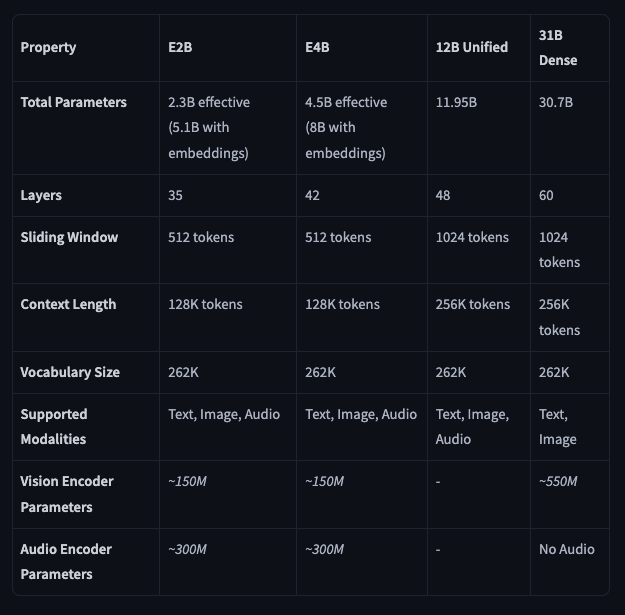
In the Gemma family, Gemma 4 12B is also the first mid-sized model to support native audio input, capable of processing text and images, and the 12B model supports a 256K context window:
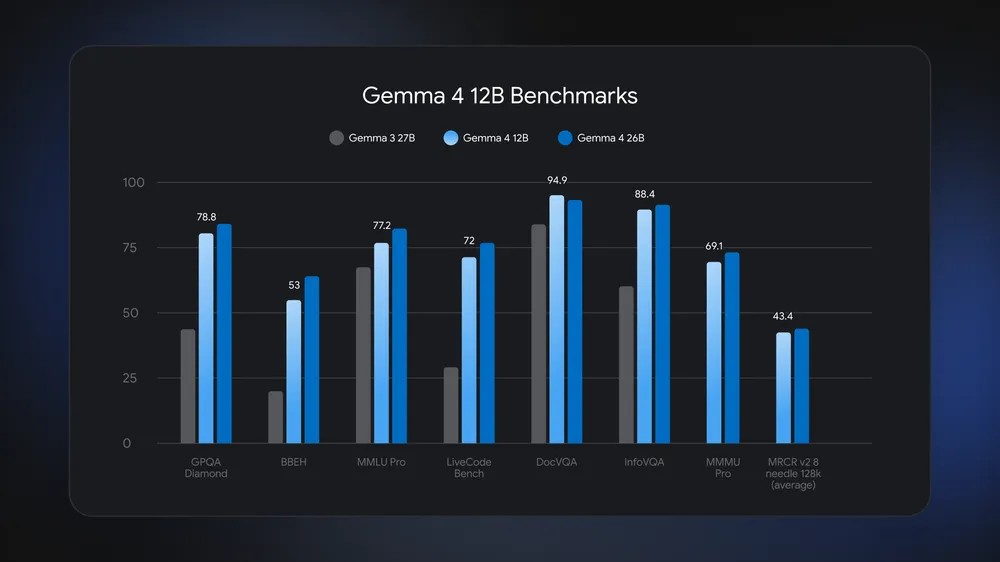
Google officially stated that Gemma 4 12B is close to larger 26B MoE models on standard benchmarks, but its total memory footprint is less than half.
Below are the performance test data for Gemma 4 12B:
- GPQA Diamond is 78.8%
- BBEH is 53%
- MMLU Pro is 77.2%.
- LiveCodeBench is 72.0%.
- DocVQA is 94.9%
- InfoVQA is 88.4%.
- MMMU Pro is 69.1%
- MRCR v2 8 needle 128k average is 43.4%.
Although 26B is still stronger overall, the gap isn’t large enough to put it in a different tier, which is why we’re positioning it this time as “performance close to 26B.”
Gemma 4 12B is now available to try directly through LM Studio, Ollama, the Google AI Edge Gallery App, the Google AI Edge Eloquent App, the LiteRT-LM CLI, and more. Model weights can be downloaded from Hugging Face and Kaggle.
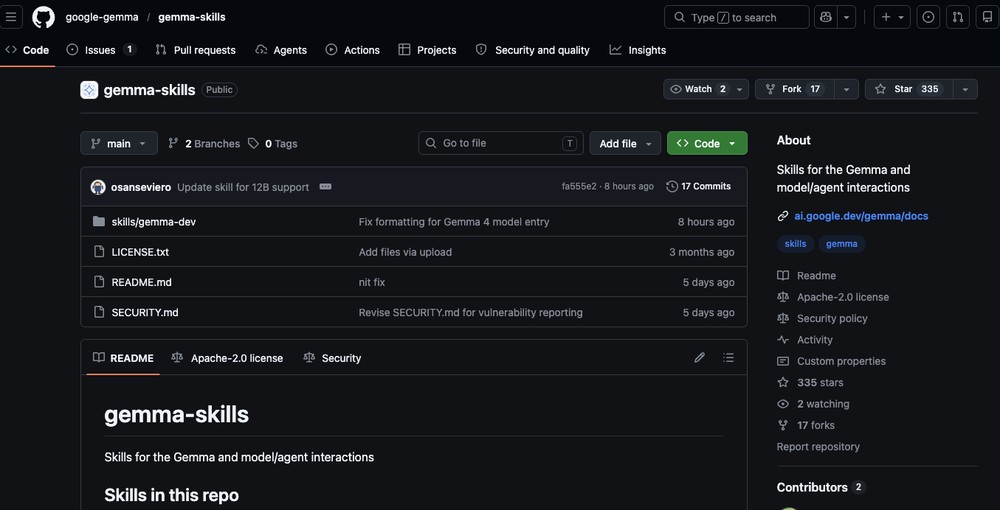
Additionally, Google also released. Gemma Skills Repository, enabling agent tools to more easily use Gemma models to complete tasks:
Source: KOCPC Chinese