


Intel’s CPU development roadmap for the next few years has recently been leaked on a large scale by the well-known whistleblower “Moore’s Law Is Dead” (MLID; Moore’s Law is Dead). The content covers multi-generation processor architecture planning from the end of 2026 to 2029. The most eye-catching changes include: Intel officially abandons the mixed large and small core architecture that has been used for many years, turning to a “unified core” strategy similar to AMD; the hyper-threading/SMT technology that has been removed since Lunar Lake and Arrow Lake has definitely returned; the LGA 1954 socket will support Nova Lake, Razer Lake and Hammer Lake three-generation desktop platforms, significantly extending the motherboard upgrade cycle.
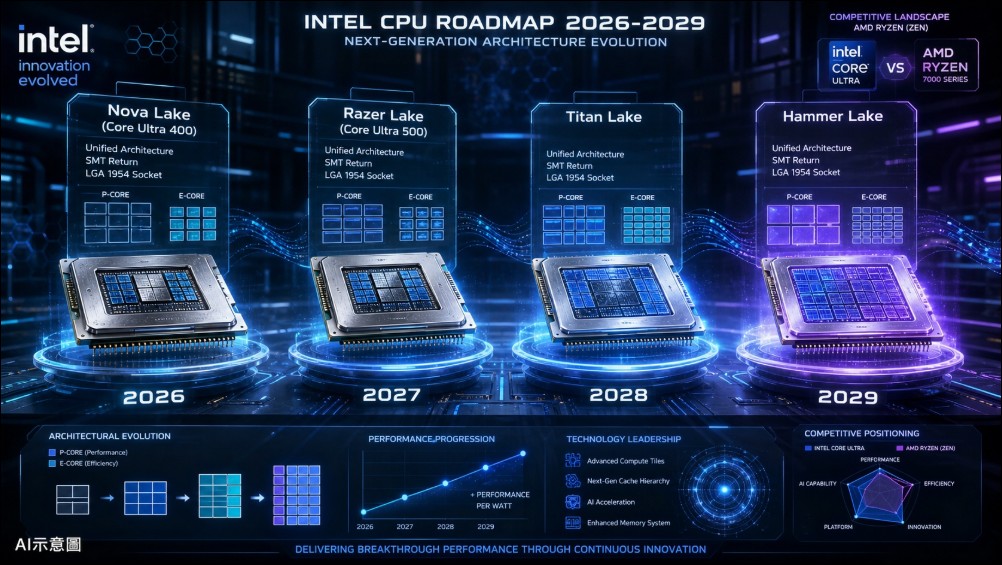
Intel’s future CPU roadmap exposed: return of super threads, unified core architecture debut
Intel has decided internally to gradually abandon the traditional hybrid design of P core and E core using different architectures, and instead adopt a unified core architecture. Under the new strategy, the underlying architecture of the P core and the E core are the same, differing only in the optimization direction, which is conceptually similar to the relationship between AMD’s Zen5 and Zen5c.
The specific core naming and evolution route are as follows:
- Griffin Cove (Razer Lake derivative): May become a transitional “unified core” that inherits some Beast Lake features.
- Copper Shark(Titan Lake): The first mobile platform core to truly launch the “unified core” strategy. The P version (Copper Shark P) is a standard performance core, and the E version (Copper Shark E) is a high-density optimized version. The underlying architecture is exactly the same as the P version.
- Thunder Hawk(Hammer Lake): The second-generation unified core will expand to the desktop area.
The point is that despite the unified architecture, Intel differentiates between P-cores and E-cores for marketing and operating system scheduling. The design ideas of the engineering team are more inclined to the original energy efficiency core team route.
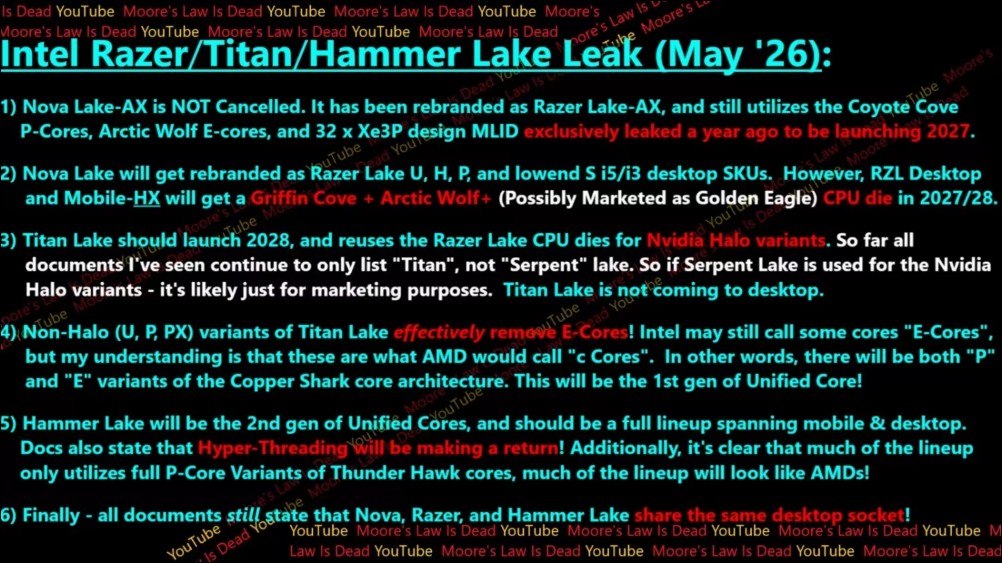
Detailed specifications and schedule of each generation of processors
Nova Lake (Core Ultra 400 Series)
The desktop version is expected to be launched at the end of 2026, using a traditional hybrid architecture with Coyote Cove as the P core and Arctic Wolf as the E core. There are internal disagreements about whether to launch -AX models, but MLID believes Intel has not completely abandoned the plan.
Razer Lake (Core Ultra 500 Series)
A desktop version is expected by the end of 2027. It is a minor upgrade compared to Nova Lake and has no revolutionary changes.
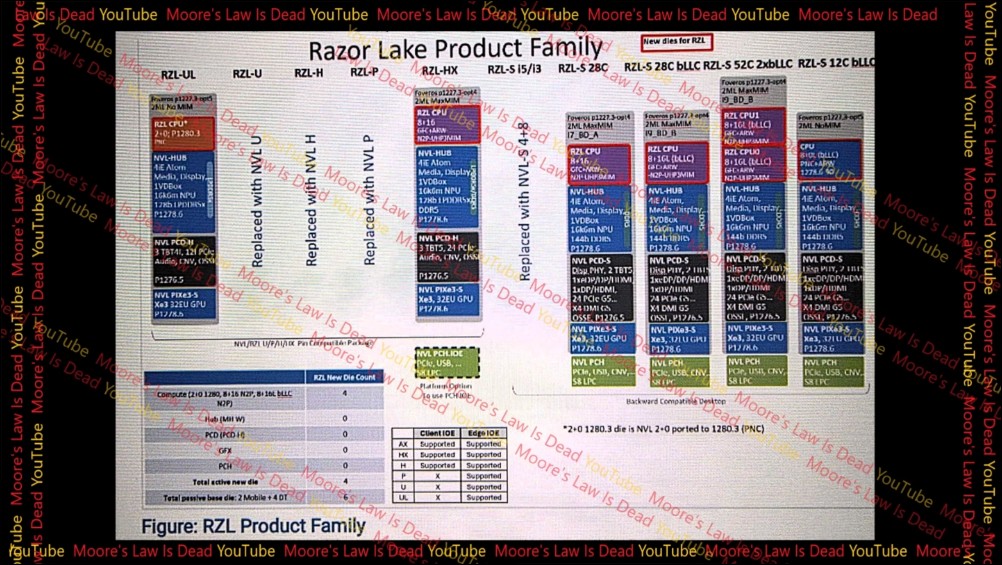
- Mobile and mainstream desktop: Following Nova Lake’s Coyote Cove P core plus Arctic Wolf E core solution.
- High-end desktop derivative: Introducing a “unified core” architecture based on Griffin Cove, with higher IPC expected.
- E Nuclear name change rumors: There is an internal intention to rename Arctic Wolf to Golden Eagle (essentially Arctic Wolf+).
- GPU: Supports up to 32 Xe3P cores.
- Naming adjustments: The originally planned Nova Lake-AX may be renamed Razer Lake-AX because its release time is closer to Razer Lake[2]。
Titan Lake (experimental mobile platform)
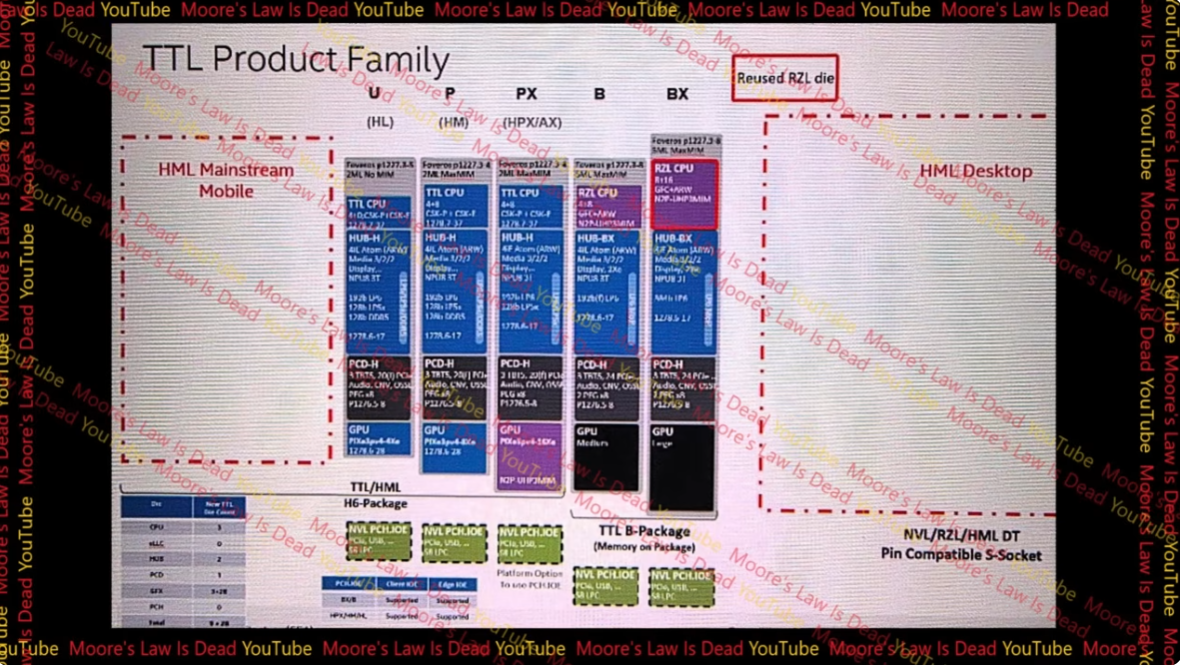
It is expected to be released in 2028 or 2029. It is only for mobile terminals. It is an experimental platform similar to Ice Lake/Meteor Lake and covers sub-categories such as U, P, PX, B, and BX.
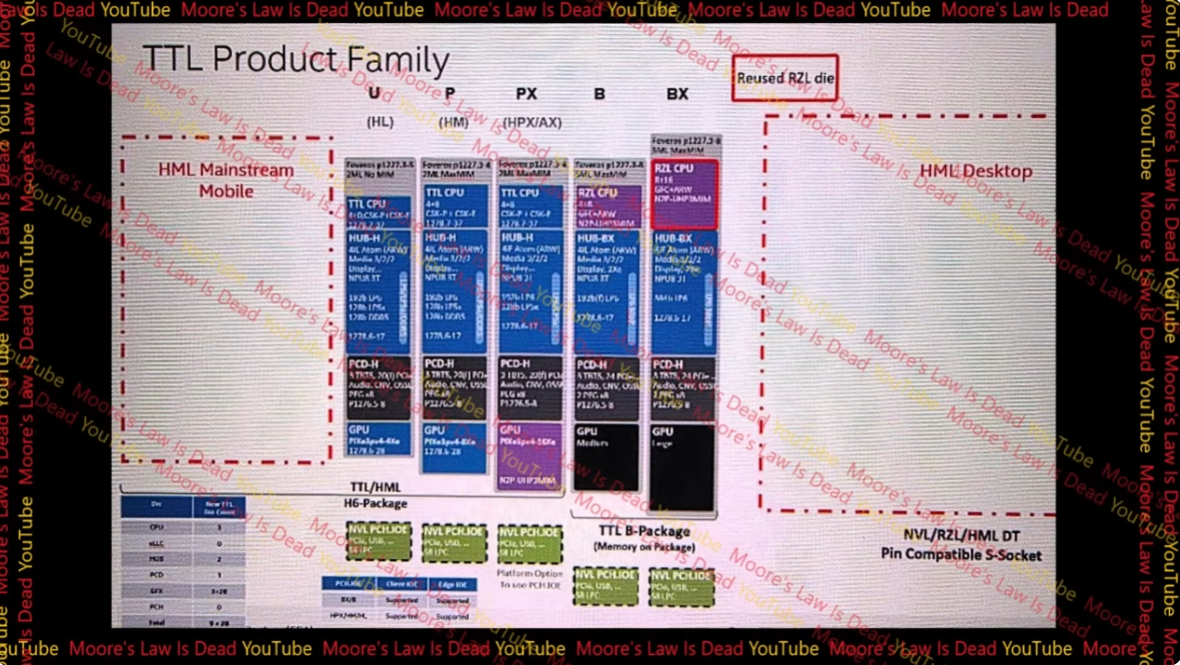
- Mainstream models (U/P/PX): Adopt Copper Shark unified core (up to 12 cores, 8P+4E configuration).
- Serpent Lake (Titan Lake-B/BX variant): Equipped with GPU cores cooperated by Intel and NVIDIA (Arc is gradually marginalized). To ensure a smooth integration, the old Razer Lake scheme (Griffin Cove P core plus Arctic Wolf/Golden Eagle E core) is still used. The flagship specifications support up to 8P+16E+4LPE (28 cores in total).
- memory solution: Using Memory on Package (MoP).
- memory support:Supports 192-bit LPDDR6 and 128-bit DDR5.
- encapsulation: H6 package, expected to be backward compatible with the next generation Hammer Lake mobile terminal[3]。
Hammer Lake (key turning point)
Released after Titan Lake, covering desktop and mobile platforms.
- core architecture: Introducing the second generation unified core Thunder Hawk, both P core and E core use Thunder Hawk architecture. Most processors will rely entirely on P cores.
- Hyper thread regression:SMT is reintroduced to consumer-grade processors. MLID predicts this will lead to “massive core” configurations. The leaked briefing shows the existence of a low-end sub-product: 8 P cores plus 0 E cores plus hyperthreads (pure big-core CPU). An ultra-high-end version is still to be determined and may have “several P-cores and more E-cores.”
- memory: The desktop version continues to use DDR5. AMD and Intel are not expected to upgrade to DDR6 until 2030.
If you want to learn more about the details of the above revelations, you can also watch this analysis video from MLID:
The return of super threads: CEO personally admitted that the removal was a strategic mistake
Intel CEO Chen Liwu has publicly stated that the removal of hyper-threading technology has put Intel at a “competitive disadvantage” and that bringing back this feature will help narrow the performance gap.
「我們將重新引入同時多執行緒(SMT)。放棄 SMT 讓我們處於競爭劣勢。把它帶回來將有助於我們縮小效能差距。」
Hyper-threading technology will first return on Xeon Coral Rapids server processors (expected to be late 2028), with consumer platforms following later. This may not represent a complete architectural shift, but rather a re-enabling of functionality that was already in the silicon. Although the Lion Cove architecture disables hyper-threading, the underlying layer supports it, so re-enabling it is a configuration change rather than a new design.
Platform compatibility and competitive landscape
- Socket compatibility: The LGA 1954 socket will support Nova Lake, Razer Lake, and Hammer Lake three-generation desktop CPUs. This echoes AMD’s long-term strategy for the AM5 platform and responds to long-standing consumer dissatisfaction with Intel’s frequent socket changes.
- competitors: The main competition for the desktop version of Razer Lake will be AMD Zen7 processors (Zen7 is progressing faster than expected).
Overall, the LEAK roadmap shows that Intel is undergoing a profound strategic adjustment. From abandoning hybrid architecture to unified core, reintroducing hyper-threading, and extending platform life cycle, these changes reflect Intel’s serious consideration of market feedback in the past few years. The fact is that Intel is willing to break its own design rules in recent years: cooperating with NVIDIA to integrate GPUs on the mobile side, embracing a unified core architecture, and bringing back super threads. If the roadmap can be implemented on time, this will be Intel’s most ambitious product strategy turnaround in recent years.
Source: KOCPC Chinese