


Following Google’s previously released world model “Genie 3,” another AI startup Dynamics Lab Recently also launched the new generation AI world model.Mirage 2This tool can instantly generate freely explorable 3D worlds from just a single image and a simple description. The core vision is not merely to showcase a technical experiment, but to progressively move toward a new era of “AI-Native Game Engines” and even “World Generation Engines.”
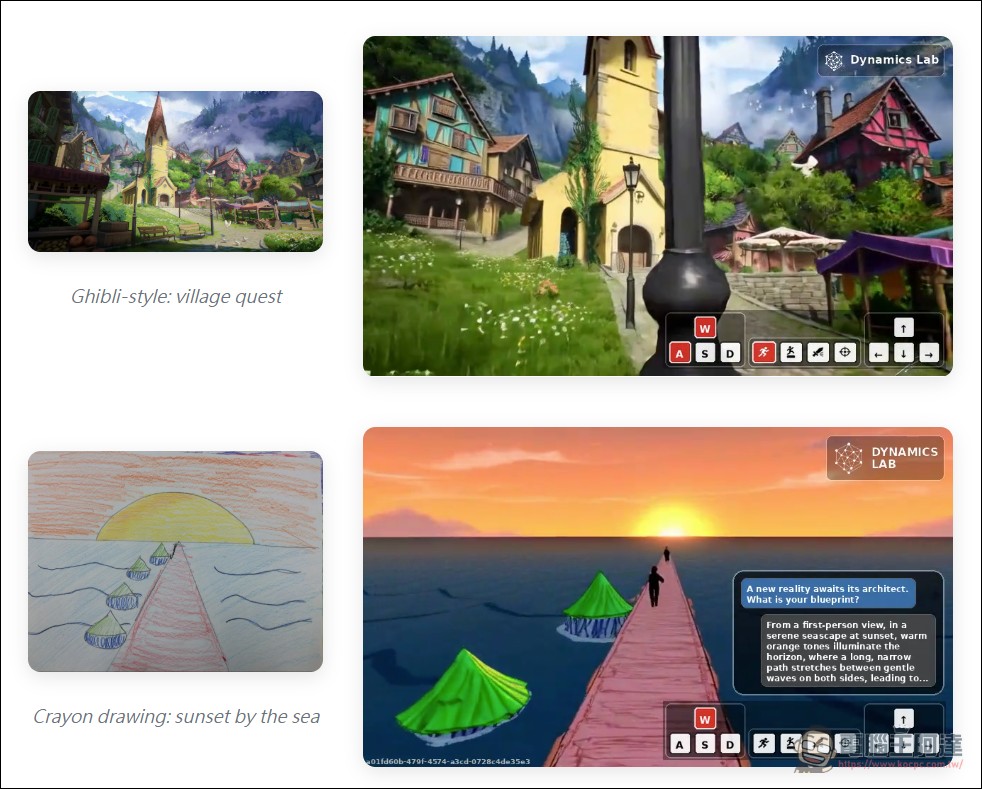
Dynamics Lab launches AI-native game engine “Mirage 2”
Traditional game engines such as Unity and Unreal Engine already provide highly modular toolkits, but creating vast game worlds still requires substantial artistic and engineering resources. Advances in AI technology, particularly breakthroughs in generative AI and real-time computing, have made the vision of “describe a world, and AI helps you build it” increasingly feasible. Mirage 2 is the latest attempt at realizing this vision—simply input an image and descriptive text, and the system dynamically generates a 3D environment, allowing users to explore it using standard WASD keys. Even more striking, the world renders in real time as the player interacts, no longer confined to pre-designed scenes.
Introducing Mirage 2 — a real-time, general-domain generative world engine you can play online
Upload any image—photos, concept art, classic paintings, kids’ drawings—and step into it as a live, interactive world.
Prompt your worlds with text to create any surreal scenes and… pic.twitter.com/bmKXjAO9Pl
— Dynamics Lab (@DynamicsLab_AI) August 21, 2025
In the online demo provided by Dynamics Lab, users can choose to upload their own images or directly use the default materials.
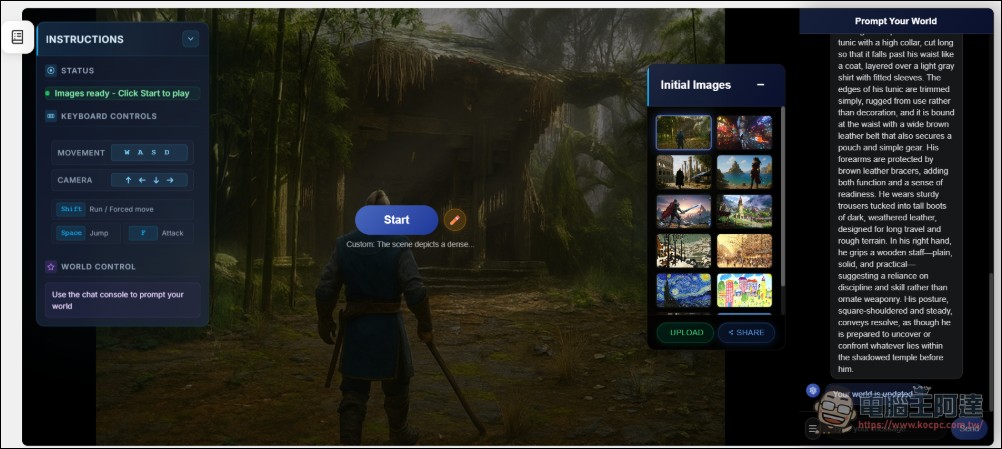
I also tested it myself, and the process is very simple:
-
Upload any image, enter a game scene prompt, and click “Start” to begin generation.
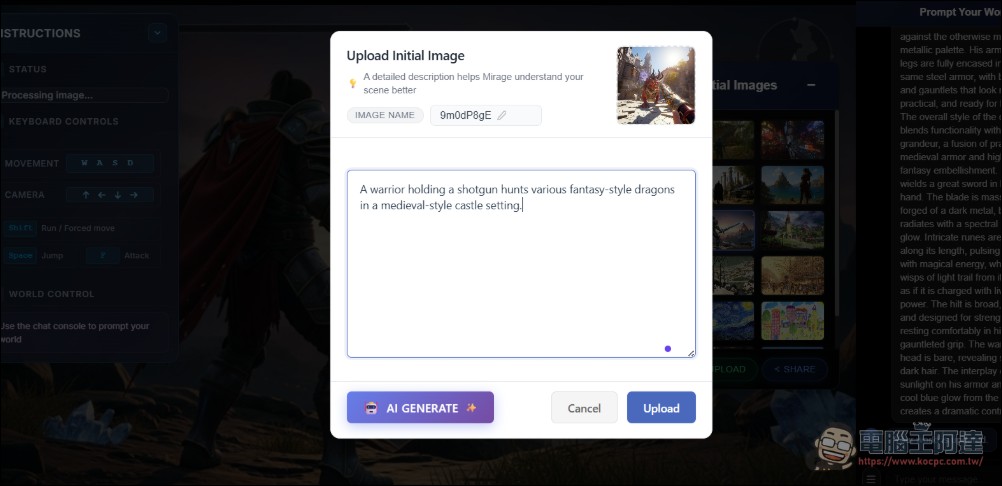
-
The system displays the waiting time.
-
After a few seconds, the 3D world finishes generating, and users can start exploring (below is a game I generated by uploading my own image).
Operationally, players can use Shift + WASD It controls movement in all directions: forward, back, left, and right. However, based on actual testing, the current control experience is still somewhat rough: the character only walks forward and backward, pressing attack triggers a response but then becomes unresponsive, and the game automatically ended in less than a minute of walking (possibly because there were too many people queuing, so the player got kicked). While it still falls short of a traditional game-like experience, this is nonetheless reasonable for an experimental platform centered on “generation.”
Introducing Mirage 2 — a real-time, general-domain generative world engine you can play online
Upload any image—photos, concept art, classic paintings, kids’ drawings—and step into it as a live, interactive world.
Prompt your worlds with text to create any surreal scenes and… pic.twitter.com/bmKXjAO9Pl
— Dynamics Lab (@DynamicsLab_AI) August 21, 2025
Real-time editing and interactivity
Another highlight of Mirage 2 is the ability to modify the world in real time. For example, when a user types “Set the season to winter.” on the right side, the system immediately updates the scene, and the ground is instantly covered with snow. This kind of dynamic feedback demonstrates Mirage 2 is not just a one-time generator, but a world-building tool that enables ongoing conversation and continuous evolution.。
Technical Advantages: Comparison with Google Genie 3
It is worth noting that Google just launched a world model with a similar concept at the beginning of this month.Genie 3“, also focuses on generating interactive worlds from simple input.
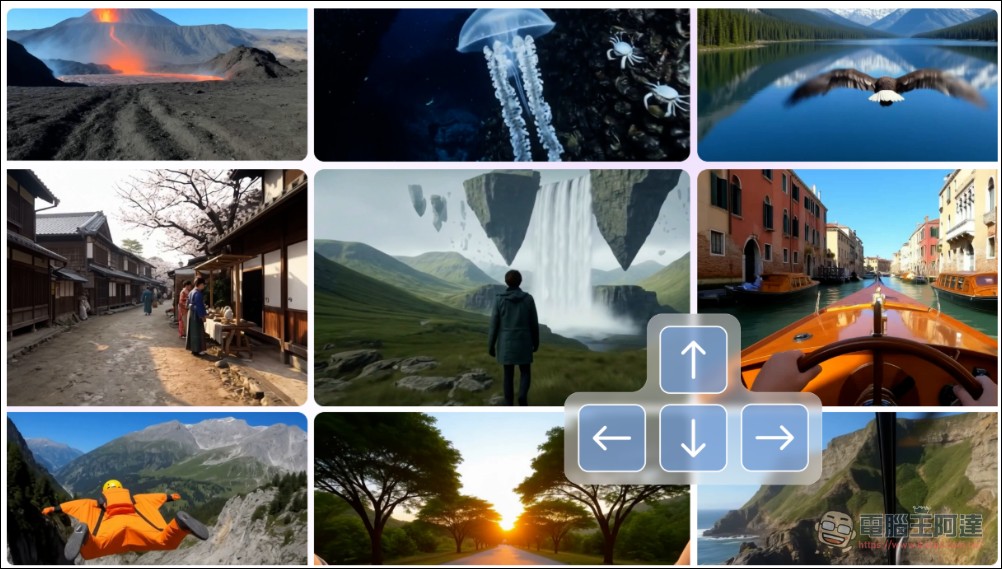
However, Dynamics Lab emphasizes that Mirage 2 has the following advantages:
-
Long-duration operation capabilityCapable of continuous generation for over 10 minutes, rather than just a short-duration experience.
-
Low latencyA response speed of just 200 milliseconds ensures real-time immediacy between operations and on-screen rendering.
-
Low hardware requirements:Runs on a single GPU, lowering the barrier to entry.
-
Available for online trial.: Provide a public demo so anyone can try it immediately.
Although Dynamics Lab positions Mirage 2 as a cornerstone for future game development, its range of applications is actually much broader:
-
Game development
For independent developers or small studios, AI world generation can significantly reduce the cost and time of scene design, allowing developers to focus on narrative and gameplay design. -
education sector
Images drawn by students can be instantly converted into 3D scenes, providing an immersive learning environment, whether for historical reenactments or scientific simulations, all achievable at low cost. -
Artistic creation
Using famous paintings or sketches as input, artists can quickly enter the world depicted in the work and further explore the possibilities of creation and performance. -
Virtual Social Interaction and the Metaverse
Real-time generated worlds may become the foundation of future virtual social platforms, allowing every user to quickly create their own dedicated space.
Limitations and challenges
Although Mirage 2 shows impressive potential, it still has room for improvement. The development team also frankly acknowledged that the following issues currently exist:
-
Operation feedback is not responsive enough.: When controlling the character, there is still delay or unnatural movement.
-
The scene transition is abrupt.Sometimes the world suddenly jumps, affecting immersion.
These limitations indicate that Mirage 2 still has some way to go before becoming a truly commercial-grade game engine. However, Dynamics Lab has stated that it will continue to address these issues in order to drive the technology toward maturity.
Dynamics Lab Mirage 2 Demo Page (Click Me)
Google’s Genie 3 and Dynamics Lab’s Mirage 2 show us the next possibility for AI in the gaming industry: scenes no longer need to be modeled one by one, but can be generated in real time and adjusted at any moment. Although challenges with controls and stability remain, this technology has undoubtedly opened new doors for game development, education, and the creative industries. Just as game engines transformed how games were produced back in the day, AI-driven generative technology may now reshape the future of gaming once again.
Source: KOCPC Chinese