


With generative AI like ChatGPT、Gemini、Grok As large language model services gain global popularity, the energy and environmental issues they bring are gradually coming to the surface. Every time you input a question and receive an answer, behind the scenes there are massive computations taking place at a massive data center somewhere across the globe, along with various cooling systems keeping things running. These processes not only consume enormous amounts of electricity, but also involve the use of precious water resources. Previously MIT’s Report on Energy ConsumptionThat’s quite astonishing. Recently,Google Released one targeting its own AI model. Gemini The detailed energy report reveals specific data on electricity consumption, carbon emissions, and water usage each time it answers user questions, but the results are apparently not as dramatic as outsiders had imagined.

Technology brings progress, the inverse growth of AI capabilities and energy efficiency.
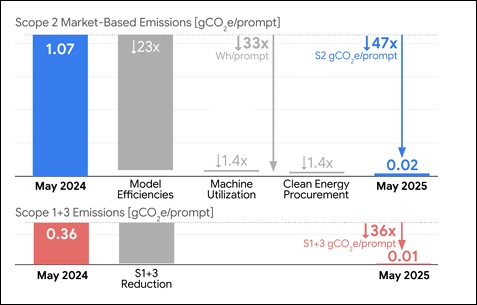
Google pointed out that in just the past year, through model optimization and various adjustments, the Gemini model’s energy consumption has been reduced to one-33rd of its original level, and carbon emissions have dropped to one-44th.
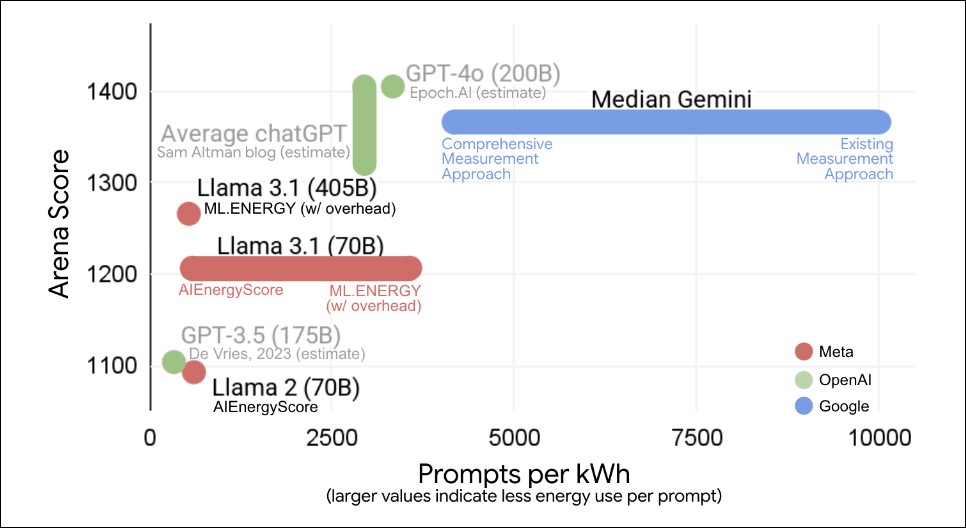
This also signifies that the synergistic optimization of AI algorithms and hardware technology is rapidly moving toward a sustainable future. In its publicly released chart, Google uses the vertical axis for “AI performance” and the horizontal axis for “number of tokens processed per 1 kWh,” i.e., energy efficiency. As seen in the chart, Gemini has advantages in both metrics, demonstrating superior energy utilization efficiency compared to Meta’s Llama 3.1 and OpenAI’s GPT-4o.
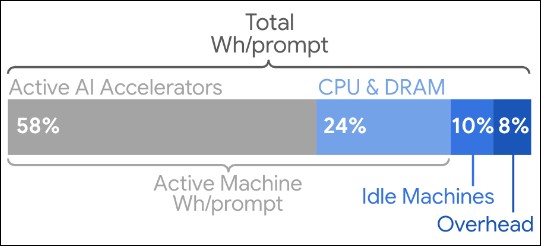
For a long time, calculations of AI model energy consumption have focused primarily on the power draw of AI computing chips such as GPUs or TPUs. However, Google points out that this assessment method is too one-sided. In reality, of the total electricity required to support AI inference within a data center, only about 58% is used for AI chip computation, while the remaining 42% is consumed by other critical components and infrastructure, including:
-
CPU and DRAM operating power
-
Power required for the system standby (Idle) state
-
Energy consumption of cooling systems and power distribution facilities
Google emphasized that failing to account for these factors would lead to underestimating AI’s overall energy and environmental impact. To address this, Google designed a calculation method that more closely reflects real-world operating scenarios.
Test result: one Gemini inference consumes only 0.24Wh of electricity.
Based on a comprehensive consideration of the above factors, Google measured using the Gemini models actually deployed in its own data centers and derived the following average inference cost data (per prompt):
-
Power consumption: 0.24Wh (watt-hours)
-
Carbon dioxide emissions: 0.03g (grams)
-
Water resource consumption: 0.26ml (milliliters)
To help the general public understand these figures more concretely, Google further illustrated with an analogy: this is equivalent to the electricity needed to watch TV for 9 seconds, and the consumption of 5 drops of water.

As a comparison, each ChatGPT reply uses about 0.34Wh; 0.322ml of water:
also, here is one part that people not interested in the rest of the post might still be interested in: pic.twitter.com/ANDhHu9g3g
— Sam Altman (@sama) June 10, 2025
The key technology behind it: TPU and efficient algorithms
Behind achieving the above results, aside from innovation in hardware design, Google also emphasized the contribution of software and system integration. The significant improvement in Gemini’s energy efficiency can be attributed mainly to the following two factors:
-
Efficient algorithm selection:Google emphasized from the early stages of model design the importance of prioritizing energy-efficient architectures and methods to reduce computational redundancy.
-
TPU hardware advantages:As Google’s self-developed AI accelerator, the TPU (Tensor Processing Unit) has better energy efficiency and inference speed compared to traditional GPUs. The use of TPUs enables Gemini to complete more computing tasks with lower energy consumption.
Energy Transparency: An Important Step for Google Toward Sustainable AI
Beyond the technological breakthroughs themselves, Google has also demonstrated a commitment to energy transparency and accountability. In its official blog and technical papers, Google has disclosed all assumptions and methodology behind its data calculations, including:
-
Power consumption monitoring in real operating environments
-
Comprehensive calculation of energy consumption for various hardware devices
-
The inclusion of cooling, water resources, and standby energy consumption
-
Correspondence between data center geographic location and carbon emission factors
This highly transparent approach stands in stark contrast to the past practice of many institutions promoting only model performance, setting a new benchmark for the entire industry.
Looking Ahead: Energy Challenges and Commitments in the Era of AI Scaling
Although Gemini has shown exciting progress in energy efficiency, Google does not deny that the rapid adoption of AI applications and the growing size of models will still bring significant energy demands. How to strike a balance between technological advancement and environmental responsibility will be a core issue that the tech industry cannot avoid.
Google says it will continue to invest in the following major areas:
-
More efficient algorithm research and development
-
Upgrades and iterative development of specialized hardware such as TPUs
-
Energy-saving innovations in data center cooling and power grid systems
-
Connecting with global renewable energy initiatives
Google’s commitment extends not only to continuous technological advancement, but also encompasses corporate social responsibility and a steadfast dedication to a sustainable future.
For more details on the technical aspects and data models behind Google’s research, please refer to its official publicly available technical white paper: 《Measuring the environmental impact of delivering AI at Google Scale》
Source: KOCPC Chinese