


Launched by China’s AI startup “Deep Seek”, the Deepseek V4 series is known as the most powerful open source model. Since its launch, the most amazing thing about the Deepseek V4 series, in addition to its excellent performance that is not inferior to several of the most cutting-edge closed-source large models, is its almost unbelievable ultra-low fee and large 1M context length. Recently, independent analyst GDP (@bookwormengr) published a tens of thousands of words on the X platformIn-depth analysis, dismantling the technical secrets and unknown long-term business layout behind DeepSeek’s high cost performance.
DeepSeek’s “unique” technical route
To understand DeepSeek’s strategy, we must first trace the evolution of its technology roadmap. Starting from V2, DeepSeek has always chosen the opposite route to the mainstream:
- When the industry focuses on dense (Dense) models, DeepSeek invests in hard-to-train mixed expert (MoE) architecture
- When the mainstream used PPO for reinforcement learning, they started from first principles and invented a more efficient GRPO algorithm.
- While other labs pursue larger model sizes, DeepSeek focuses onCompensate for hardware disadvantages with algorithm innovation
The core driver of this route is clear:Chinese AI chips will always lag behind the West in raw FLOPs due to US export controls (lack of EUV lithography equipment and limited advanced packaging technology), so DeepSeek must use extreme software efficiency to make up for the inherent deficiencies of the hardware.
KV Cache Revolution: Evolution from MLA to CSA/HCA
The most critical part of DeepSeek’s technical layout is the KV Cache (key value cache) Continuing revolutionary compression.
MLA (Multi-head Latent Attention) multi-head latent attention mechanism
In May 2024, DeepSeek V2 released Multi-head Latent Attention (MLA). Traditional multi-head attention (MHA) stores complete K and V vectors independently for each attention head, causing the KV Cache to grow linearly with the sequence length and multiples with the number of heads. The core innovations of MLA are:Instead of caching the complete K and V, a smaller latent representation is stored and the complete KV information is reconstructed when needed.
This technology reduced DeepSeek V2’s KV Cache by approximately 90%, making it one of the most memory-saving attention mechanisms at the time.
DSA (DeepSeek Sparse Attention) DeepSeek sparse attention mechanism
DSA introduced in V3.2 further solves the calculation problem of long context scenarios. The calculation amount of the traditional attention mechanism grows with the context length O(N²). DSA uses a sparse mechanism toEnsure that the amount of calculation does not increase as the context grows,Processing time remains nearly constant over long contexts. This also significantly relieves pressure on HBM bandwidth.
CSA + HCA(Compressed & Heavily Compressed Attention)
DeepSeek V4, released in April 2026, brought an architectural leap. Rather than using a single attention mechanism, V4 designed aHybrid Attention Architecture, including two complementary compression strategies:
- Compressed Sparse Attention(CSA): First compress the KV Cache along the sequence dimension, and then apply sparse attention, with a compression rate of 4× to 128×
- Heavily Compressed Attention(HCA): Highly compress KV Cache to further reduce memory usage
KV Cache cost comparison: the amazing efficiency of DeepSeek V4
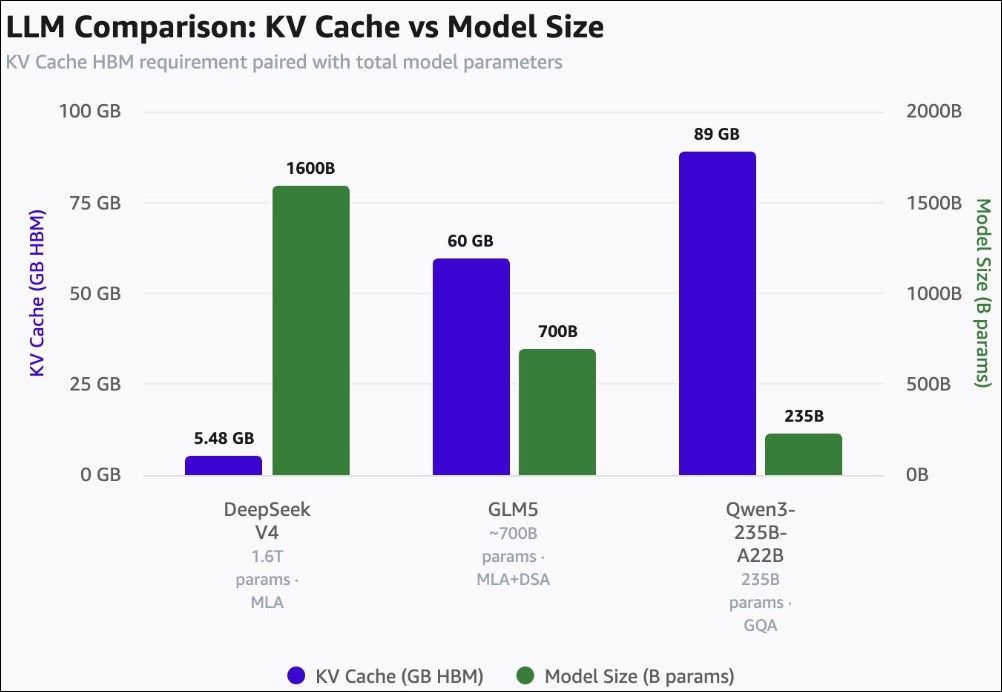
according to kvcache.ai Calculator with data from multiple technical analysts on 1M token context length, 8-bit KV precision, 16-bit indexer precision Under the standard settings, the KV Cache usage comparison of various mainstream models is as follows:
- DeepSeek V4 Pro (1.6T parameters / 49B active):5.48 GB HBM
- GLM-5 (~700B parameters):60 GB HBM(MLA + DSA adopted, but no CSA/HCA)
- Qwen3-235B-A22B (235B parameter / 22B active):89 GB HBM(using traditional GQA)
The conclusions presented by the numbers are extremely impactful:Although DeepSeek V4 Pro is a behemoth with 1.6T parameters, its KV Cache requirement is only 1/11 of GLM-5 and 1/16 of Qwen3-235B. Note that GLM-5 has adopted the MLA and DSA technologies pioneered by DeepSeek, but because it has not yet imported CSA/HCA compression attention, KV Cache is still an order of magnitude higher than V4 Pro.
If comparing bf16 accuracy (industry standard):
- DeepSeek V3.2 (previous generation):83.9 GiB
- DeepSeek V4 Pro (latest):9.62 GiB(Only 1/8.7 of V3.2)
This means that V4 is much better than its predecessor V3.2 KV Cache is reduced by nearly 9 times, while single-token inference FLOPs are reduced to 27%. Compared with competitors of the same generation, the compression gap is as much as 11-16 times.
The strategic significance of making KV Cache smaller
KV Cache reduction seems to be just a technical detail, but it is actually the core of why DeepSeek can keep the cost so low:
First, extremely low Cache Hit pricing:Precisely because the KV Cache is extremely small, DeepSeek can lower the API price of “cache hits” to less than 3% of its competitors, which is 97% cheaper than Claude Sonnet 4.6’s Cache Hits, and it can remain unexpired for several hours.
Second, SSD Offloading becomes a reality: The extremely small KV Cache can be offloaded to a consumer-grade SSD that is N times cheaper than HBM, and can be quickly loaded when needed. DeepSeek in the Dual Path paper (arXiv:2602.21548) published dual-path KV Cache loading technology, which solves the storage bandwidth bottleneck, which fundamentally reduces the dependence on expensive HBM.
Third, unlock the scale of long-context Agents: Long-running autonomous agents (such as coding agents and planning agents) need to maintain a large number of KV Cache. DeepSeek’s compression technology allows such applications to transform from expensive laboratory demonstrations into scalable commercial products.
mHC: The signal stabilization revolution of macroscopic architecture
In addition to the innovation of the attention mechanism, DeepSeek V4 is also equipped with the mHC(Manifold-Constrained Hyper-Connections)。
The traditional residual connection (x + F(x)) has been the standard configuration of deep networks since ResNet, but as the number of layers increases, signal attenuation or explosion becomes a bottleneck. mHC expands the residual flow into multiple parallel information highways andConstrain the mixing matrix to a doubly stochastic matrix through the Sinkhorn-Knopp algorithm, which mathematically guarantees that signal strength is accurately preserved at any depth.
Comparison: ByteDance’s original unconstrained Hyper-Connections amplified the signal to 3000× at 27B scale, and the training completely collapsed. While mHC only increases training overhead by 6.7%, it brings BIG-Bench Hard +7.2 points, DROP +3.2, GSM8K +2.8, MMLU +1.4 A significant improvement, which is a pure architectural dividend under the same parameter amount and calculation budget.
Engram: Complementary strategies using memory to convert calculation power
Published by DeepSeek in Q1 2026 Engram It is a very original design. Traditional Transformer is forced to use a lot of calculations to simulate knowledge retrieval (essentially inefficient), while Engram introduces a O(1) hash table module, modernizing classic N-gram embeddings and creating a new sparse axis that DeepSeek calls “conditional memory.”
The trade-off behind this is very subtle: the energy consumption and latency of an LPDDR memory table lookup are much lower than a complete Transformer layer forward propagation. Replacing some calculations with memory queries increases memory usage, but the overall computing cost drops significantly. For China’s GPU ecosystem, which is always lagging behind cutting-edge manufacturing processes,Convert computing power (China has a disadvantage) with large amounts of NAND and LPDDR (China has a production capacity advantage), is a trade-off of great strategic value.
From memory layout to hardware ecosystem
Combining the above technologies, the complete hardware layout of DeepSeek gradually becomes clear:
- MoE + 4-bit weight: Weights can be placed in LPDDR, JIT streaming into HBM
- CSA/HCA Extreme Compression KV Cache: KV Cache can be resident in SSD
- Dual Path Paper: Solve the SSD loading bandwidth bottleneck
- Engram lookup table: Use LPDDR to replace part of Transformer calculations
result:Dramatically reduce dependence on HBM and state-of-the-art GPUs. YMTC’s 3D NAND and CXMT’s LPDDR become key elements of AI infrastructure. CXMT’s LPDDR speed lags only 0.5 generations behind, and the density lags behind 1 generation. The gap is not big, and SK Hynix, Micron, and Samsung have shifted their production capacity to high-profit HBM, which has just opened a market gap for Chinese memory manufacturers.
TileLang language: bypassing the CUDA moat
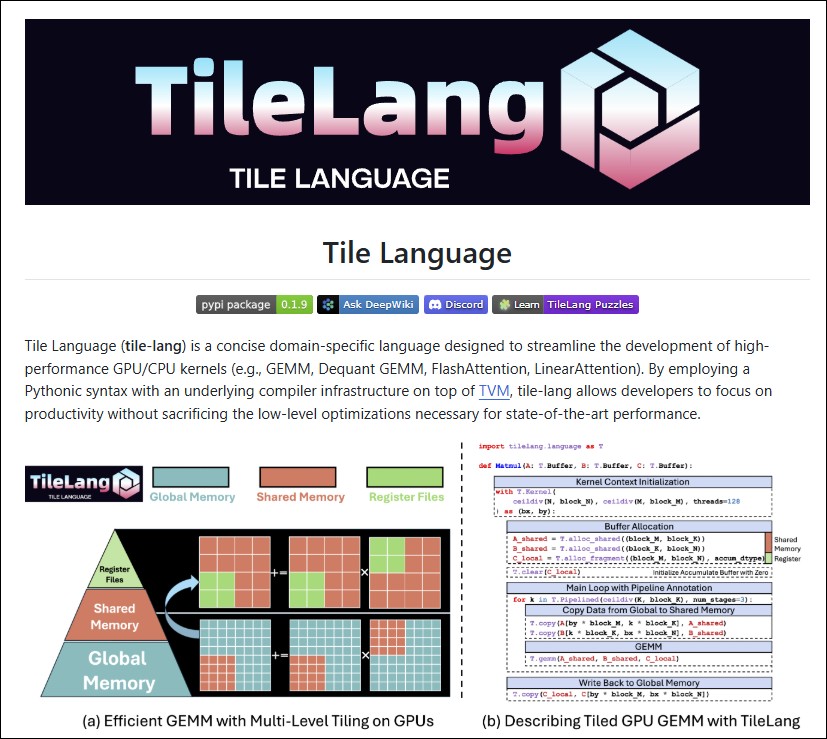
DeepSeek’s investment in TileLang is equally important.TileLang Allow developersDevelop Kernel once and execute on multiple hardware platforms(As long as the platform has backend support). This is especially critical for Chinese GPU manufacturers (Moore Thread, Muxi, Biren, etc.): they do not need to rely on NVIDIA’s CUDA ecosystem, but provide a hardware-neutral software layer through TileLang. This strategy is conceptually similar to AMD’s ROCm, but more radical – it decouples directly from the compiler level.
A bigger chess game: a DeepSeek version of the OpenAI-AMD model
GDP’s analysis points to an overlooked analogy: in OpenAI’s strategic partnership with AMD, AMD issued up to 160 million share warrants to OpenAI, vested based on computing power deployment milestones. This model of “exchanging future computing power commitments for equity” is likely to be copied by DeepSeek into its cooperation with many memory, ASIC, and CPU manufacturers in China. For these suppliers, obtaining DeepSeek’s in-depth engineering support and ecological endorsement is far more valuable than simple product verification.
Conclusion
DeepSeek does not do multi-modality, does not sell commercial coding solutions, and insists on open source. This is not a lack of business acumen, but a patient long-term layout. From MLA to CSA/HCA, from mHC to Engram, from Dual Path to TileLang, every technology points to the same strategic goal:Without EUV or cutting-edge manufacturing processes, we will use algorithm innovation to build an alternative AI hardware ecosystem that can compete with the West.
Whether this strategy can achieve a market value of US$1 trillion ultimately depends on whether Chinese memory and ASIC manufacturers can catch up with Western products under the protection of DeepSeek’s software. But at least from a technical point of view, DeepSeek has proven that it is feasible to “complement hard with soft”.One company’s open source technology may be reshaping the competitive landscape of global AI infrastructure.
— GDP (@bookwormengr) May 22, 2026
Source: KOCPC Chinese