


The field of artificial intelligence and high-performance computing has once again achieved a major breakthrough. NVIDIA, the global leader in graphics processing units and AI computing, officially released its next-generation small open-format language model, “Nemotron Nano 2,” on August 18, 2025. The model’s most notable highlight lies in its innovative hybrid inference architecture, which successfully combines the industry-standard Transformer with the emerging Mamba state space model (SSM). This design aims to solve the challenges of high memory and computational costs that traditional models face when processing long sequences, while maintaining high accuracy and achieving several times the inference throughput of models at the same level.
Technical Core: The Powerful Combination of Transformer and Mamba
Nemotron Nano 2 is not a brand-new design from scratch, but rather a hybrid-architecture model based on NVIDIA’s internal codename “Nemotron-H.” To understand its revolutionary nature, one must first understand the background and strengths and weaknesses of its two major technical pillars.
-
Transformer Architecture: The Cornerstone and Bottleneck of Today’s Mainstream
Since it was proposed by the Google team in 2017, the Transformer architecture has become the foundation of almost all large language models (such as GPT, PaLM, Llama, etc.). Its core “Self-Attention Mechanism” enables the model to simultaneously weigh the importance of all words in the input sequence, thereby achieving an excellent understanding of contextual semantic relationships.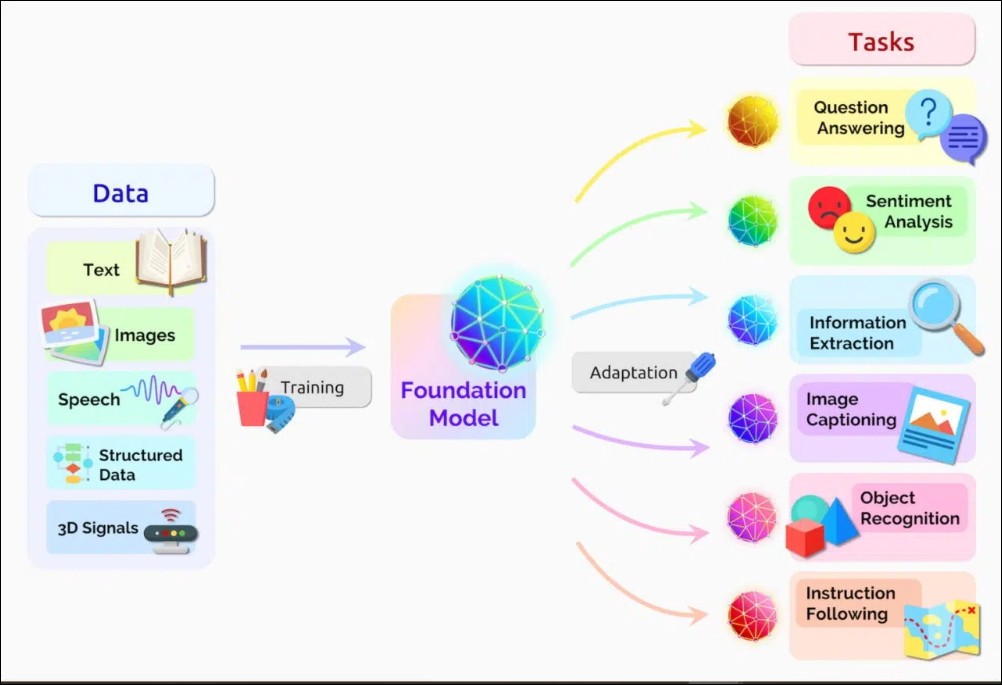
However, its fatal weakness is that the computational complexity of the self-attention mechanism grows quadratically (O(n²)) with sequence length (n). This means that when handling long-sequence tasks such as long articles, codebases, or long conversations, the memory and computational resources required by the model increase sharply, becoming a major obstacle to inference efficiency and deployment cost.
-
Mamba Architecture: The Rise of an Efficiency Star
To address the bottlenecks of Transformer, academia and industry have been constantly seeking alternatives. The Mamba architecture, published in December 2023, stands out among them. It belongs to the state space model (SSM) family and, through a mechanism called “selective state spaces,” is able to dynamically and selectively attend to or ignore different parts of the input information.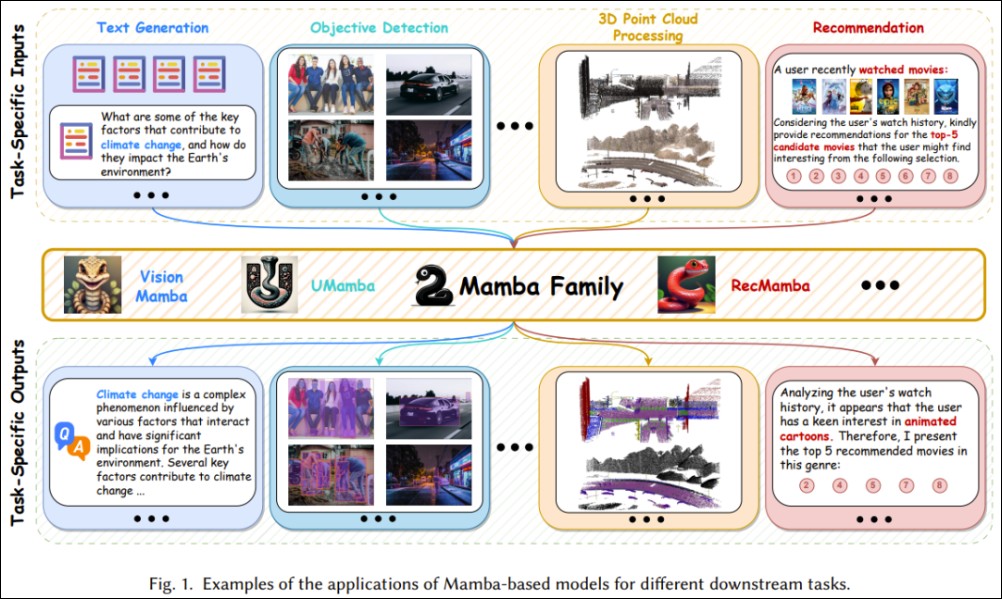
Its greatest advantage is that computational complexity scales linearly with sequence length (O(n)). This allows Mamba to significantly reduce memory and computational resource requirements when processing extremely long sequences, while maintaining or even surpassing Transformer performance on certain tasks.
Nemotron-H’s hybrid strategyThis is precisely about combining the strengths of both approaches. NVIDIA’s research team cleverly designed the model architecture so that the Transformer module handles core tasks requiring deep contextual understanding, while the Mamba module efficiently processes long-sequence dependencies. This hybrid approach claims to achieve higher throughput and comparable accuracy in long-context scenarios.
Model Specifications and Open Ecosystem
This time, NVIDIA did not just release a single model, but provided a complete model family, and made it available to the developer community through the Hugging Face platform:
-
Nemotron-Nano-12B-v2-Base: A base pre-trained model with 12 billion parameters before pruning, for researchers to conduct in-depth analysis and further fine-tuning. -
Nemotron-Nano-9B-v2-BaseThe pruned 9-billion-parameter base model offers more streamlined parameters and higher efficiency. -
Nemotron-Nano-9B-v2:The final aligned and pruned model, optimized for downstream applications, is also the centerpiece of this performance comparison.
Particularly worth mentioning is,Nemotron-Nano-9B-v2 Highly optimized, it runs smoothly on just a single NVIDIA A10G GPU.This significantly lowers the deployment barrier for enterprises and developers, making it possible to deploy high-performance private models without relying on expensive cloud APIs or large GPU clusters.
Real-World Performance Test: Completely Crushes Same-Tier Competitors
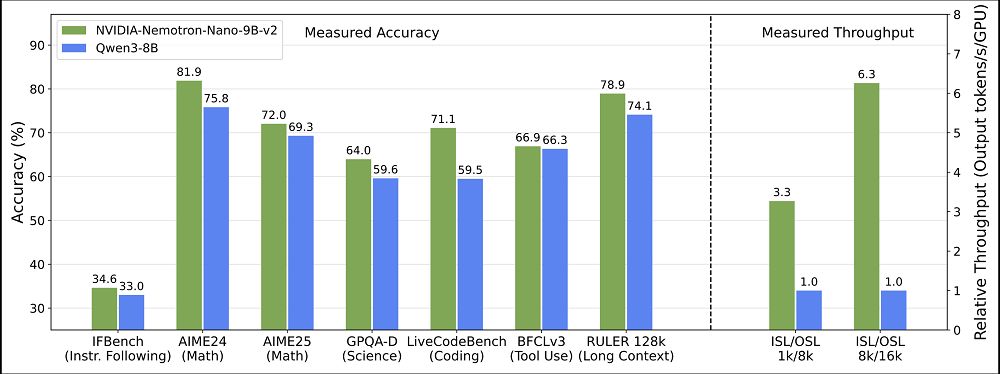
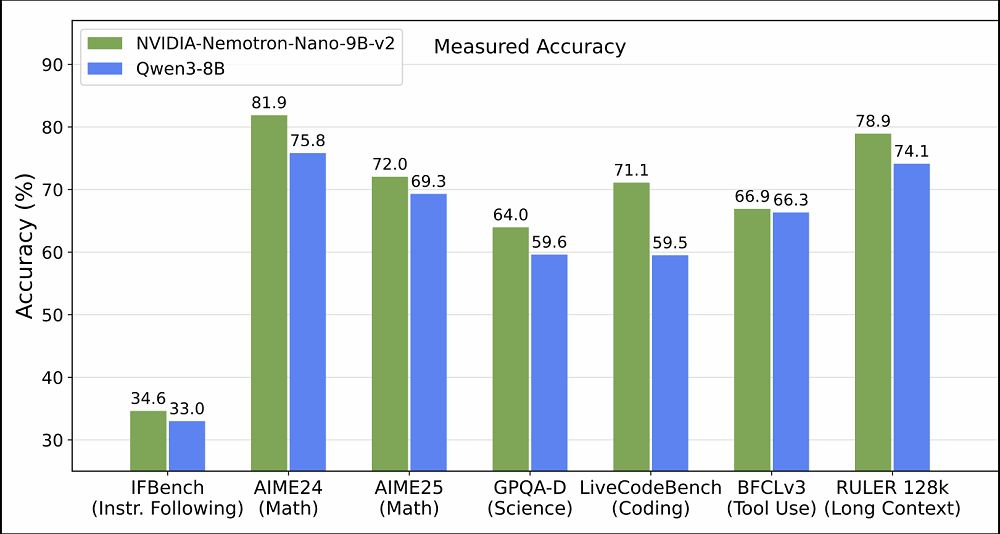
NVIDIA, in its official report, compared Nemotron-Nano-9B-v2 against current open-source benchmark models of the same scale (approximately 8 billion parameters): Alibaba’s Tongyi Qwen3-8B A comprehensive comparison was conducted. The results show that Nemotron not only matches or even surpasses it in accuracy, but also demonstrates an overwhelming advantage in efficiency.
Accuracy Competition
In standard academic benchmarks covering complex reasoning across mathematics (e.g., GSM8K), science (e.g., MMLU), and coding (e.g., HumanEval), Nemotron-Nano-9B-v2 (green bars in the figure) outperforms Qwen3-8B (blue bars) on most tasks. This demonstrates that the hybrid architecture excels at maintaining the model’s “intelligence” and “capability,” without sacrificing performance in pursuit of efficiency.
2. Throughput Showdown
This is the real killer feature of Nemotron Nano 2. The figure below shows the throughput (tokens/sec) performance of the two models under different input sequence lengths (ISL) and output sequence lengths (OSL).
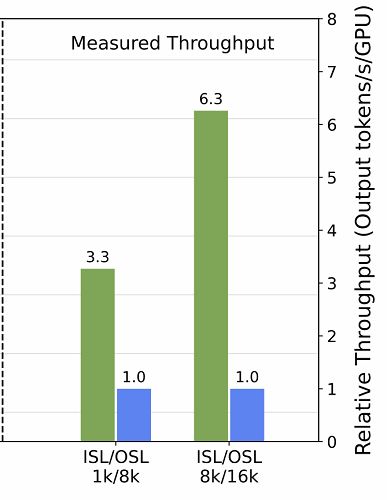
The chart clearly shows,Nemotron-Nano-9B-v2’s throughput can reach up to 6 times that of Qwen3-8B.More critically, as the length of the sequences being processed increases, the performance gap between the two expands dramatically. This perfectly validates the linear efficiency advantage of the Mamba architecture when handling long sequences, which is of immense significance for real-world applications such as long-document summarization, chatbots with long conversation histories, and long code generation.
License and Commercial Terms: Embracing Open Source and Commercialization
The Nemotron Nano 2 series models adopt NVIDIA’s own proprietary 「NVIDIA Open Model License」This license is quite friendly to developers and enterprises:
-
Commercial use permitted: : Developers can freely use the model for commercial purposes, integrating it into their own products and services.
-
Modification and redistribution permittedDevelopers can create and distribute their own derivative models based on Nemotron Nano 2.
Of course, users also need to comply with some basic obligations, such as:Without proper protective measures, one must not deliberately bypass built-in security mechanisms.(to avoid malicious abuse of the model), and when redistributing, it must beRetain the original copyright notice and license statement.Overall, this is an open license that encourages innovation and commercialization.
Industry Significance and Future Outlook
NVIDIA’s release of Nemotron Nano 2 this time sends several strong signals:
-
The era of efficiency-first has arrived.: :在追求「更大參數量」的軍備競賽之外,「更高效率」已成為另一個核心賽道。如何用更少的資源做更多的事,是模型真正實現普及與落地應用的關鍵。
Translation: Beyond the arms race for larger parameter counts, “higher efficiency” has become another core track. How to do more with fewer resources is key to models truly achieving widespread adoption and real-world deployment.
-
Hybrid architecture becomes a new trend.Nemotron-H proves that future model design need not be an either/or choice. Combining the strengths of different architectures to complement each other will become the main direction for next-generation model innovation.
-
Advancement of Edge Computing AIHigh-performance models that can run efficiently on a single consumer-grade enterprise GPU (such as A10G) will greatly accelerate the deployment of AI on edge devices and local servers, meeting the demands of data privacy, low latency, and cost control.
Conclusion
The arrival of NVIDIA Nemotron Nano 2 is not just the release of a new model—it is an important demonstration of the future direction for large language models. It successfully showcases the immense potential of hybrid architectures, striking an elegant balance between precision and efficiency. For the entire AI open-source community and the enterprise sector, this undoubtedly serves as a powerful shot in the arm, signaling that more efficient, more accessible, and more powerful AI tools are on the horizon. It further drives the deep integration and innovative application of generative AI technology across industries.
Source: KOCPC Chinese