


In recent years, China has seen a growing number of AI models. Besides well-known ones like DeepSeek and Qwen, Xiaomi has now officially joined the fray, announcing on social media the open-sourcing of its first Xiaomi MiMo reasoning model. It comes in multiple versions, and the 7B-RL variant’s scores in mathematical reasoning and code testing even surpass OpenAI’s o1-mini and Qwen’s QwQ-32B—quite impressive. All parameter versions are now available on Hugging Face.
Xiaomi’s first Xiaomi MiMo reasoning large model debuts, with a total of 4 models.
Earlier on the WeChat platform, Xiaomi’s large model announced the open-sourcing of Xiaomi MiMo, its first large model built for reasoning. Although Xiaomi calls it “large,” its parameter count is actually much smaller than that of competitors, with only 7 billion parameters, yet some of its performance still surpasses that of larger language models.
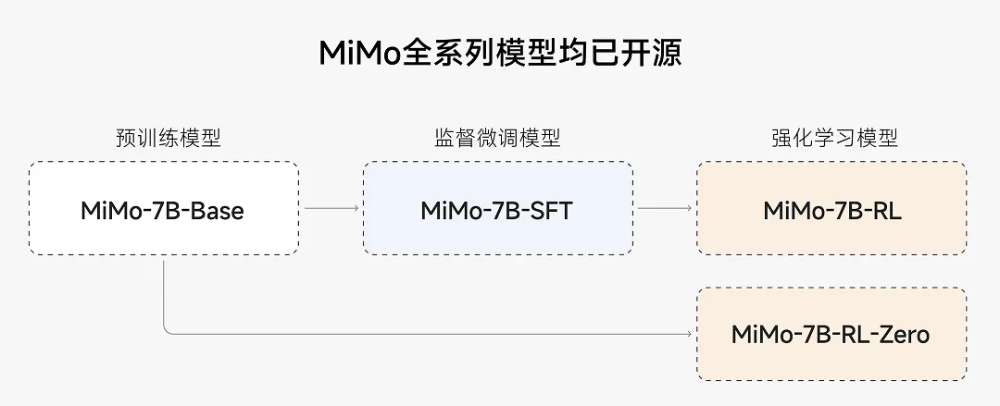
Xiaomi MiMo has 4 versions in total, which are:
- Mimo-7B-Base: Pretrained Model
- Mimo-7B-SFT: Supervised Fine-Tuning Model
- Mimo-7B-RL, Mimo-7B-RL-Zero: Reinforcement Learning Models
Below is the test data shared by Xiaomi, with scores from three tests: AIME-24, AIME-25, and LiveCodeBench v5, for mathematical reasoning and code competition:
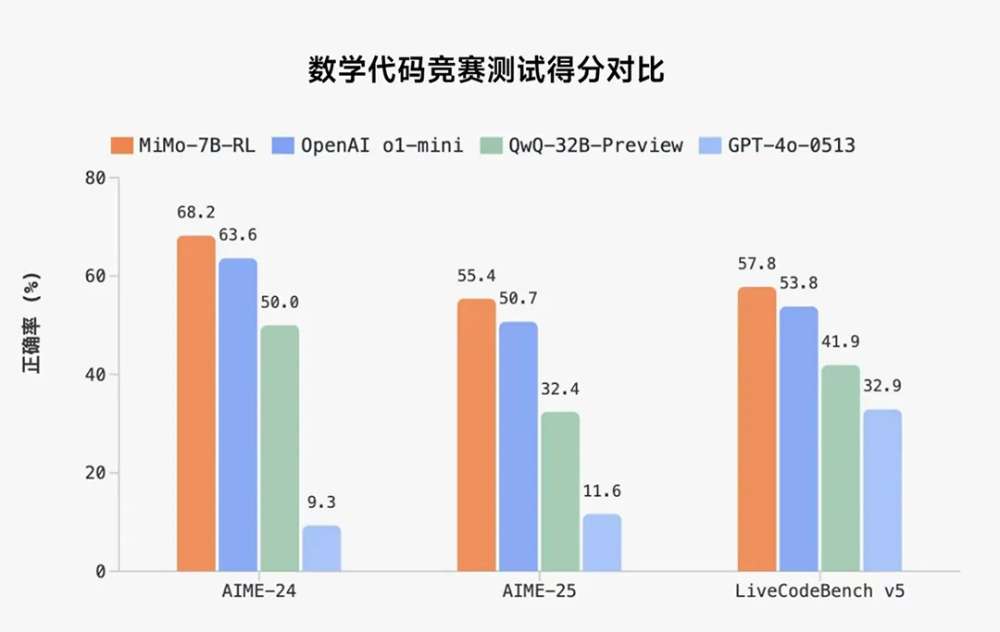
It can be seen that MiMo-7B-RL leads competitors OpenAI o1-mini and GPT-4o-0513, as well as Qwen’s QwQ-32B-Preview, across all three tests. A 7B model defeating a 32B model is quite impressive, and the margin of victory is also substantial.
For instance, in AIME-24, MiMo-7B-RL scored 68.2, leading QwQ-32B-Preview’s 50 by 36.4%. In AIME-25, the gap widened to 71%.
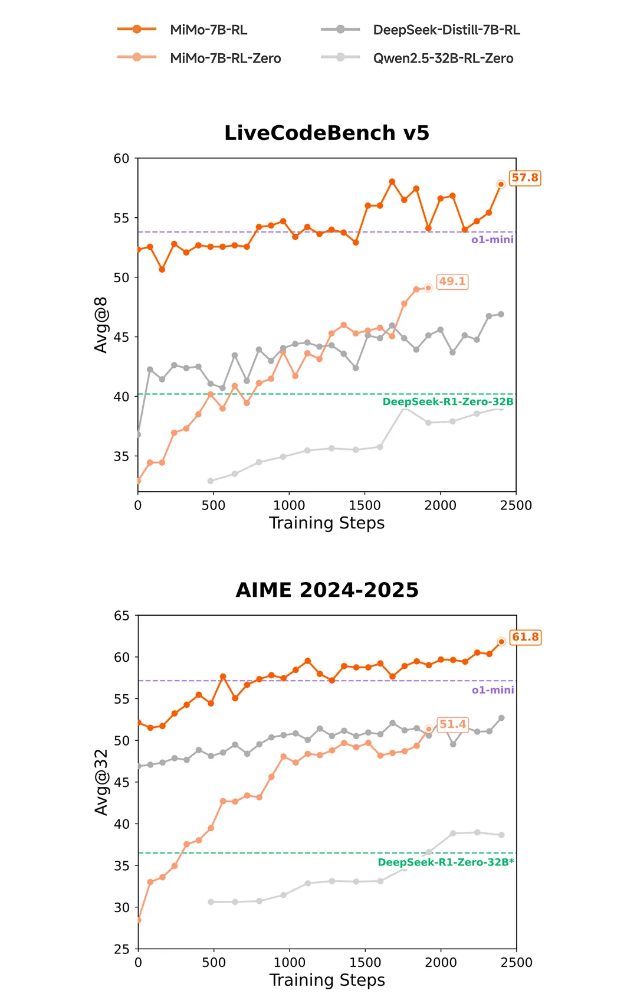
There are also comparisons with DeepSeek. Against the DeepSeek-R1-Distill-7B model, which also has 7 billion parameters, MiMo-7B clearly leads in reinforcement learning potential in the fields of mathematics and code:
Xiaomi also emphasized that the improvement in MiMo’s inference capabilities is driven by multi-level innovations in data, algorithms, and other areas during both the pre-training and post-training phases.
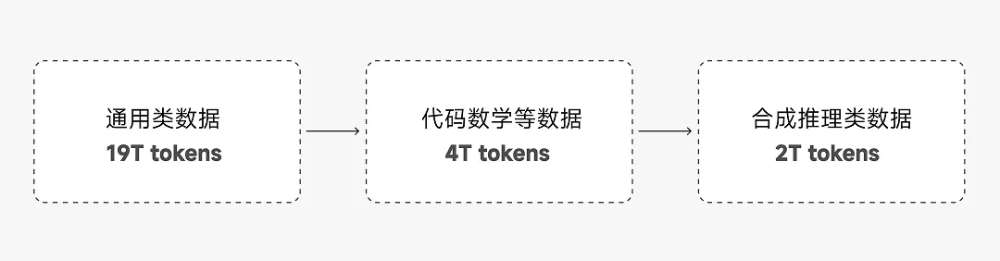
The pre-training phase focuses on exposing the model to more reasoning patterns. By mining reasoning-rich corpora, approximately 200B tokens of reasoning data were synthesized, and a three-stage training approach was used to gradually increase difficulty, with total training reaching 25T tokens. The core of post-training is an efficient and stable reinforcement learning algorithm and framework.
As for the relevant technical report, Xiaomi has posted it… GitHub websiteOn. For those interested in trying out the four MiMo-7B open-source models, you can go to Hugging Face Download.
MiMo-7B benchmark comparison table for four models, MiMo-7B-RL is strongest in mathematics and code:
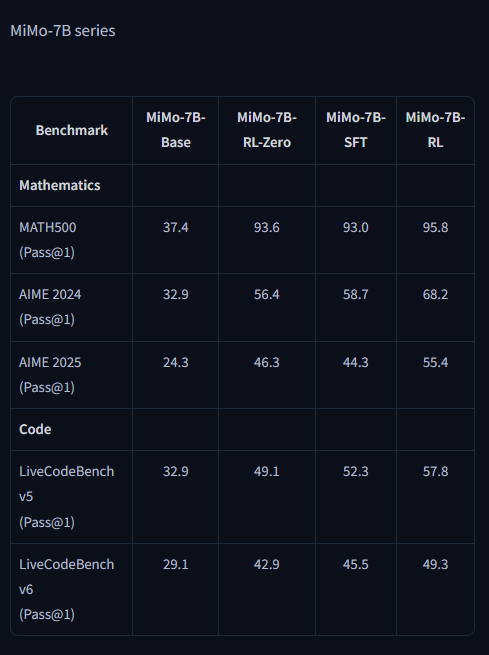
Since Xiaomi has kept emphasizing math and code, it’s basically safe to say the MiMo-7B model is essentially only useful for those two areas—don’t expect too much from the rest.
Source of information:Xiaomi
Source: KOCPC Chinese