


Since DeepSeek made its debut, the AI model space has reached a fever pitch. Not only have various AI services started letting free users experience the latest models and features right away, but it has also pushed OpenAI—which originally had no intention of working on open-weight language models—to change course, admit its strategic mistakes, and earlier even hinted that it would consider releasing new models.
And just recently, OpenAI’s CEO took to social media to announce that a new open-weight language model will be released within a few months. This would also be the first new one since GPT-2, and it should have many AI users excited.
OpenAI’s all-new powerful open-weight language model is coming soon and can be installed and run locally.
OpenAI CEO Sam Altman announced earlier on the X platform that the company will release an open-weight language model with reasoning capabilities in the coming months. He also stressed in the latter part that they had this idea for a long time, but it was delayed in the past due to other priorities—now is the time to make it happen.
We are excited to launch a powerful open-weight language model with strong reasoning capabilities in the coming months. We have high hopes for this model, hoping it will become a very, very impressive one.
TL;DR: we are excited to release a powerful new open-weight language model with reasoning in the coming months, and we want to talk to devs about how to make it maximally useful: https://t.co/XKB4XxjREV
we are excited to make this a very, very good model!
__
we are planning to…
— Sam Altman (@sama) March 31, 2025
Got to say, OpenAI is moving pretty fast this time. It was only in early February that they last talked about “standing on the wrong side of history,” and in just about two months, they’re already ready to roll out a new open-weight language model. Really looking forward to it.
As this news emerged, many in the AI community saw it as OpenAI’s response to DeepSeek’s R1 model from China, not wanting to be outdone. OpenAI has shifted toward a more open AI model strategy.
While it’s still unknown how powerful OpenAI’s new open-weight language model will be, judging from their recently updated GPT-4o image generation capabilities and the new GPT-4o version, it probably won’t disappoint.
Barring any surprises, the model will likely come in different parameter sizes, and it might not even require very powerful hardware to run.
Sam Altman also mentioned that before the official release, the model will be evaluated under OpenAI’s Preparedness Framework, just like other models, with additional safety risk assessments and preventive measures in place.
OpenAI technical team member Steven Heidel also reposted Altman’s post and added: “We are going to release a model this year that can run on your own hardware.”
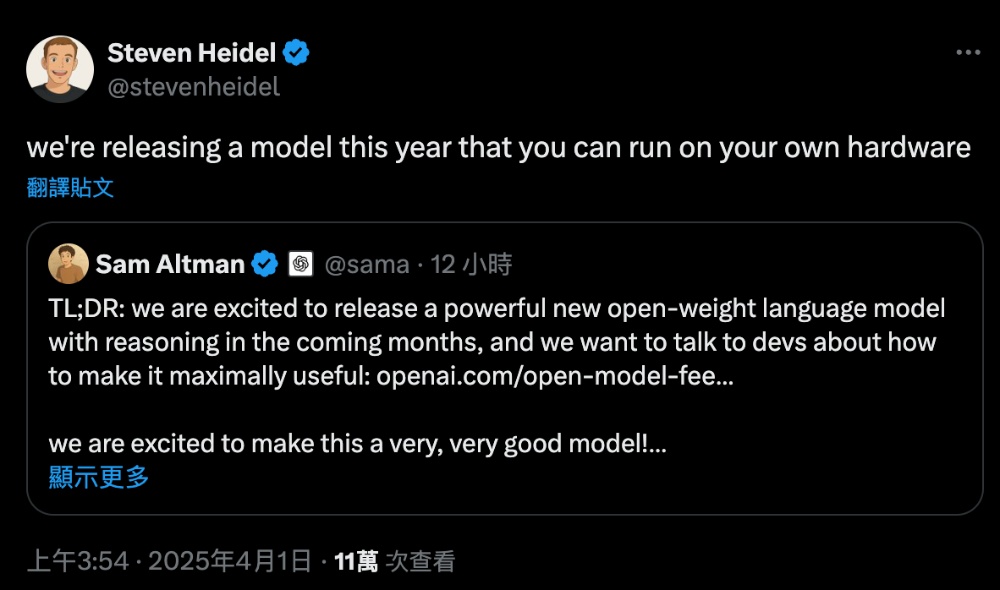
Unlike online models, open-weight models can be downloaded, modified, and deployed independently, which means lower costs and the ability to tailor them into suitable application models based on user and task requirements.
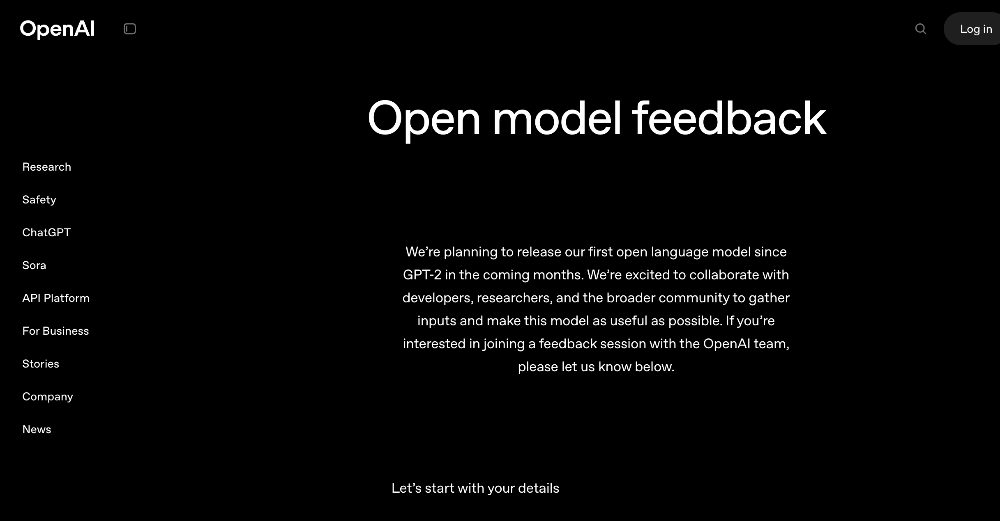
OpenAI also launched one today in sync. Open model feedback page, inviting developers to apply for early access. Altman said that over the next few weeks, a series of developer events will be held to showcase prototypes of the new model and gather feedback.
Now that OpenAI has entered the fray, competition in the open-weight language model space is bound to intensify.
Source: KOCPC Chinese