


Due to the spread of the epidemic, many companies and industries have adopted the method of working from home. Although productivity has not decreased, it is easy to neglect network security issues. According to research by the security agency CheckPoint, cyberattacks in the Asia-Pacific region increased significantly from April to May 2021, and Taiwan topped the list. This is not something to be happy about. This time I would like to share with you the precautionary awareness that companies and consumers should have in response to working from home.

Cyber attacks surge in May: Internet security matters you must pay attention to when working from home
According to data released by CheckPoint, cyberattacks in the Asia-Pacific region increased by 53% between April and May 2021, with Taiwan ranking fifth in the number of cyberattacks in the Asia-Pacific region, an increase of 17% compared to other months. Compared with the same period last year, the number of cyber attacks in the Asia-Pacific region as a whole increased by 168% in May, with each company suffering an average of 1,245 attacks per week. The malware types with the largest increase are the well-known ransomware and remote access Trojans (RAT). Compared with the beginning of 2021, both increased by 26% in May, while banking Trojans and Infostealer also increased by 10%. The most well-known case recently was that the servers of Omiai, a popular Japanese dating software, were attacked and more than 1.7 million user personal information was leaked, including driver’s licenses, passports and other documents submitted to prove age. Domino’s in India was also recently attacked by a network, and about 180 million user information was put for sale on the dark web.
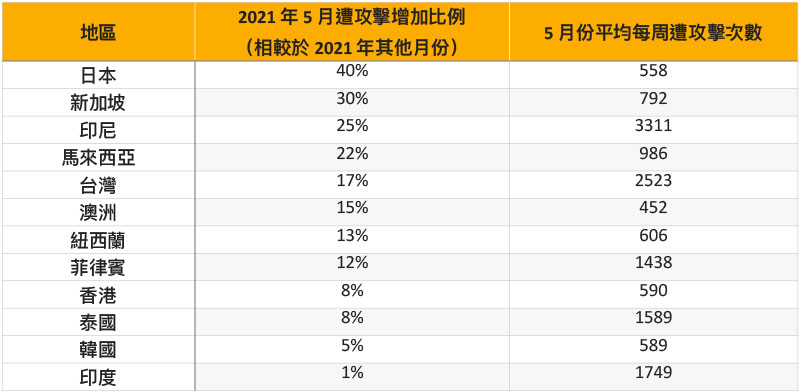
Recently, the Asia-Pacific region has begun to implement a new wave of work-from-home plans, which means that attackers have more security vulnerabilities to exploit. In addition, the “snowball effect” is also an important reason for the increase in attack incidents. When the probability of successful cyber attacks in the Asia-Pacific region is higher, more attackers will target this region. The industries with the largest increases in cyberattacks were utilities (39%), Internet service providers/hosted service providers (12%), and software (6%).

Faced with the overwhelming attacks launched by unscrupulous people, the author has also compiled security suggestions for enterprises and consumers for your reference. Don’t ignore the most basic security issues because of the deployment of working from home.
[Advice to businesses]
- Stay safe at all times
Instantly install the latest patches on all systems and software. Enterprise networks should be segmented for protection, and firewalls and intrusion prevention systems should be installed between segments to prevent viruses from spreading throughout the network. - Principle of least privilege access
Users and software should be given least privileged access; it is not necessary for all users to have administrator permissions on their PCs. - take precautions
Network attacks can not only be blocked, but also prevented, including zero-day attacks and unknown malware, all of which have the opportunity to be defended in advance. As long as the most appropriate security tools are used, even advanced cyber attacks can be successfully prevented without affecting corporate operations. - Consider all attack methods comprehensively
Including networks, mobile devices, clouds, terminals and IoT, every detail may contain opportunities that can be exploited by cyberattacks. - Get the latest threat intelligence at any time
Use all-round intelligence to proactively block threats and maintain normal business operations; use security services to monitor corporate networks and security incident response (Incident Response) to quickly respond and resolve cyber attacks.

[Advice to consumers]
- Check your inbox for complete email addresses and watch for misspelled hyperlinks.
- To confirm the authenticity of the URL, we recommend that you do not click directly on the URL in the email. Instead, use the link in the Google search results page.
- Be wary of similar domain names, misspellings in emails or websites, and unknown emails.
- Use advanced network security solutions to protect web browsing on mobile devices and terminal devices to prevent users from accidentally entering known or unknown phishing websites.
- Use two-factor authentication when there are any changes to account information or wire transfer instructions.
- Never send login credentials or personal information back to text messages or emails.
- Review your financial accounts regularly.
- All software and systems are updated instantly.

If the company you have purchased from is attacked by a network and personal information may be leaked, it is recommended to take the following measures:
- Use password management software to instantly update all passwords to stronger versions.
- Try to use two-factor authentication, which actually involves two verification steps.
- If you believe that personal credentials (such as your ID card or driver’s license information) have been compromised, please apply for new credentials from the relevant authorities.
- If your credit card is stolen, please contact your bank to freeze it and replace it.
- When your email address or mobile phone number has been compromised, be especially wary of links in emails and text messages. Scammers will use this information to make phishing or scam calls.
- Install security software on your device to protect against malware attacks and data leaks, and to safely visit websites and conduct online transactions.
Source: KOCPC Chinese