


Qualcomm officially announced two new flagship smartphone chips at Snapdragon Summit 2026: the Snapdragon 8 Elite Extreme Gen 6 (hereinafter referred to as 8EE6) and the Snapdragon 8 Elite Gen 6. They are officially positioned as a dual-flagship strategy for the “agentic AI era,” and both use TSMC’s 2nm process. Among them, the 8EE6 is Qualcomm’s most powerful mobile platform ever, officially claimed to feature the world’s first 5GHz smartphone CPU. Tech channel Geekerwan obtained a Qualcomm QRD engineering device before the launch, and even got hold of an 8EE6 chip to dissect, completely tearing it down from packaging and dieshot to actual power efficiency testing.
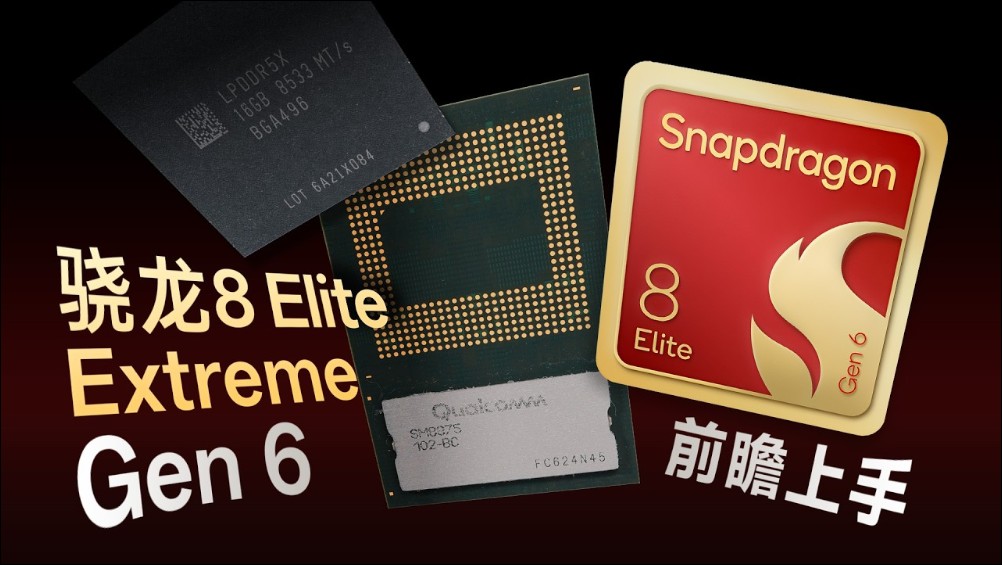
This time Qualcomm launched two flagships at once, expanding its product line from a single flagship into a “dual-flagship” lineup: the 8EE6 pushes the high end, while the 8 Elite Gen 6 covers more premium models. The official partner list includes Honor, iQOO, Motorola, OnePlus, OPPO, Redmi, RedMagic, vivo, and Xiaomi, meaning all the first-tier Android manufacturers are on board.
Renaming and Offset PoP Packaging: Thermal Innovation but Larger Package
At the beginning, Yunfei joked that Qualcomm had “changed its name yet again—again, again, and again—as if afraid people would remember it.” The official Chinese name for this generation is “Sixth-Generation Snapdragon 8 Super Supreme Edition,” while the English name is 8 Elite Extreme Gen 6, which he directly abbreviates as 8EE6. The reason the chip’s appearance is so “unusually built” lies in a packaging innovation: this time Qualcomm uses a packaging called Offset PoP, maintaining the PoP architecture (with memory stacked above the SoC) but offsetting the memory dies from the SoC below, freeing up space above the SoC for a thermal block.
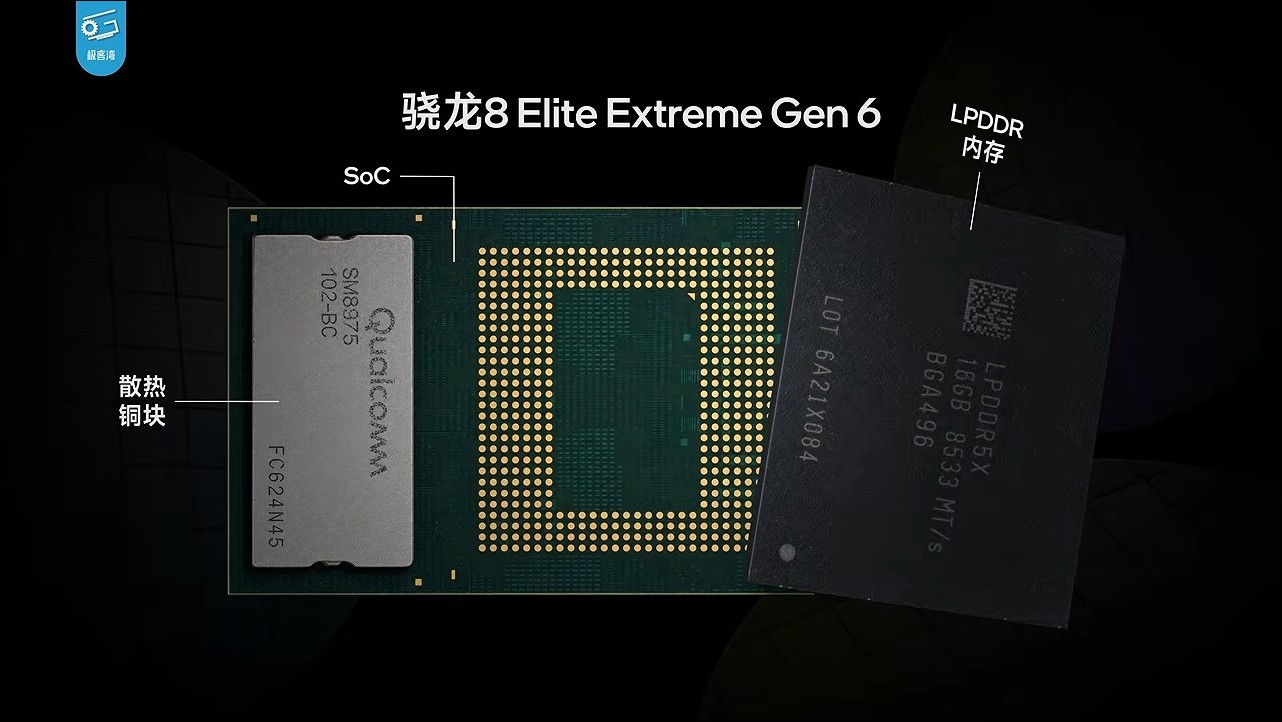
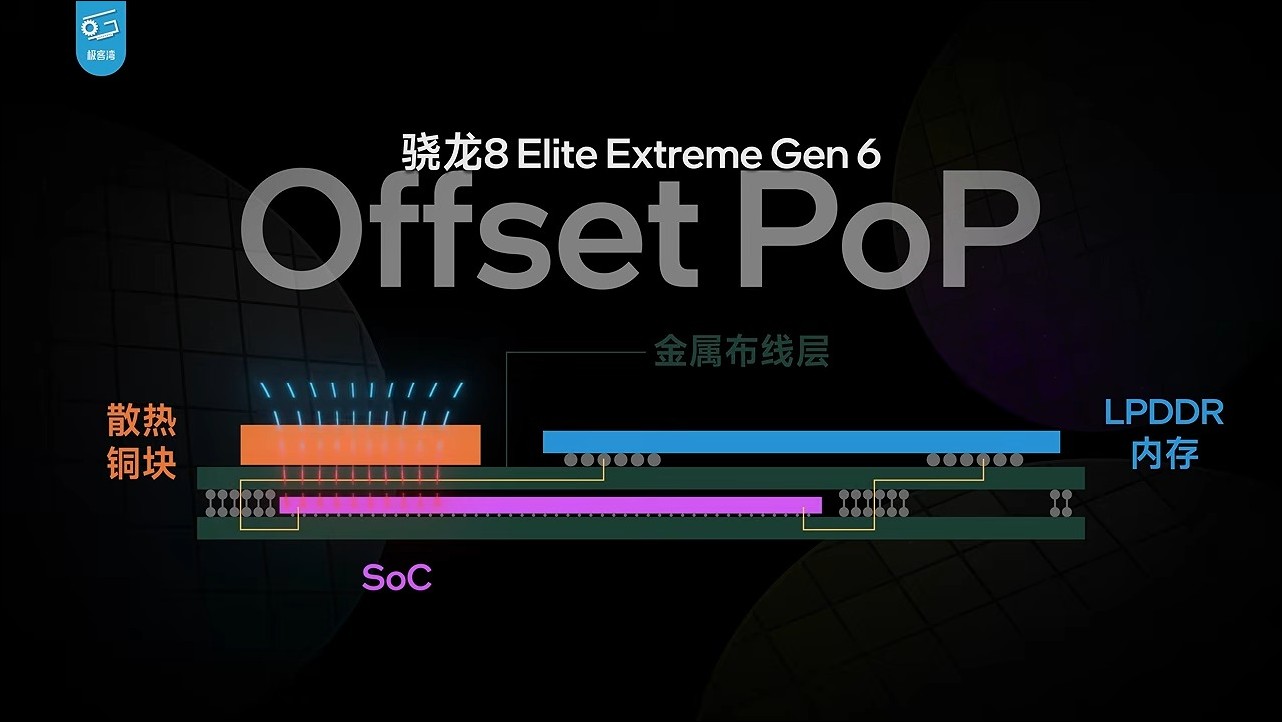
Although the heat spreader still cannot directly contact the core, it conducts heat much better than through a layer of memory dies. According to Qualcomm internal test data, the new package takes more than twice as long to hit the 105-degree thermal wall. The trade-off is a larger package area; the 8EE6 has the largest package of this generation.
Chip Anatomy: Minor CPU Tweaks, Major Cache Structure Overhaul
The die shot after package removal shows the core area is slightly larger than the previous-generation 8 Elite Gen 5 (8E5). The CPU retains a 2 ultra-large cores + 6 efficiency cores configuration; the ultra-large core architecture is largely unchanged, retaining 9-wide decode. The biggest breakthrough is that the maximum frequency finally reaches 5GHz; previous leaks gave the clock combination as 5.01GHz, 4.03GHz, and 3.74GHz. Officials no longer disclose the core breakdown, only stating “2 big cores up to 5GHz + 6 performance cores up to 4GHz.”
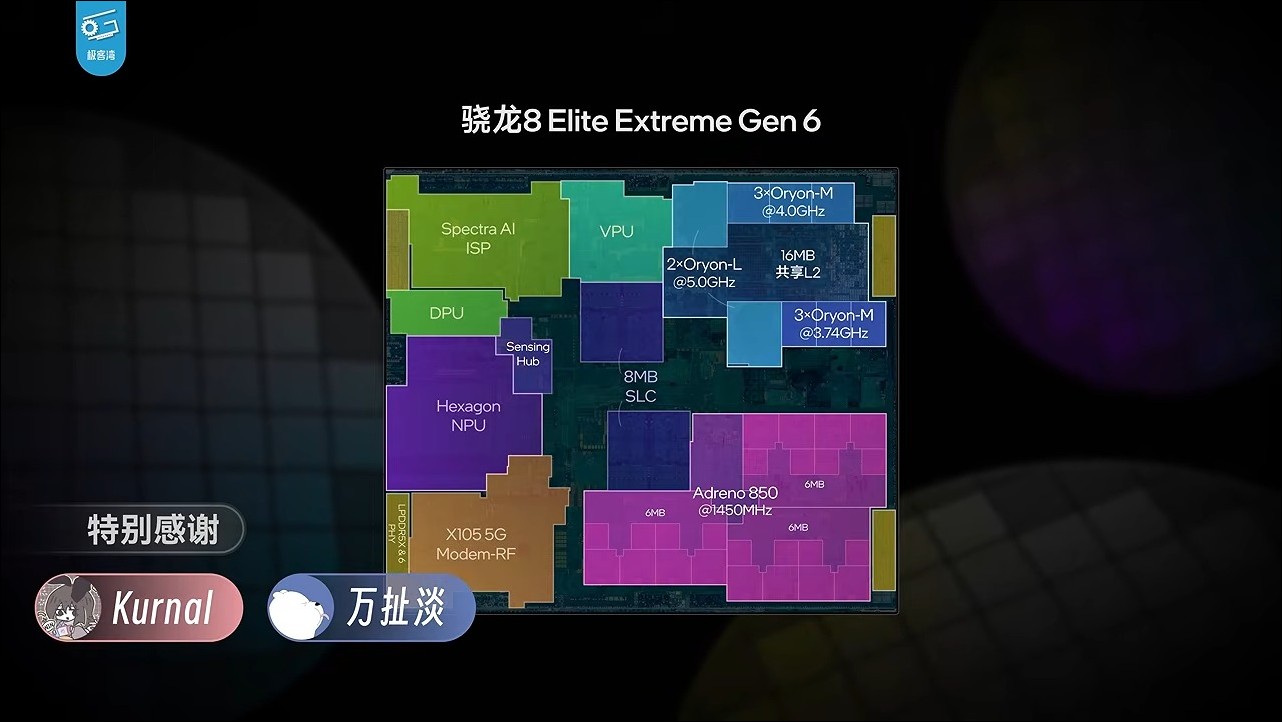
The biggest upgrade is in the efficiency cores: decode width has increased from 4-wide to 5-wide, which greatly helps energy efficiency and multi-core efficiency for games with medium loads running at 60 fps; the six efficiency cores are also split into two groups, high-frequency (4GHz) and low-frequency (3.7GHz), making the overall configuration a 2+3+3 three-cluster setup. Coincidentally, MediaTek Dimensity 9600 Pro also has a 2+3+3 architecture and also uses TSMC’s N2P process.
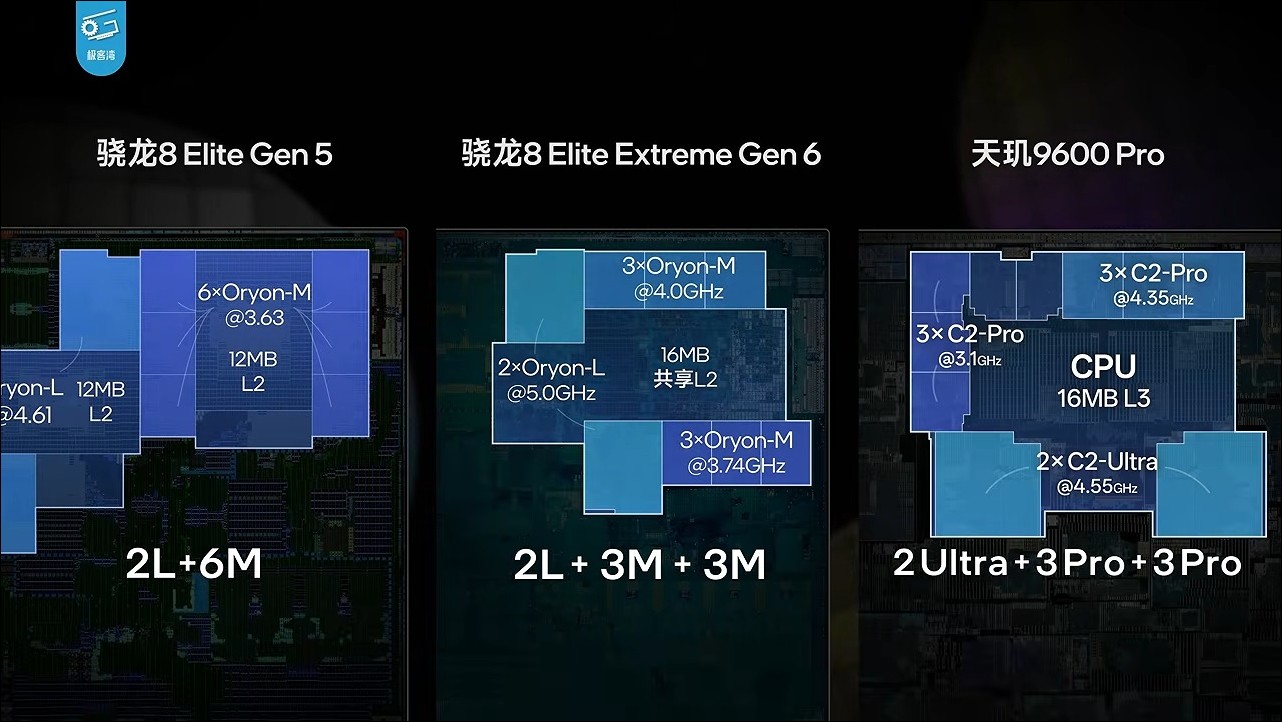
The cache structure has also changed significantly: the previous generation’s prime cores and efficiency cores each shared 12MB of L2, while 8EE6 now has all 8 cores sharing 16MB of L2. Qualcomm was relatively restrained with this generation’s CPU iteration; the upside is that the CPU area shrank by nearly a quarter, and the saved area went to the LPDDR6 memory controller and GPU. Geekerwan also tested 8EE6 and found it improved inter-core latency, with communication between the prime cores and efficiency cores smoother than in the previous generation.
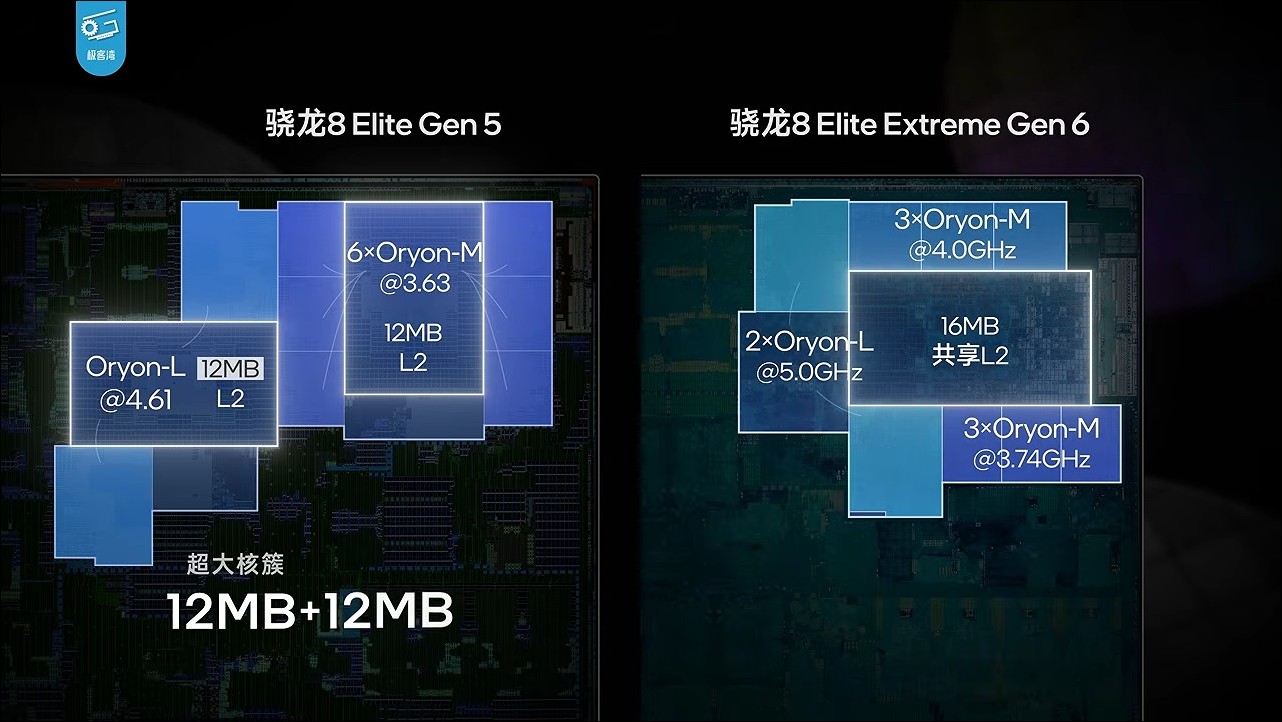
5GHz is the first time a mobile CPU has crossed this threshold, but Geekerwan’s overall assessment of the CPU is that it is “relatively restrained.” It cedes area budget to the GPU and memory controller, reflecting Qualcomm’s judgment: the growth engine for mobile computing has shifted from CPU to GPU and AI.
Major GPU Overhaul: Adreno Matrix Cores and ANF Super Resolution and Frame Interpolation
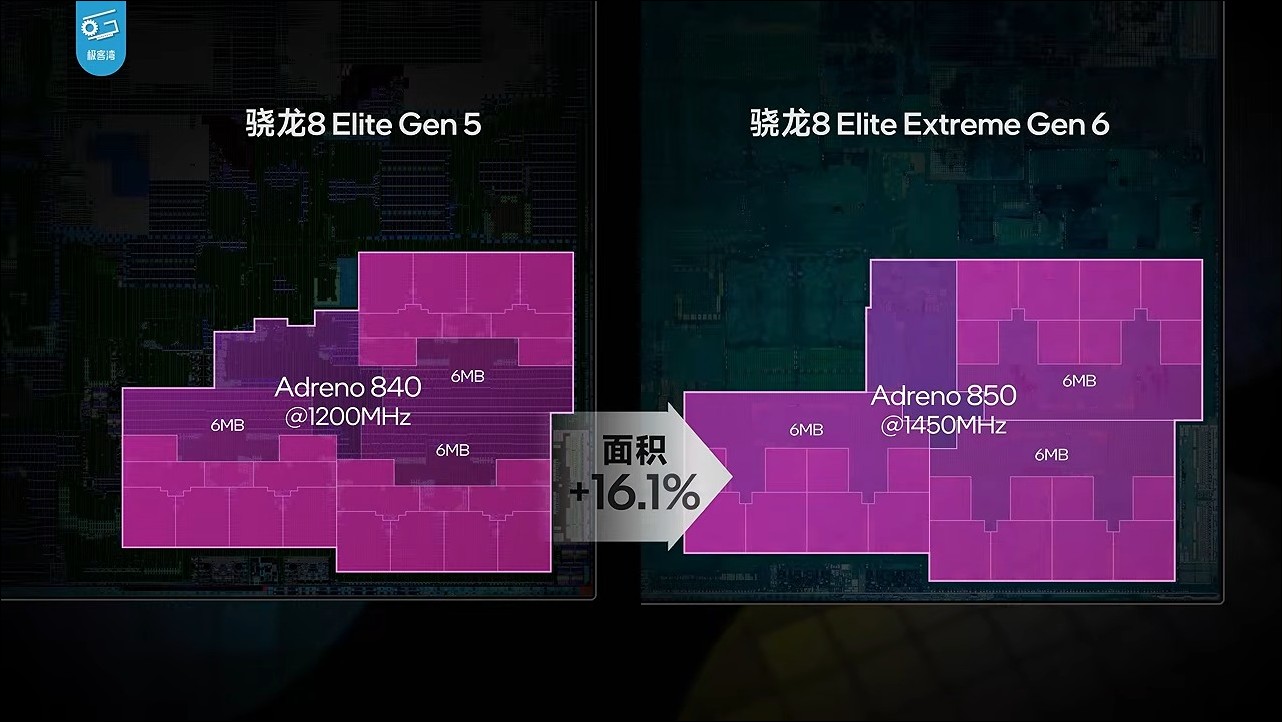
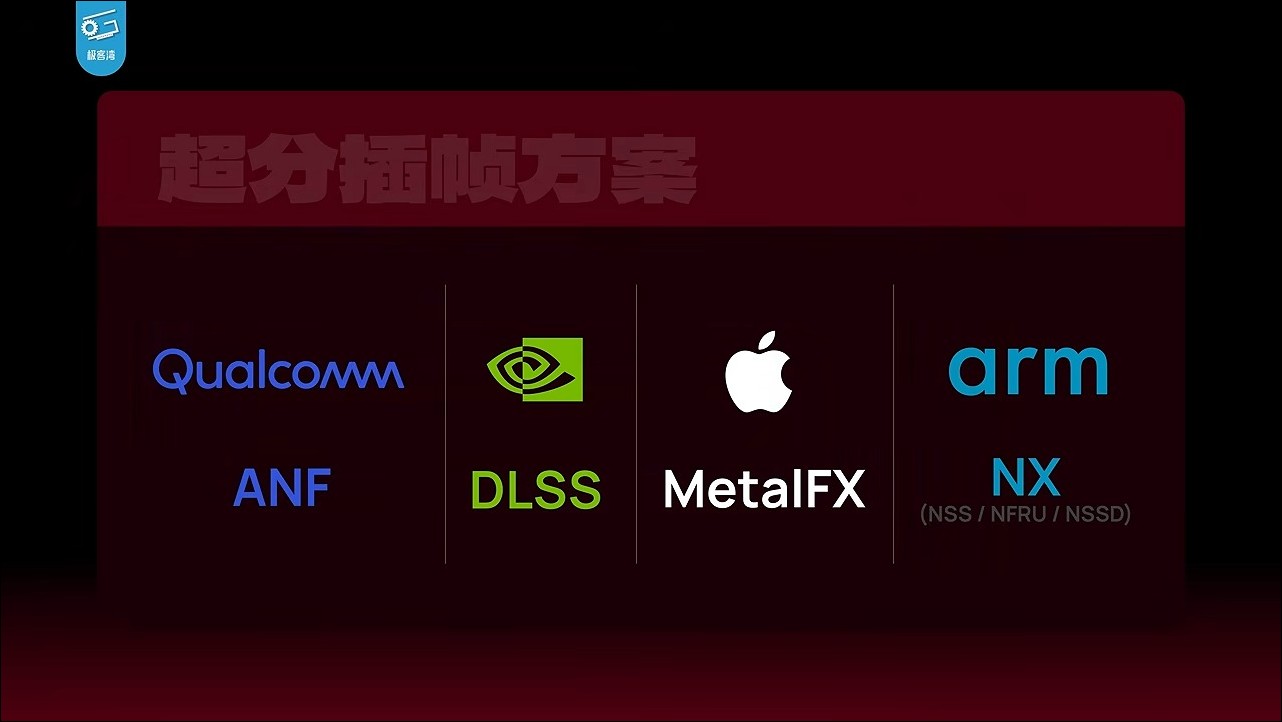
The 8EE6’s GPU area is considerably larger than the 8E5’s; it keeps 3 Slice but has very extensive internal changes. In addition to upgraded graphics performance and more ray-tracing units, Qualcomm has added “Qualcomm-style Tensor Cores” to a GPU for the first time, officially called Adreno Matrix Cores; the accompanying “Qualcomm-style DLSS” is called Adreno Neural Fusion (ANF), which can perform AI super-resolution and frame interpolation.
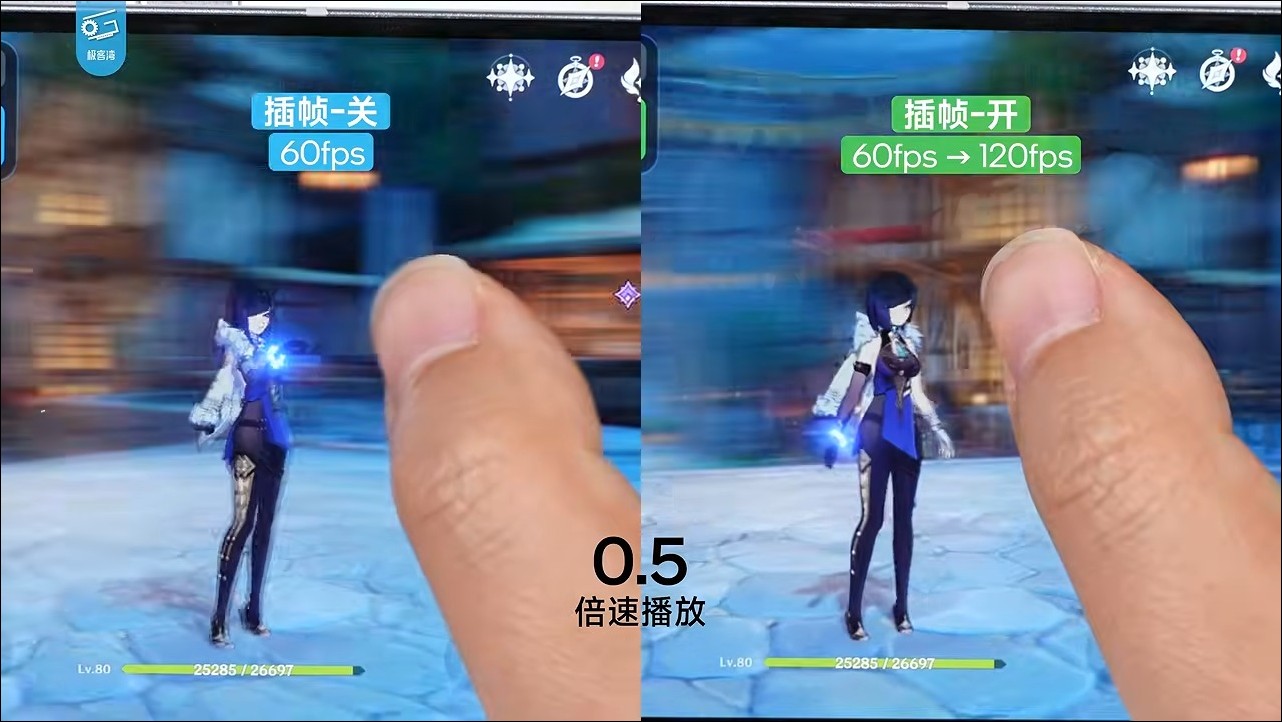
Geekerwan tested ANF super-resolution frame interpolation in Genshin Impact: interpolating 60 fps to 120 fps “no longer feels noticeably delayed—it’s quite smooth.” Another benefit of dedicated units in the GPU is lower overhead; ANF’s power consumption is already close to that of an external display enhancement chip, while delivering better results than external solutions. In key games such as Naraka: Bladepoint and Honkai: Star Rail, ANF brings 40% improvements in power consumption and performance, and Qualcomm will also integrate it into game engines to facilitate future support.
Qualcomm also told Geekerwan that Adreno Matrix Cores are not dedicated to graphics like Arm’s NX; instead, like Apple’s and NVIDIA’s approaches, they are programmable and can be used for AI acceleration and neural network computing. As mobile GPUs enter the era of “built-in AI matrix units,” super-resolution and frame interpolation move from external chips into the GPU, delivering gains in both power consumption and visual quality. Programmable matrix cores also leave options open for the future, essentially pushing mobile GPUs in the direction of small AI accelerators.
PC Game Translation and New NPU Module
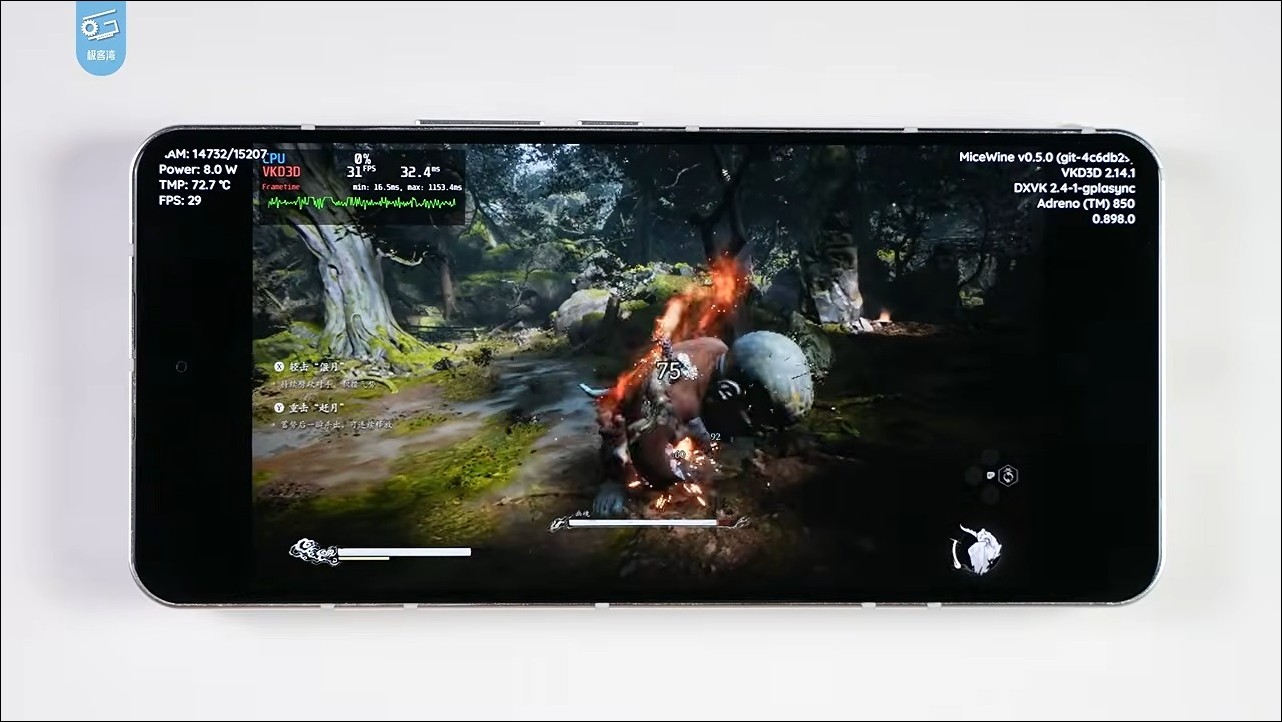
A friend at Qualcomm also shared some good news: the company is starting to take PC game translation seriously and is no longer relying solely on the community’s open-source Mesa Turnip driver, but is writing its own driver. Geekerwan tested Cyberpunk 2077 and Black Myth: Wukong, and both ran smoothly translated in DX12 mode. In the future, it also wants to try directly supporting DX12 drivers on Android, which would be more efficient.
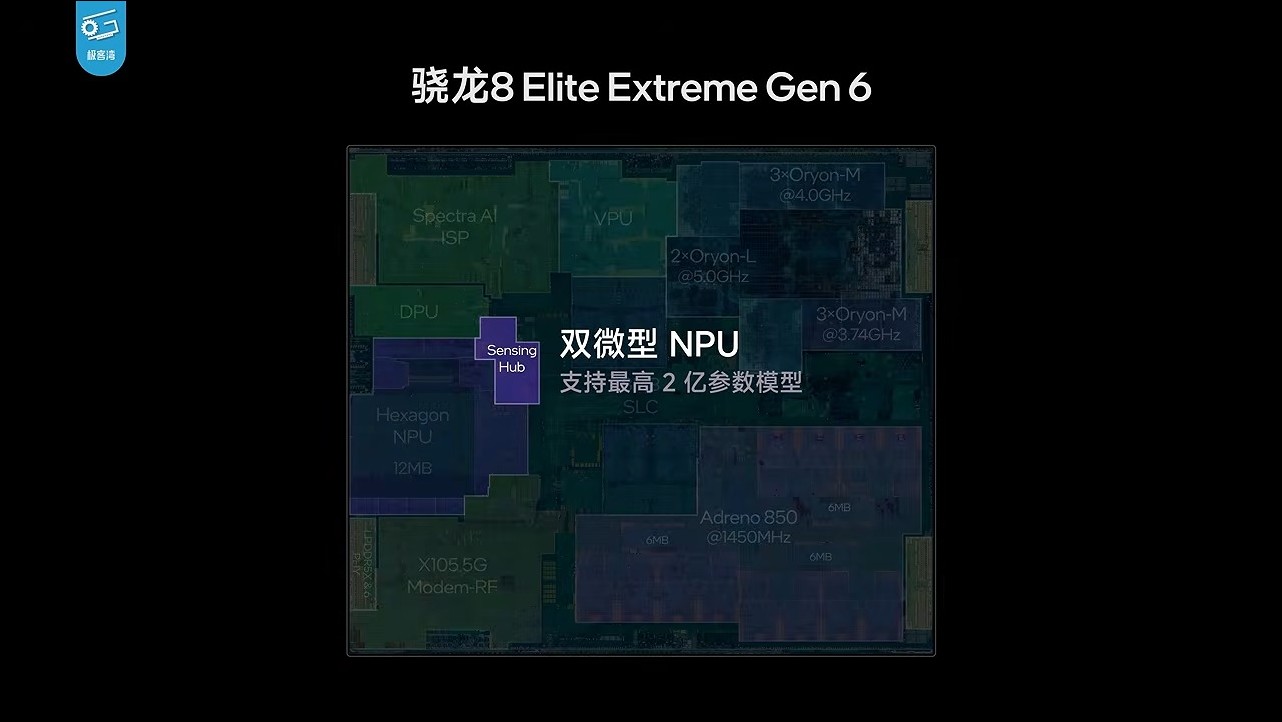
On the NPU side, the 8EE6 does not multiply its NPU like Apple does, but it is still substantial: it adds a module named Element Accelerator that hardwires some operators for Transformer models and accelerates them in hardware. Qualcomm also emphasizes giving more modules their own AI acceleration capabilities: the Sensing Hub responsible for sensor perception has dual micro NPUs and an independent memory architecture built in, so always-on sensing tasks are processed directly within the module, reducing main CPU wake-ups to lower power consumption. Tom’s Guide believes the Sensing Hub is the core of the agentic AI loop spanning the CPU, GPU, and NPU.
The official takeover of translation drivers pulls “playing AAA games on phones” out of community self-hype and into an official support roadmap, a positive signal for handhelds and the mobile gaming ecosystem. AI acceleration, meanwhile, is spreading from a single NPU point to dedicated hardware throughout the GPU and Sensing Hub, preparing for always-on agentic AI.
Power efficiency tested: CPU is conservative, GPU shows clear improvement.
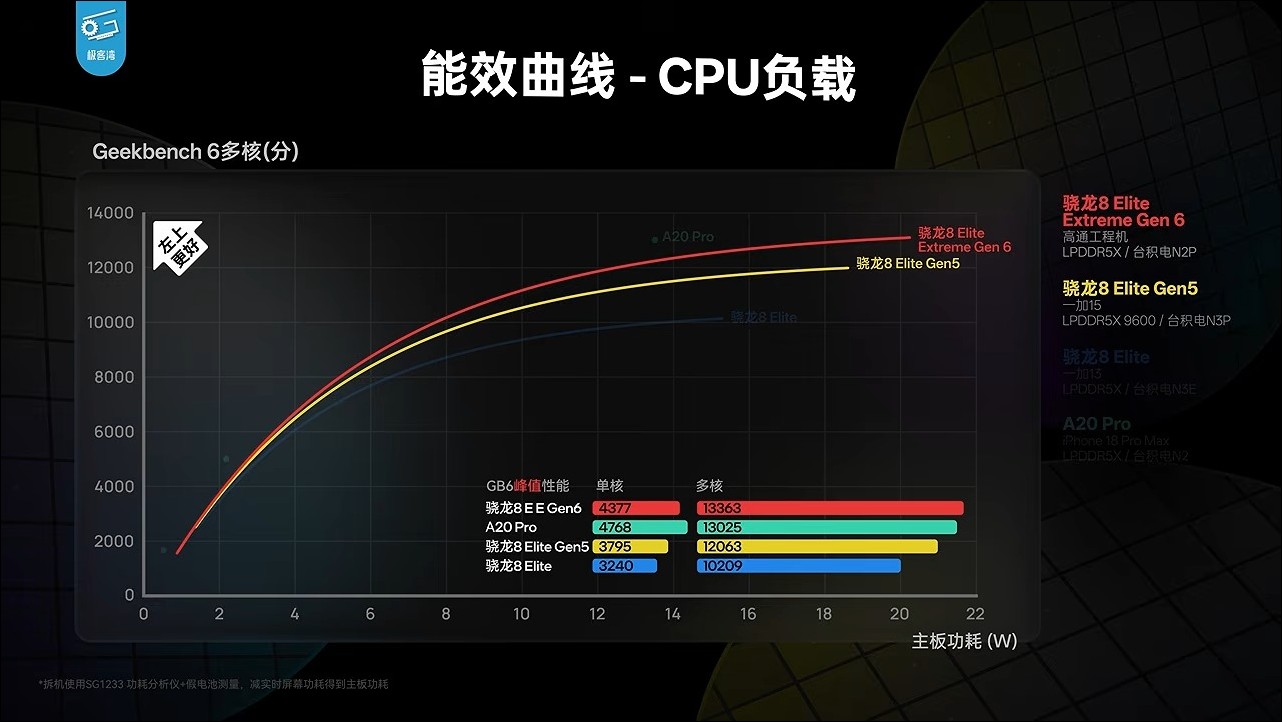
Geekerwan measured the energy efficiency curve on a QRD engineering sample. In Geekbench 6, multi-core efficiency shows some improvement over the 8E5 in the mid-to-high frequency range, but overall efficiency “definitely isn’t a particularly huge CPU generational iteration,” and there’s still a gap compared with Apple’s A20 Pro. Single-core scored 4,377 points thanks to an ultra-high 5GHz frequency, which counts as an improvement. The Geekbench 7 results are much better: the Oryon architecture is “right at home” in GB7, with multi-core efficiency having caught up to the A20 Pro in the high-frequency portion, while still lagging somewhat at mid-to-low frequencies.
The GPU is the highlight of this generation, and the 3DMark Steel Nomad Light efficiency curve has improved considerably. From 8 Elite to 8E5, the GPU has made almost no real progress; the low-frequency efficiency gains on 8EE6 are especially pronounced. At low frequencies it comes close to A20 Pro, while at high frequencies there is still a gap with Apple, but mobile games mainly depend on low frequencies, so the impact on actual gaming is minimal.
Real-world gaming test: mid-to-low-load power efficiency is a pleasant surprise (⏱️ 08:09-09:44)
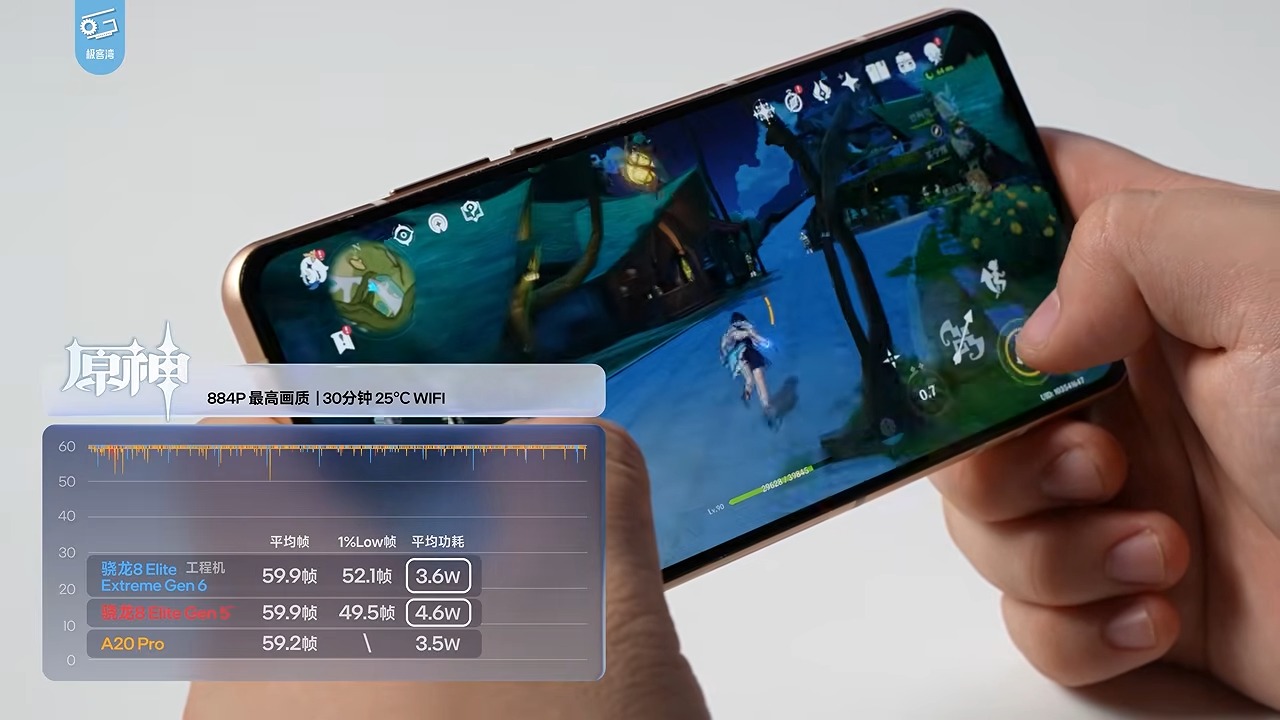
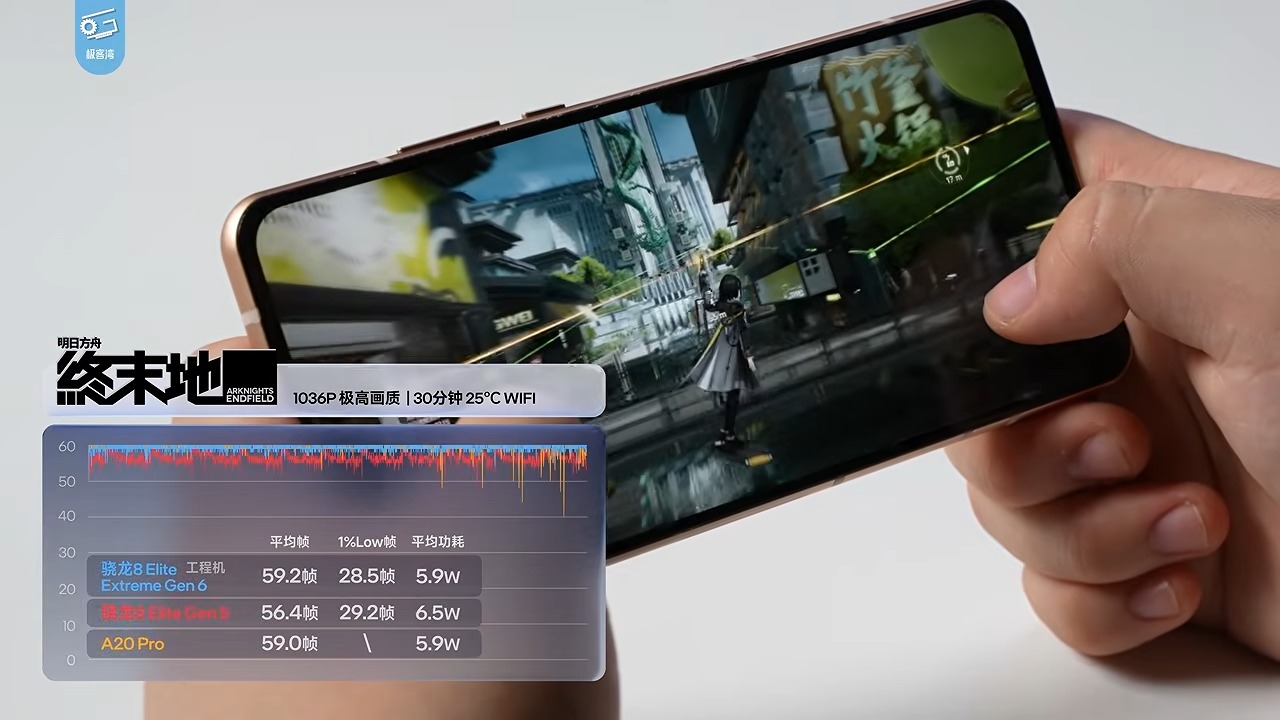
The real-world test results for four games were unexpected. In Genshin Impact at 884P on Very High graphics, running around Sumeru City held full frame rate without issue, and power consumption was much lower than 8E5, already approaching the A20 Pro, which has a major advantage in Genshin Impact. In Arknights: Endfield at 1036P on Very High graphics, a 30-minute run through Wuling City came closer to full frame rate than 8E5 with lower power consumption, also approaching the A20 Pro’s level.
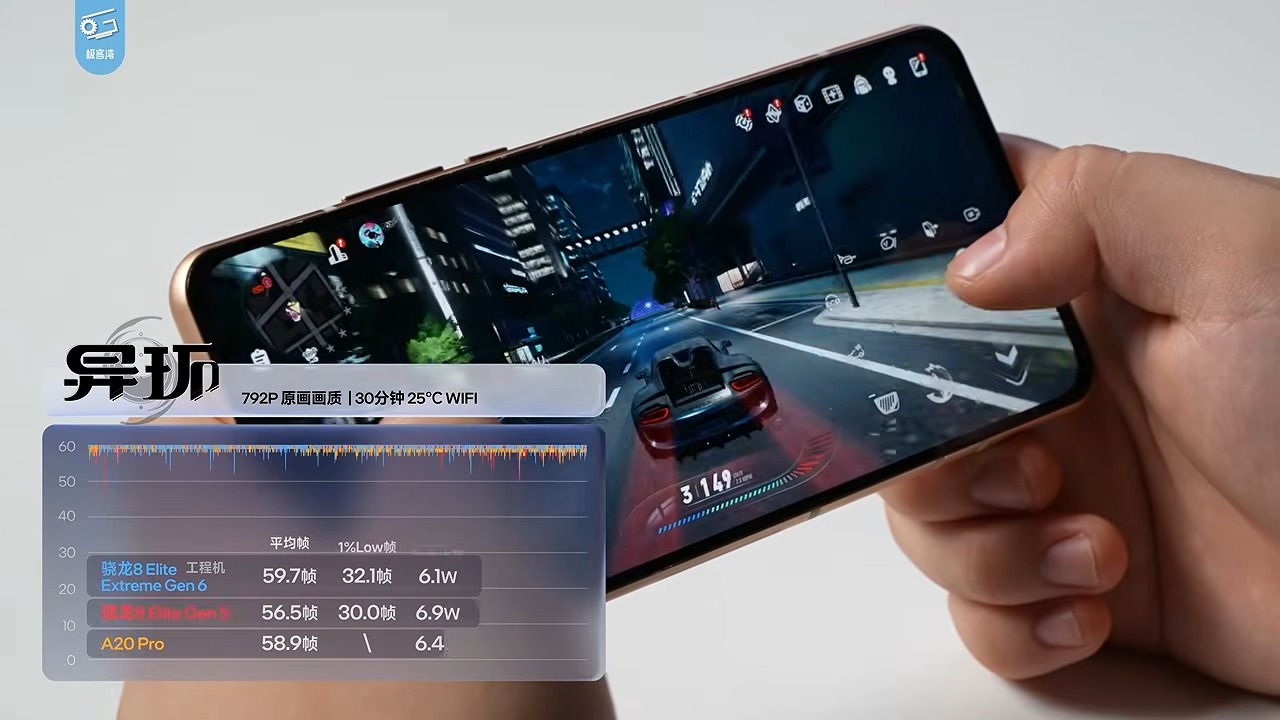
In the more demanding driving test in Neverness to Everness, it nearly hit a full 60 FPS, with power consumption considerably lower than the 8E5 and even lower than the A20 Pro. The Android version of Wuthering Waves supports 1080P ultra-high resolution; in Xuanfang City, the 8EE6 kept power consumption at 7.4W during motorcycle traversal while still averaging 58.4 FPS.
The power-efficiency curve is restrained, yet real-world gaming delivers surprises—the key lies in power consumption control under medium-load scenarios. For most players, whether the phone gets hot and how much battery it drains after an hour of gaming determines the experience more than benchmark rankings.
Summary and Outlook
To sum up this hands-on engineering sample’s performance: the efficiency curve improvement is relatively limited, but actual gaming performance is worth looking forward to, and medium-load gaming efficiency is “something of a pleasant surprise.” Commercial devices from various brands equipped with the 8EE6 will arrive soon, and Geekerwan promises to review them one by one and to buy retail units from all brands as soon as possible for a major chip efficiency comparison, to check “which brand’s engineering samples have been most heavily specially tuned.”
The official mass-production timeline has also been revealed: new flagship phones from Honor, iQOO, Motorola, OnePlus, OPPO, Redmi, RedMagic, vivo, and Xiaomi will arrive one after another, and the Motorola Signature 27 has been confirmed to feature the 8EE6 plus a 2-megapixel periscope lens. From 5GHz super cores and GPU-integrated matrix cores to Offset PoP packaging, the biggest question the 8EE6 leaves for retail devices is still thermal stacking and the level of custom tuning; real-world testing of commercial devices over the next month will provide the answer.
Source: KOCPC Chinese