


As rumored, Qualcomm officially unveiled the Snapdragon 8 Elite Gen 6 series earlier at its Snapdragon Summit 2026 event. This time, it launched two models at once: besides the standard version succeeding last year’s Snapdragon 8 Elite Gen 5, there is also a higher-tier Snapdragon 8 Elite Extreme Gen 6, the “Pro” version that had been rumored for months, which is finally officially named Extreme.
Both models are Qualcomm’s first batch of mobile chips built on TSMC’s 2nm process. The maximum CPU clock speed has been raised to 5GHz, marking the first time a mobile CPU has crossed the 5GHz threshold, while the Extreme version’s GPU performance is 44% higher than the previous generation.
Image source: Qualcomm
Snapdragon 8 Elite Gen 6 series officially announced! The first 2nm chip, with the Extreme version’s CPU reaching 5GHz and GPU performance up 44%.
Both the Snapdragon 8 Elite Gen 6 and Snapdragon 8 Elite Extreme Gen 6 are flagship-tier smartphone chips, both manufactured using TSMC’s 2nm process, and both CPUs consist of 2 5.00GHz Prime cores plus 6 performance cores at up to 4.00GHz. Compared with the previous generation Snapdragon 8 Elite Gen 5, the standard version delivers 10% higher CPU performance and 35% higher GPU performance, while the Extreme version delivers 13% higher CPU performance and 44% higher GPU performance. Both models improve CPU power efficiency by 37%.
Qualcomm said that the standard version is the successor to the Snapdragon 8 Elite Gen 5, while the Extreme version goes one tier higher, giving smartphone brands more options.
As mentioned earlier, the CPU architecture of both models is exactly the same, both featuring an 8-core Oryon CPU paired with 16MB of Oryon Flex Cache, dynamically allocated based on workload.
The previous generation Snapdragon 8 Elite Gen 5 had a 4.6GHz Prime core and 3.62GHz performance cores, while this Snapdragon 8 Elite Gen 6 series increases them to 5.0GHz and 4.0GHz respectively, with clock speeds up by about 9% and 10%. Memory still supports up to 24GB, while storage is upgraded to UFS 5.0.
Both Snapdragon 8 Elite Gen 6 and Snapdragon 8 Elite Extreme Gen 6 support both LPDDR5X and LPDDR6, with a maximum frequency of 5,300MHz and up to 24GB capacity. In other words, whether phones actually released on the market use LPDDR5X or LPDDR6 depends on each phone brand’s product configuration.

Image source: Qualcomm
The real difference between the two models lies in GPU, AI, and video recording.
The GPU is one of the biggest highlights of the Extreme Edition, incorporating Adreno Matrix Cores dedicated to AI computing and paired with Adreno High Performance Memory (HPM). HPM is high-speed on-chip memory dedicated to the GPU, allowing image data, the Frame Buffer, and intermediate results from AI computations to remain near the GPU for processing as much as possible, without frequently accessing the phone’s LPDDR main memory, helping reduce latency and power consumption.
The previous-generation Snapdragon 8 Elite Gen 5 actually already featured 18MB HPM. This Extreme version also comes with 18MB HPM and further accelerates Adreno Neural Fusion through new Adreno Matrix Cores. This technology combines AI Super Resolution and AI Frame Generation, enabling AI-powered in-game image super-resolution and frame interpolation.
As for the regular Snapdragon 8 Elite Gen 6, the official specifications page does not list Adreno Matrix Cores. However, the latest official developer documentation shows that Adreno Neural Fusion supports the Snapdragon 8 Elite Gen 6 and later platforms, and that on devices without Matrix Cores, it can also run through coordinated GPU and NPU computing. Therefore, it cannot currently be concluded that Neural Fusion is an exclusive feature of the Extreme version; the two chips may use different hardware to execute this technology.
In terms of video recording specs, the standard version maxes out at 8K 30fps and 4K 120fps slow motion, while the Extreme version offers 8K 60fps and 4K 240fps slow motion, plus an APV professional video codec and what is claimed to be the world’s first hardware H.266 (VVC) decoder.
Below is a specification comparison between the two Gen 6 models and the previous-generation Gen 5:
| Specifications | Snapdragon 8 Elite Extreme Gen 6 | Snapdragon 8 Elite Gen 6 | Snapdragon 8 Elite Gen 5 (previous generation) |
|---|---|---|---|
| manufacturing process | TSMC 2nm | TSMC 2nm | TSMC 3nm (N3P) |
| CPU architecture | Oryon 8 cores (2+6) | 8 Oryon cores (2+6) | Oryon 8-core (2+6) |
| Prime Core Clock | Up to 5.00GHz | Up to 5.00GHz | Up to 4.74GHz |
| Performance core clock speed | Up to 4.00GHz | Up to 4.00GHz | Up to 3.62GHz |
| CPU cache | 16MB Oryon Flex Cache | 16MB Oryon Flex Cache | 12MB L2 per cluster (24MB total) |
| GPU | Adreno GPU (including Matrix Cores) | Adreno GPU (including Matrix Cores) | Adreno 840 |
| High-performance GPU memory | 18MB Adreno HPM | 12MB Adreno HPM | 18MB Adreno HPM |
| AI gaming technology | Adreno Neural Fusion AI Super Resolution + AI Frame Interpolation |
Adreno Neural Fusion AI Super Resolution + AI Frame Interpolation |
Snapdragon Game Super Resolution 2.0 Adreno Frame Motion Engine 3.0 |
| NPU | Hexagon NPU (newly added Element Accelerator) | Hexagon NPU (newly added Element Accelerator) | Hexagon NPU |
| memory | LPDDR5X/LPDDR6 Up to 24GB, 5300MHz |
LPDDR5X/LPDDR6 Up to 24GB, 5300MHz |
LPDDR5X, up to 24GB |
| Save | UFS 5.0 | UFS 5.0 | UFS 4.1 |
| Maximum video recording specification | 8K 60fps 4K 240fps slow motion |
8K 30fps 4K 120fps slow motion |
4K 120fps 1080p 480fps slow motion |
| Video codec | H.266/H.265/VP9/AV1 hardware decoding Supports APV recording |
H.265/VP9/AV1 hardware decoding | H.265/VP9/AV1 hardware decoding Supports APV recording |
| Camera ISP | Three 20-bit AI ISPs Up to 320 megapixels |
Three 20-bit AI ISPs Up to 320 megapixels |
Three 20-bit AI ISPs Up to 320 megapixels |
| Display support | 4K+ 120Hz/QHD+ 240Hz | 4K+ 120Hz/QHD+ 240Hz | 4K+ 120Hz/QHD+ 240Hz |
| 5G modem | Snapdragon X105 Download 14.8Gbps / Upload 4.2Gbps |
Snapdragon X105 Download 14.8Gbps / Upload 4.2Gbps |
Snapdragon X85 Download 12.5Gbps / Upload 3.7Gbps |
| Wi-Fi | FastConnect 8800 Wi-Fi 8, up to 11.6Gbps |
FastConnect 8800 Wi-Fi 8, up to 11.6Gbps |
Wi-Fi 7 |
| Bluetooth | Bluetooth 6.0 | Bluetooth 6.0 | Bluetooth 6.0 |
From the spec sheet, you can see that this next-generation Hexagon NPU adds an Element Accelerator specifically to accelerate the Transformer workloads common in large language models. The overall configuration has also been upgraded to 12 Scalar, 8 Vector, 1 Tensor, plus 1 new Element Accelerator.
The Extreme version’s NPU shared memory capacity is also 50% higher than the previous generation, allowing more model states, Activations, and intermediate computation data to remain on-chip, reducing the latency and power consumption caused by frequent external memory access. Qualcomm says this architecture can already run MoE models with around 30 billion parameters on smartphones, while when generating each token, only about 3 billion parameters actually need to be activated, thereby reducing compute and memory bandwidth requirements.
Now that we’ve covered the specs, let’s take a look at performance.

Image source: Qualcomm
Qualcomm says that, apart from CPU power efficiency and GPU power efficiency being the same, the Extreme version is a notch higher than the regular version in all other metrics. The biggest gap is in the NPU: the regular version has only a 14% increase, while the Extreme version has a 35% increase.
| vs Snapdragon 8 Elite Gen 5 | Snapdragon8 Elite Extreme Gen 6 | Snapdragon 8 Elite Gen 6 |
|---|---|---|
| CPU performance | +13% | +10% |
| CPU energy efficiency | +37% | +37% |
| GPU performance | +44% | +35% |
| GPU energy efficiency | +40% | +40% |
| NPU performance | +35% | +14% |
| AI performance per watt | +33% | +20% |
Foreign media AndroidHeadlines Benchmark results for Qualcomm’s reference device have been shared; this unit is equipped with 24GB LPDDR5X memory and 1TB UFS 5.0,
AnTuTu scored 5,522,833 points, while the previous-generation 8 Elite Gen 5 reference device scored 4,084,711, about 35% more. In Geekbench 6, single-core scored 4,329, multi-core 12,748, and GPU 29,021, compared with the previous generation’s 3,739, 12,101, and 23,721, increases of about 16%, 5%, and 22%, respectively. Multi-core improved by only 5%, still some way off the official claim of +10%–13% CPU performance:
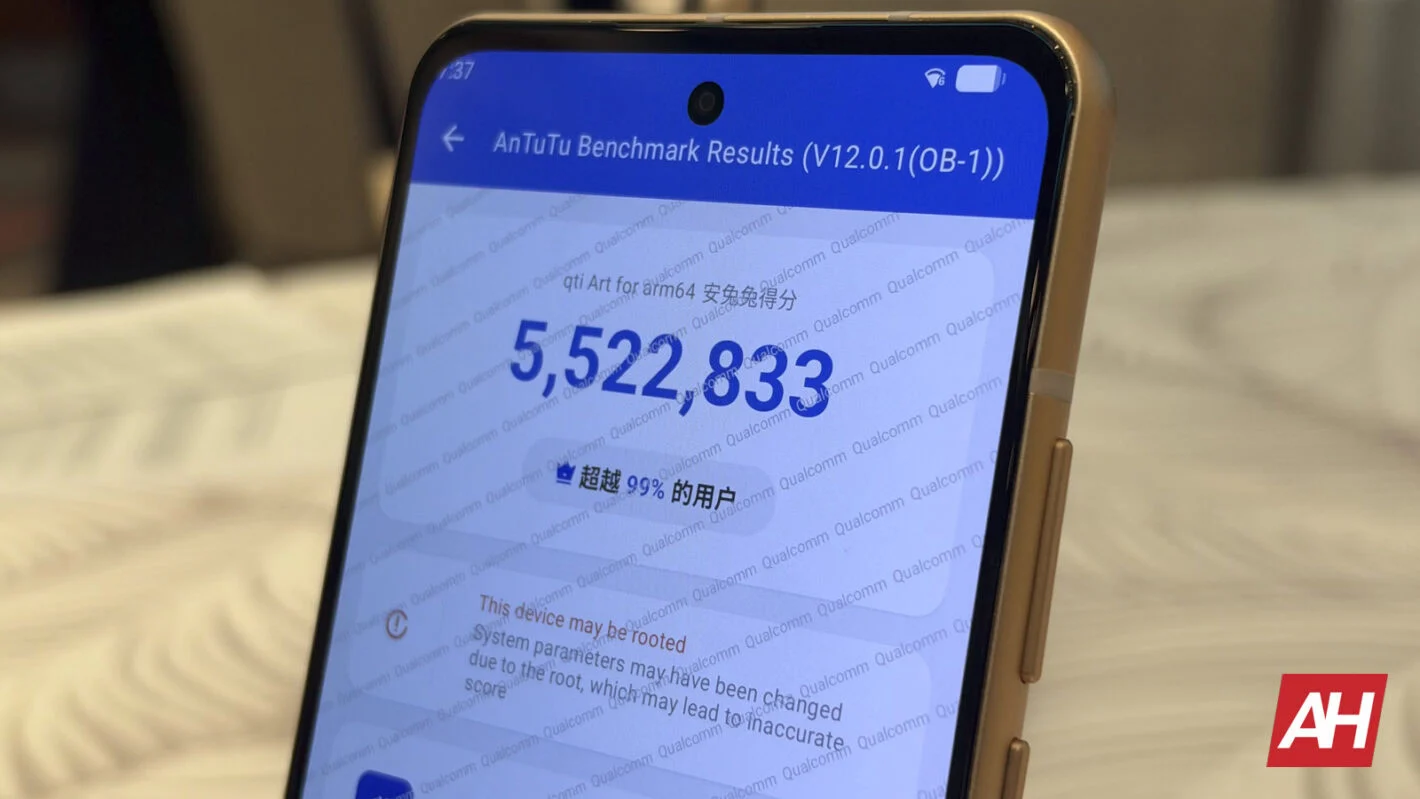
Image source: AndroidHeadlines
Gizmochina We also spotted the score for the OnePlus 16 with the Extreme version, hitting 5,384,433 on AnTuTu V12, including 1,458,283 for CPU and 2,010,584 for GPU. This unit comes with 16GB LPDDR5X plus 1TB UFS 4.1:
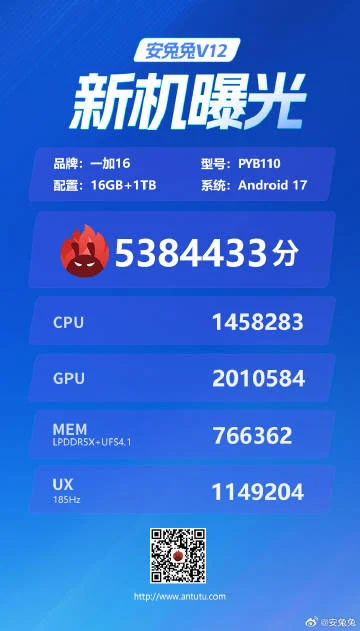
Image source: Gizmochina
The first phone with the Snapdragon 8 Elite Extreme Gen 6 is the Motorola Signature 27. The highly anticipated Xiaomi 18 Pro series: the 18 Pro will feature the standard Snapdragon 8 Elite Gen 6, while the 18 Pro Max gets the Extreme version.
Source: KOCPC Chinese