


OpenBMB and Tsinghua University officially open-sourced MiniCPM5-2B on September 7, a dense language model with 2.5 billion parameters. The model’s positioning is clear: enabling models that can run on phones and laptops to possess tool calling, long-context understanding, and agent capabilities without requiring data center GPUs. This is the second model in the MiniCPM5 series following the 1B version released in May, and it is currently OpenBMB’s most powerful on-device language model, with all weights, training data, and deployment tools fully released under the Apache-2.0 license.
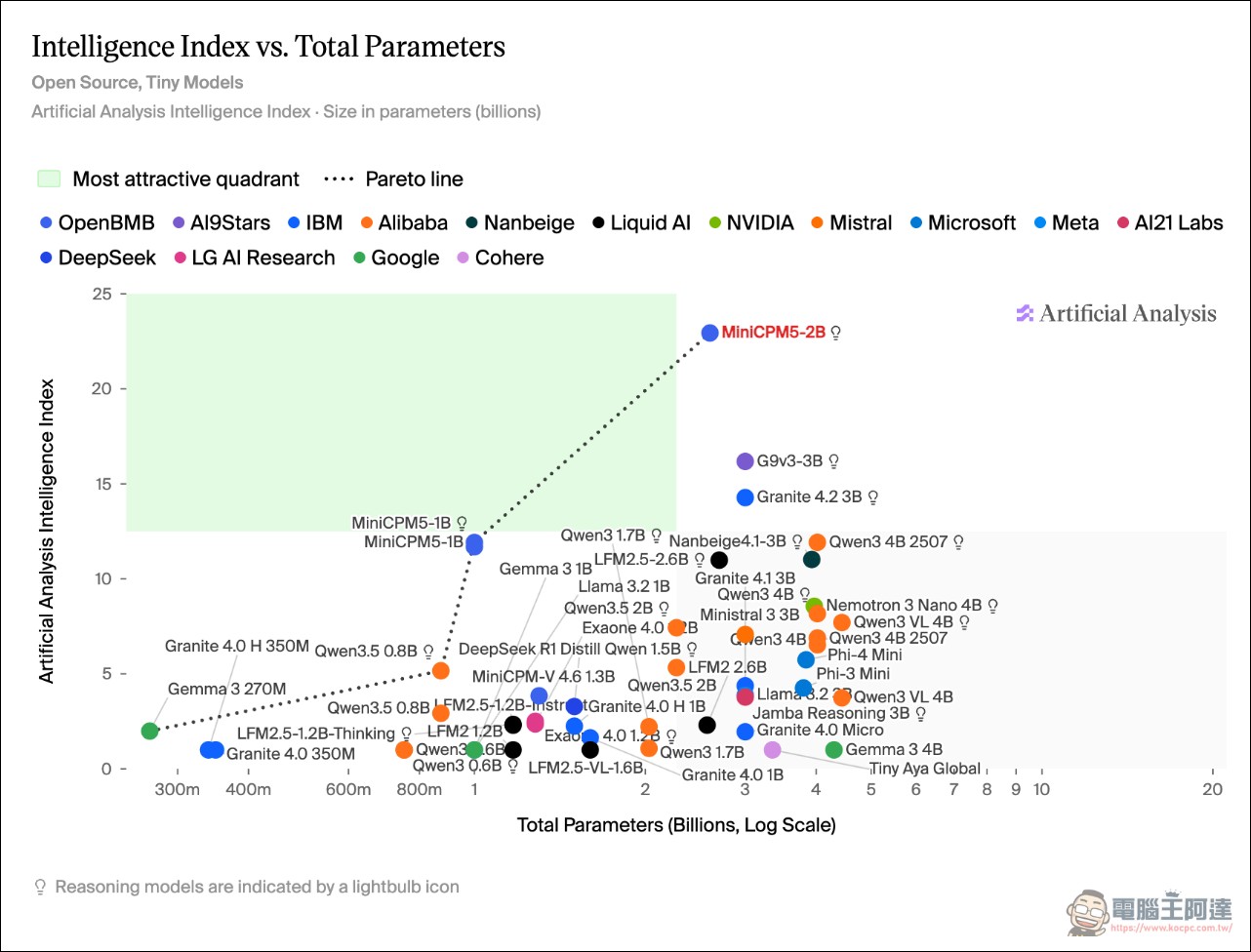
On the Artificial Analysis Intelligence Index v4 leaderboard, MiniCPM5-2B scored 23 points to take first place among open-source models under 4B parameters, while scoring 20 points on the Agent Index. Across OpenBMB’s own 34 benchmark tests, it achieved an average score of 53.9, covering code reasoning, mathematical reasoning, long-context understanding, tool calling, and agent tasks. Compared to the previous generation MiniCPM5-1B’s average of approximately 48 points, the 2B version shows clear improvements across all capabilities.
Deployment: mobile phones, laptops, multi-chip platforms.
MiniCPM5-2B provides multiple deployment formats:
- BF16: Full precision version, for inference frameworks such as vLLM, SGLang
- GGUF: Local inference for llama.cpp, Ollama, LM Studio
- MLX 4-bit: For Apple Silicon, runs directly on Mac/iPhone
- GPTQ 4-bitQuantized version, reducing memory requirements
- DSparkDraft model, used for speculative decoding acceleration.
Through the FlagOS platform, MiniCPM5-2B also supports automatic migration and deployment across 9 chip families. This means not only NVIDIA GPUs, but also domestic chips such as Huawei Ascend and Cambricon can run directly. Starting with vLLM requires just one command: `vllm serve openbmb/MiniCPM5-2B –port 8000`, with SGLang and Transformers also working out of the box.
Someone has already deployed it on a MacBook with 16GB RAM, performed web searches, and extracted summaries of results—the effect was surprisingly good:
Running MiniCPM5-2B locally on a 16GB MacBook 💻
It beats Qwen3.5-4B on benchmarks, so we asked it to find recent AI news, it called web search, pulled back 10 results and summarized the key developments inside Atomic Chat
Run local models via https://t.co/RbcCOIgVkj https://t.co/afCy4YtNIq pic.twitter.com/ODWz7Xfl8B
— atomic.chat (@atomic_chat_hq) September 7, 2026
MiniCPM5-2B uses the standard LlamaForCausalLM architecture with 42 layers and GQA attention, totaling 2.52 billion parameters, of which 1.98 billion are non-embedding parameters. It has a context window of 131,072 tokens and is licensed under Apache-2.0.
“Dense” is relative to MoE (Mixture of Experts): every parameter is activated at each inference. AI/TLDR points out that this makes memory usage predictable on phones, unlike MoE models, where it depends on which experts are activated. For mobile devices, predictable memory footprint matters more than peak performance.
Benchmark: beat Qwen3.5-4B, but knowledge and code are weak points.
In OpenBMB’s own benchmark tests, MiniCPM5-2B scored an average of 53.9 points, surpassing Qwen3.5-4B’s 53.2 points despite having roughly twice the parameter count. Other 2B-class models in the same comparison included LFM2.5-2B and Gemma-4-E2B-it, and MiniCPM5-2B took the lead in code reasoning, mathematical reasoning, and agentic tasks.
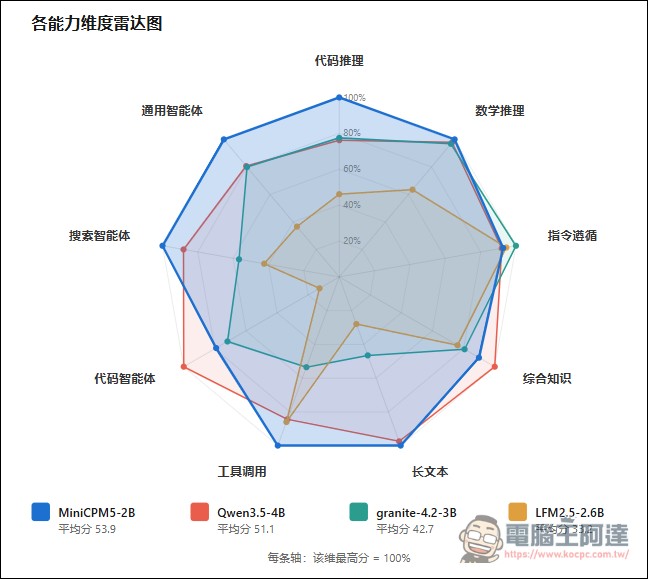
The largest gap is in long context: MiniCPM5-2B scored 68.4 on the NoLiMa test, while Qwen3.5-4B scored 59.0. For applications that need to handle long documents or long conversations, this gap has practical significance. Tool-calling performance is equally outstanding, which is also the core basis for OpenBMB’s emphasis on “bringing Agent capabilities to the edge.”
However, independent testing by Artificial Analysis also revealed weaknesses: on Humanity’s Last Exam and Terminal-Bench, MiniCPM5-2B scored only 9% each, showing a clear gap with larger models in breadth of knowledge and complex coding tasks. Its performance on Agent tasks, however, was relatively strong, achieving 831 Elo on GDPval-AA v2. Overall, MiniCPM5-2B excels at structured reasoning and tool calling rather than encyclopedic knowledge Q&A (after all, the model is simply too small).
MiniCPM5-2B – Huggine Face
Significance for developers
MiniCPM5-2B’s core value lies in bringing Agent capabilities to scenarios that don’t require the cloud. A 2B model that can run on a phone—if it can truly execute tool calls and long-context reasoning reliably—means applications like on-device assistants, offline coding assistants, and intelligent agents on edge devices are no longer just demos. For privacy-sensitive use cases, such as medical record processing or internal enterprise document analysis, the fact that data never leaves the device is itself a tremendous advantage.
Source: KOCPC Chinese