


Moonshot AI announced on October 24. Kimi K3.1 Pro, it is an all-new post-trained version released after the highly acclaimed K3, officially positioned as “the most capable open-weight model at the 3-trillion-parameter scale to date,” with a 1-million-token context window. Also debuting alongside are K3.1 Pro Highspeed, with capabilities exactly the same as Pro, 2 to 3 times faster, specifically for users who don’t want to wait. The more enticing numbers come later: the full model weights will be Open source by November 4.In other words, you can use it through official channels today, and within two weeks you’ll even be able to host the weights yourself locally.

What is it: K3 plus large-scale reinforcement learning
K3.1 Pro is the post-trained version of Kimi K3 (2.8 trillion parameters), launched in July, with a significantly larger post-training compute scale. The official approach is to conduct large-scale joint reinforcement learning across hundreds of downstream domains. To this end, every layer of the tech stack has been reworked: the reinforcement learning framework, long-context reasoning, training efficiency, sandbox infrastructure, rollout scheduling, and a shared platform for checking environment quality. The goal is for every unit of reinforcement learning compute invested to deliver stable and predictable returns.
Meet Kimi K3.1 Pro, our most capable 3T-class model. https://t.co/TB8aTQggHT
— Kimi.ai (@Kimi_Moonshot) October 23, 2026
There are a few hard settings you need to know before use: the model only supports thinking mode; requesting to disable thinking will be rejected outright and return HTTP 400; reasoning effort can be set to low, high, or max, with max as the default; official test conditions are fixed at temperature 1.0 and top-p 0.95, and third-party tests also confirm that the sampling parameters are locked, so setting temperature 0.2 will produce the error “only 1 is allowed”; both image and video inputs are supported.
Report card: outperforms GPT-6 Astra and closely trails Claude Opus 5.5.
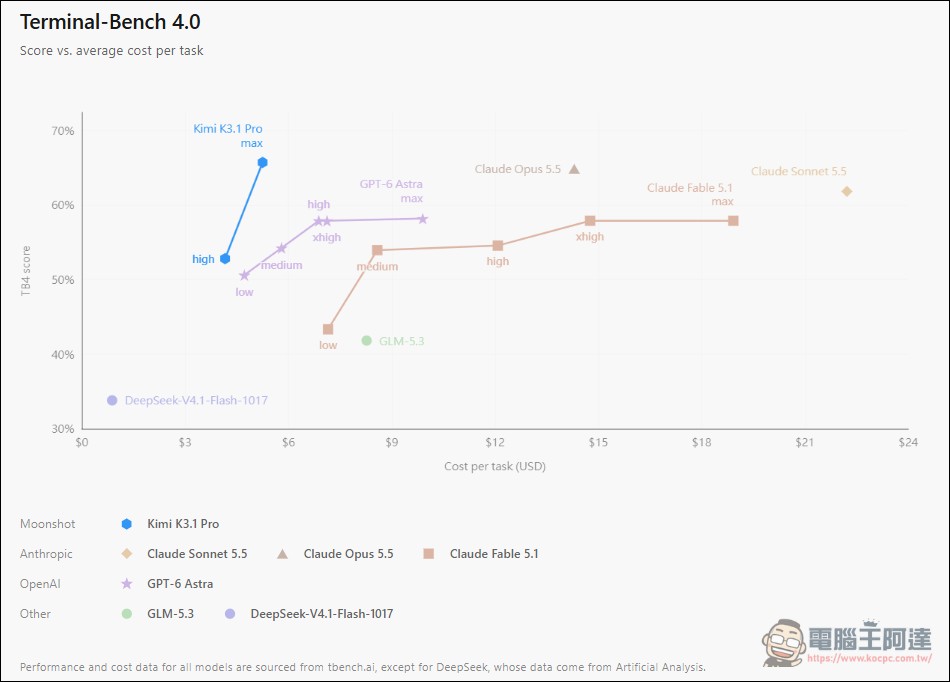
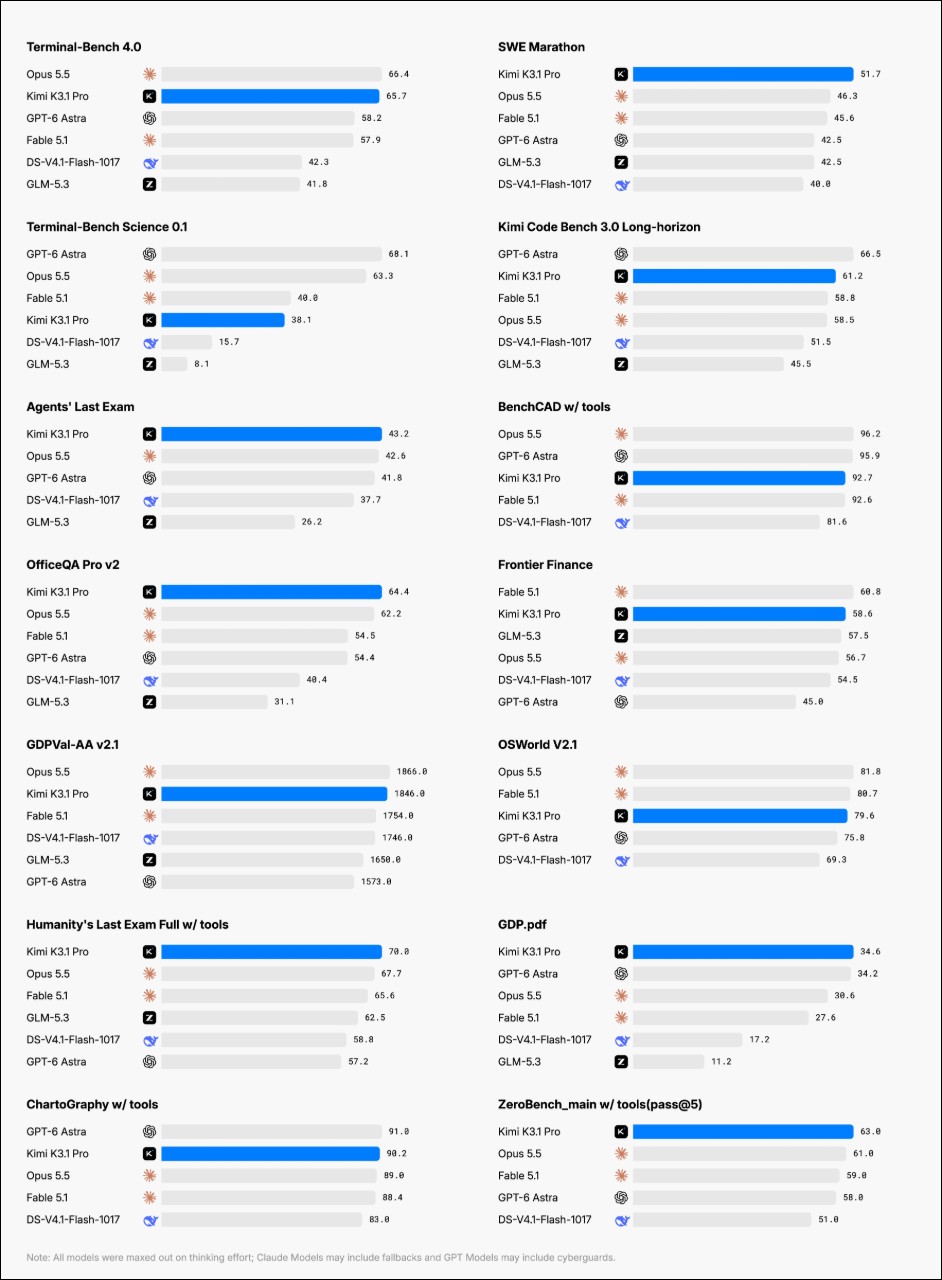
Coding ability is the main event this time. In Terminal-Bench 4.0(Evaluating coding agent performance on real, resource-constrained terminal tasks) got 65.7%, beating GPT-6 Astra’s 58.2% and only narrowly trailing Claude Opus 5.5’s 66.4%. On the official internal benchmark Kimi Code Bench 3.0 Long-horizon (measuring multi-step execution, tool use, and end-to-end problem solving), it scored 61.2%, a clear improvement over K3’s 55.95%.
In terms of 3D and spatial reasoning, in BenchCAD(Reconstructing 3D models from multi-view rendered images using CAD code) It scored 92.7% (with tools), close to Claude Opus 5.5’s 96.2% and GPT-6 Astra’s 95.9%; single-shot generation without tools is even closer, 72.8% vs. Opus 5.5’s 73.0%, essentially tied.
It can infer shapes and proportions from text descriptions, sketches, or reference images, and directly write scripts to operate Blender and CAD software for modeling, modifying components, and adjusting geometry and materials—without needing to attach an MCP connector. It can also combine Unity, Unreal Engine, Godot, and other game engines to create a complete experience. The official also conveniently… 3D Make The feature is now available on kimi.ai and the Kimi App: preview and edit 3D models online, download files ready for direct 3D printing, or export as videos and Live Photos to share.
Featured case: a repaired walking simulator
The official long-horizon coding test case paints a vivid picture. K3.1 Pro built a human walking dynamics simulator based on the open-source human anatomy model human-atlas (296 skeletal components, 402 muscle components), along with training and evaluation pipelines. Across 167 tasks and 420 independent reviews, it repeatedly analyzed experimental results and revised the walking controller, improving the simulated human from “falling within seconds” to “walking continuously with alternating steps for 11.2 seconds.”
The key moment comes later: when no matter how reward shaping was tuned, it could not improve the arm movement, it did not stubbornly keep tuning the reward. Instead, it performed open-loop probing of the simulator dynamics, found and corrected 36 errors in the calculation of shoulder muscle moment arms, and then retrained the controller. The path of “if you find the model itself has a bug, fix the model first” is closer to how a human engineer would work than piling on parameters and tuning them.
Financial Research and Factual Accuracy
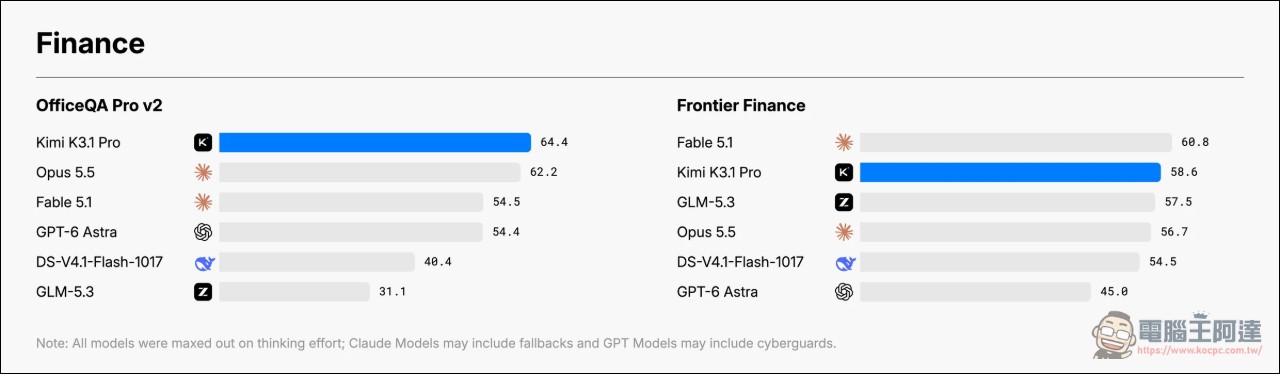
Financial workflows are another key focus area. In OfficeQA Pro v2(Using real financial documents to test complex data analysis, covering retrieval, cross-document verification, and multi-step numerical reasoning) It scored 64.4, claimed to be the current best. Official internal benchmarks beat K3 across the board: Financial Modeling 57.6 vs. 50.4, Financial Research 70.4 vs. 58.8, Business Operation 37 vs. 8.9 (about 4.2x).
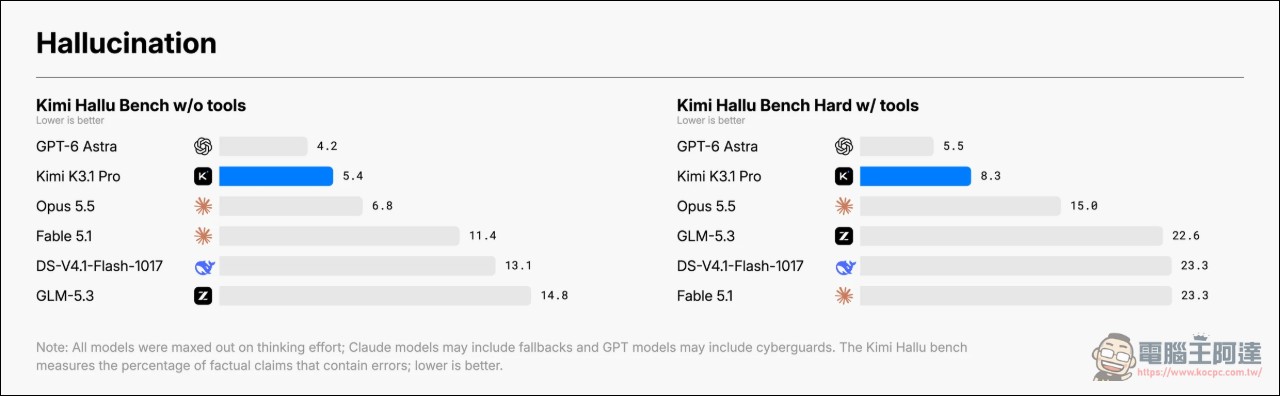
Factual accuracy has also been strengthened in tandem. On the internal stress test Kimi Hallu Bench Hard, deliberately designed to be adversarial, the claim-level hallucination rate fell from 23.4% for K3 to 8.3%…, better than Claude Opus 5.5’s 15.0% and slightly behind GPT-6 Astra’s 5.5%; the official team also candidly notes that this is a test designed specifically to hit the model’s pain points, and the number does not represent the overall error rate in everyday use.
Cybersecurity by Subtraction: “Dumb It Down” Before Open-Sourcing
The cybersecurity controls before releasing the open weights were the most unusual part of this operation. Officials found that as post-training scale increased, the model’s performance on vulnerability research tasks continued to improve. Tracing the source, they found that cybersecurity content was mixed into the general mid-training corpus, and cybersecurity tasks were also mixed into the reinforcement learning environments. So they took a subtractive approach for the open-source version: identify and remove cybersecurity-related data from both the mid-training and reinforcement learning stages, while retaining general coding tasks.
Performance was quantified on the internal benchmark xdev-bench-hard (expert-curated real-world vulnerability discovery and exploitation tasks): the unprocessed checkpoint can solve 90.5% of the problems at pass@3, and the final version K3.1 Pro is 81.0%, indicating that removing the data did indeed reduce cybersecurity capability; the control group also included GPT-5.6 Sol’s perfect score, DeepSeek-V4.1-Flash’s 85.7%, and K3’s 33.3%.
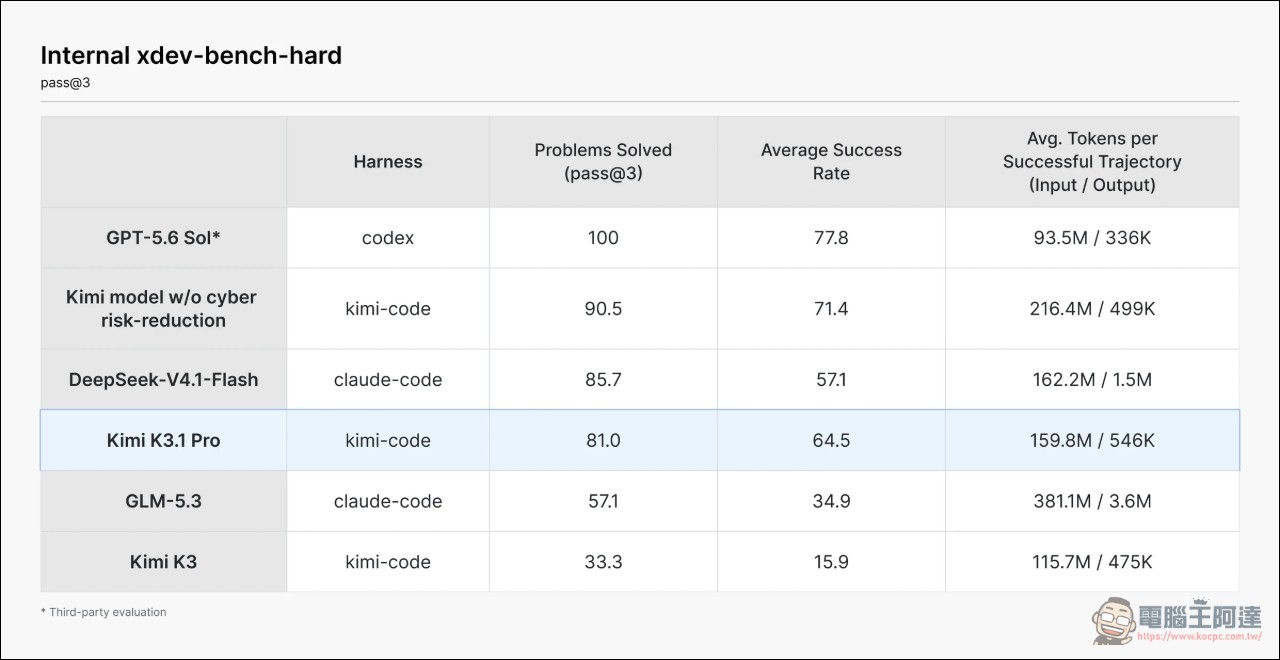
Officials wrote two open-weight principles for this: first, do not release open-weight models that would push cybersecurity capabilities to the absolute frontier; second, gradually improve the cybersecurity capabilities of open-weight models, because indiscriminate access allows more teams to audit the code they maintain, including legacy systems that are rarely subjected to dedicated security review.
Prices and Highspeed’s Calculations
Pricing (per million tokens): K3.1 Pro is $2 for input and $10 for output, about one-third cheaper than K3’s $3/$15; Highspeed is doubled across the board to $4/$20, with only the cache hit price the same for both ($0.2).
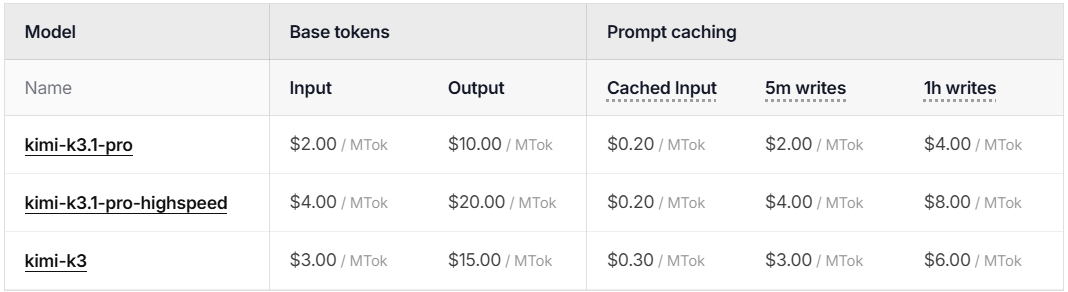
Third-party platform AIHubMix did on launch dayRandom spot checks and actual testingThe figures differ from the official ones: Highspeed measured output speed is 138 to 150 tokens/second, while Pro is 85 to 88 tokens/second; the speedup ratio is approximately 1.6 to 1.75 times, not the 2 to 3 times claimed officially. They also point out a billing trap: 85% to 90% of the tokens in each response are spent on reasoning, and most of the doubled cost goes to thinking content no one will read; only scenarios like interactive coding, where someone is waiting, are worth buying Highspeed for, while unattended batch tasks are fine with Pro.
Where can it be used, and when will it be open-sourced?
Available across all channels on launch day: kimi.ai and the mobile app (iOS, Android, HarmonyOS), Kimi Work desktop (Windows and Apple silicon Mac, v3.1.0 or later), and Kimi Code (using /model select model), Kimi API (kimi-k3.1-pro and kimi-k3.1-pro-highspeed Two IDs; API users can use the zero data retention feature). Enterprise admins can enable it for their organization, but it is off by default at launch. For Kimi Code membership tiers, k3.1-pro requires Plus or above, a 1 million token context requires Pro or above, and Highspeed requires Pro or above.
Source: KOCPC Chinese