


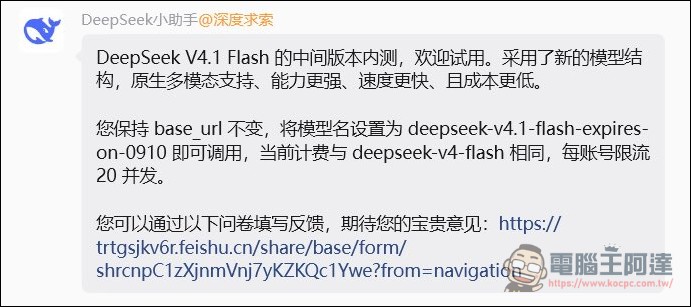
DeepSeek today posted a notice in its official community group, launching a limited-time internal beta of the DeepSeek V4.1 Flash intermediate version. This is the largest architecture-level update to the V4 series since its release in April 2026, featuring an entirely new model structure with native support for multimodal inputs. The official announcement says it is “more capable, faster, and more cost-effective.” Unlike the V4-Flash-Vision-Exp released on August 21, which attached a vision extension pack to the text model, V4.1 Flash integrates multimodal capabilities directly into the model architecture itself, processing text, image, and speech inputs in a unified manner. The API call name for this version is deepseek-v4.1-flash-expires-on-0910Developers can keep the existing API base_url unchanged and simply modify the model name to call it directly, with pricing fully consistent with the current DeepSeek V4 Flash.
The timing of this release comes amid reports that DeepSeek is raising 50 billion RMB in funding, with founder Liang Wenfeng contributing 20 billion of his own money. The V4.1 Flash strategy of “matching Pro capabilities at Flash prices” is clearly not just a technical iteration but a key step in the commercialization path. If the low-cost model can take on most of the tasks handled by the high-priced model, DeepSeek’s pricing competitiveness in the enterprise market will be significantly strengthened.
Speed test: 5.7 times faster than Pro.
As soon as the internal testing news broke, the Chinese tech community quickly conducted hands-on testing. X users @riba2534 Published detailed benchmark test data:
- Time to First Token (TTFT):178ms,short Q&A stabilizes at around 160ms
- Continuous articulation rateStable at 355 tok/s, with peaks exceeding 365 tok/s.
- Long-form code generation: A complete doubly-linked list LRU implementation in 1,500 tokens took only 4.40 seconds.
- Chain of thoughtBuilt-in Thinking phase completes reasoning in about 1.1 seconds, seamlessly switching to the main text.
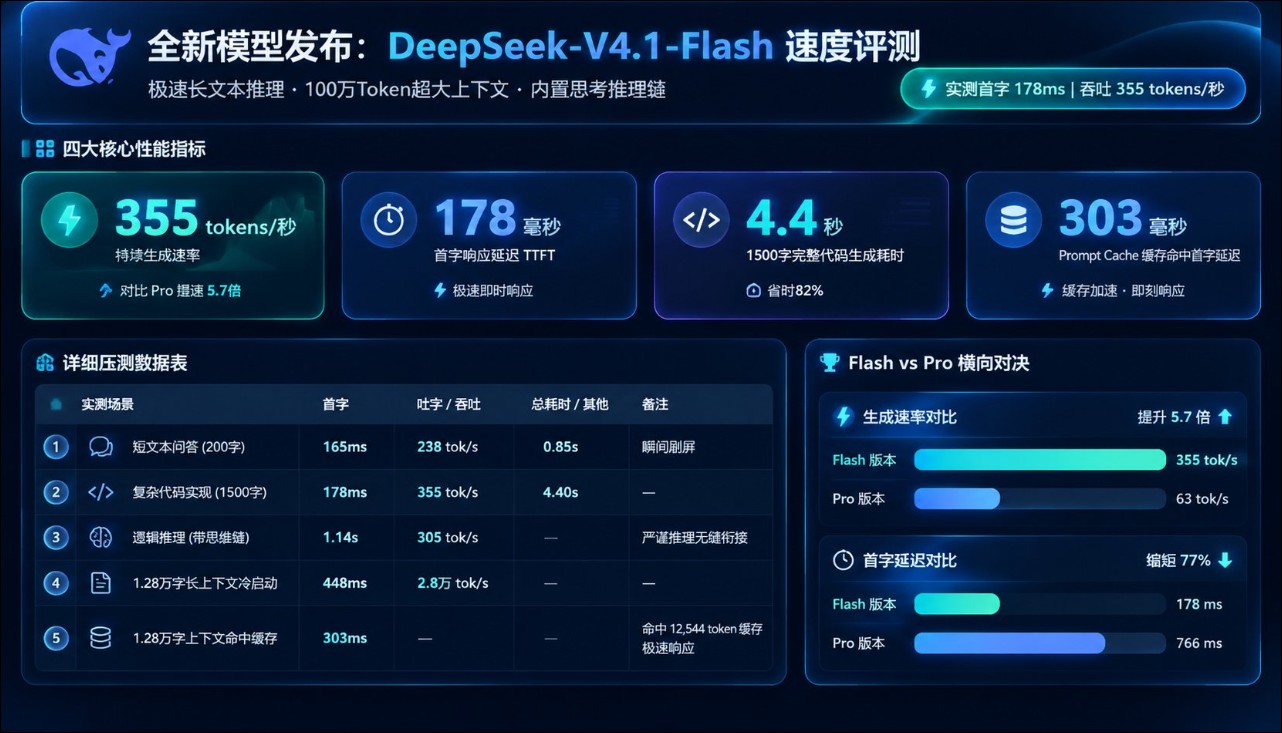
Compared to DeepSeek V4 Pro, sustained throughput has increased 5.7x (355 tok/s vs. 63 tok/s), first-token latency has been reduced by 77% (178ms vs. 766ms), and generating 1,500 characters of content has been compressed from 24.7 seconds to 4.4 seconds, saving 82% of waiting time.
Actual testing by other community users has also confirmed this speed level, calling it “the fastest AI currently available.” Other beta testers reported that “the minimum is 300 tok/s, and the maximum can reach 600 tok/s,” but they speculate this is the speed of a separately deployed version, which may not be as impressive once officially launched.
DeepSeek v4.1 Flash via API is almost TOO fast 🤯 pic.twitter.com/u8nzcJoa02
— Mia (@MiaAI_lab) September 8, 2026
Flash pricing, Pro ambition
The most striking focus of this internal beta test was the question raised in the feedback questionnaire concurrently distributed by DeepSeek officials: “Can the DeepSeek V4.1 Flash intermediate version fully replace the DeepSeek V4 Pro currently in production?”
DeepSeek V4.1 Flash is already live on the DeepSeek API.
but weirdly… DeepSeek hasn’t even announced it on X yet.
it’s currently running as a limited intermediate test until Sep 10.
and from the early results I’m seeing, this looks surprisingly better than the previous V4…
— Sahil Panhotra | Indie Builder (@SahilPanhotra) September 8, 2026
The intent behind this question is very clear: DeepSeek wants to verify whether the new-generation Flash architecture can handle Pro-level tasks at Flash prices and speeds. According to the official pricing list, V4 Flash output costs approximately NT$21 (US$0.66) per million tokens during off-peak hours, while V4 Pro output costs around NT$63 (US$1.98). If V4.1 Flash truly approaches Pro-level capability, developers’ call costs would drop directly to one-third of the original.
For developers, this means the logic behind technology selection could undergo a fundamental shift. The old dichotomy of “choose Flash for speed, choose Pro for power” may be replaced by “try Flash first to see if it’s sufficient.”
Closed Beta Restrictions and Notices
As a limited-time intermediate version, V4.1 Flash has several clear limitations:
- Auto-expireThe “expires-on-0910” in the model name indicates that this version will automatically go offline on September 10, leaving a testing window of only about two days.
- Concurrency limitEach account is limited to 20 concurrent streams, far below the 2,500 in the production version, making it unsuitable for large-scale production environments.
- No independent baseline performanceThe official has not yet announced technical specifications, standalone pricing, or benchmark results.
- Billing remains unchanged.Billing during the beta period is identical to V4 Flash, with no additional fees incurred.
Based on community reactions, the biggest appeal of V4.1 Flash is that it breaks the either-or dilemma of being “cheap but weak” or “strong but expensive.” If the official version maintains its current speed and capability levels while restoring the concurrency limit from the beta’s 20 requests to the official version’s 2,500 requests, it would be highly attractive for high-frequency call scenarios such as Agent workflows, batch code generation, and real-time dialogue systems. For developers who want to try it before the September 10 deadline, simply change the model name to deepseek-v4.1-flash-expires-on-0910 in the API request—no additional beta qualification application is needed.
Source: KOCPC Chinese