


It’s not just cloud-based AI models—local AI models are getting more powerful too, which is why more and more people are starting to run AI agents directly on their own computers to help handle various tasks. However, when an AI faces a complex task, it typically breaks the work down into multiple smaller subtasks and assigns them to different sub-agents to handle in parallel. If all the sub-agents’ requests end up being sent to the same local inference engine and GPU, some requests may end up waiting in a queue, which actually creates a computational bottleneck and makes the overall execution speed very slow.
To address this issue, NVIDIA unveiled a new NVIDIA PAIR application at IFA 2026. It is a free, open-source personal AI Router software that connects Windows, Linux, and Mac devices on the same local network, routing different local AI inference requests to the computer best equipped to handle them. NVIDIA also demonstrated that a multi-agent workload that originally took an average of 18 minutes on a single RTX Spark laptop was reduced to 8 minutes and 48 seconds when run on a PAIR cluster of three devices.
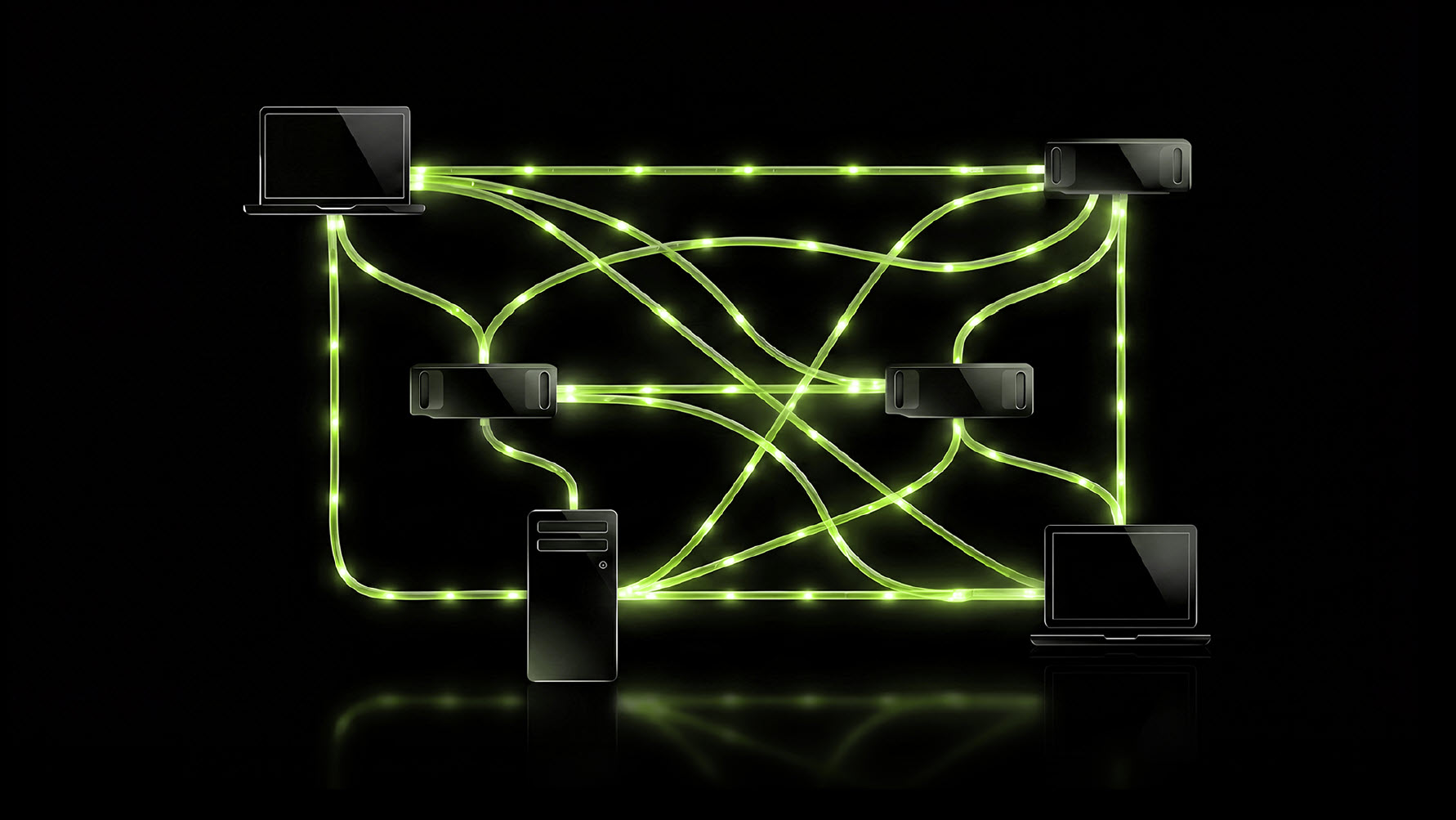
Image source: Wccftech
NVIDIA PAIR is now free and open source: string together idle home computers to run local AI, cutting multi-agent task time from 18 minutes to 8 minutes 48 seconds.
You can think of this NVIDIA PAIR application as a command center for local AI. It doesn’t merge the GPUs of different computers into one more powerful AI computing machine; instead, it helps distribute tasks appropriately so that workloads don’t pile up on a single computer, ultimately completing tasks faster.
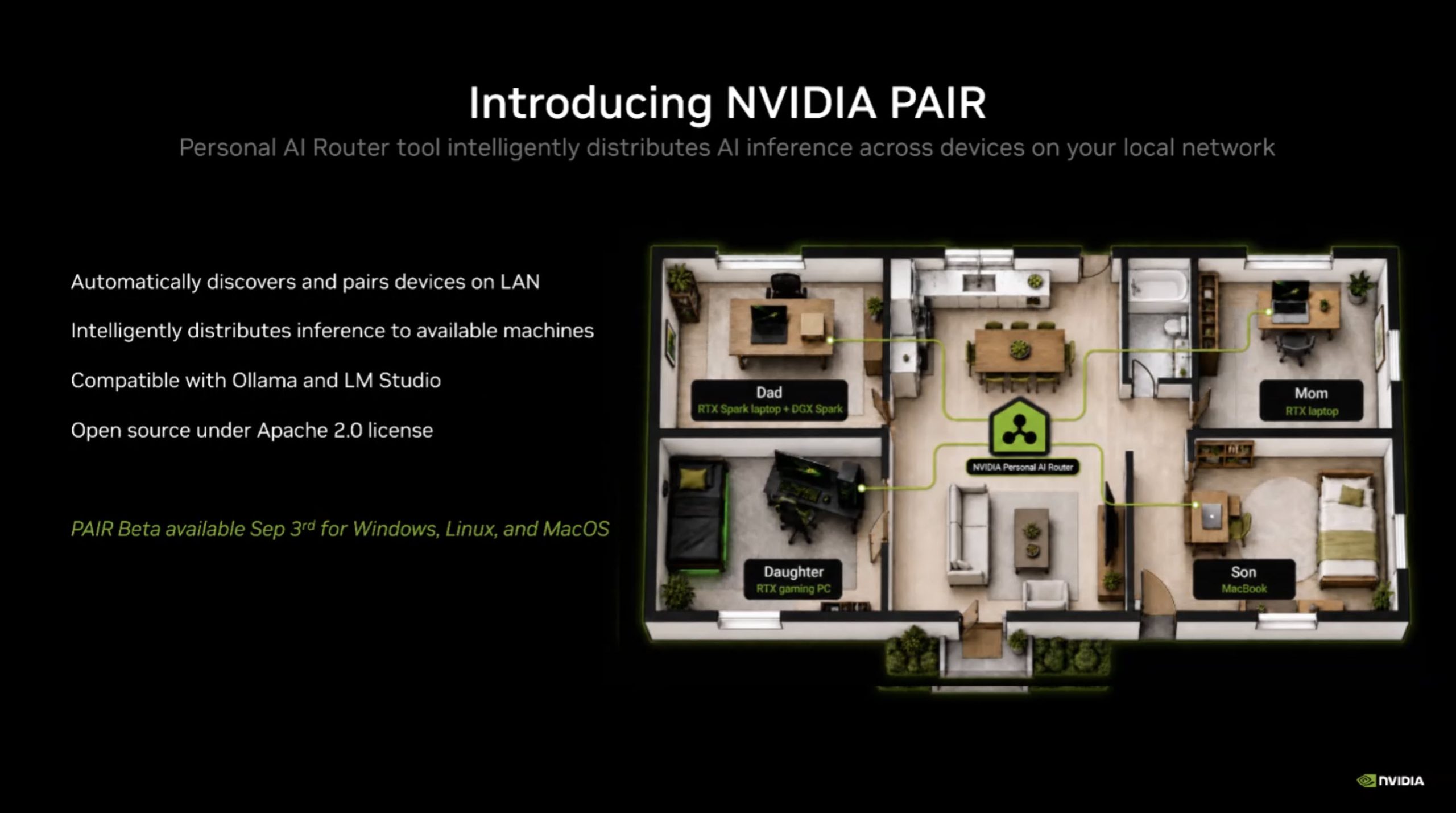
Image source: Wccftech
Using it is also simple: after installing PAIR on your home computers, pair the devices into the same cluster, then prepare the inference engine and models you intend to use. When an AI application or agent sends a request to the local endpoint provided by PAIR through an Ollama- or LM Studio-compatible interface, PAIR selects the eligible nodes and has Ollama or LM Studio on that node execute the full request, then sends the result back to the original application.
This is quite convenient for those who are already using Ollama or LM Studio, since they don’t need to rewrite their proxy tools separately.
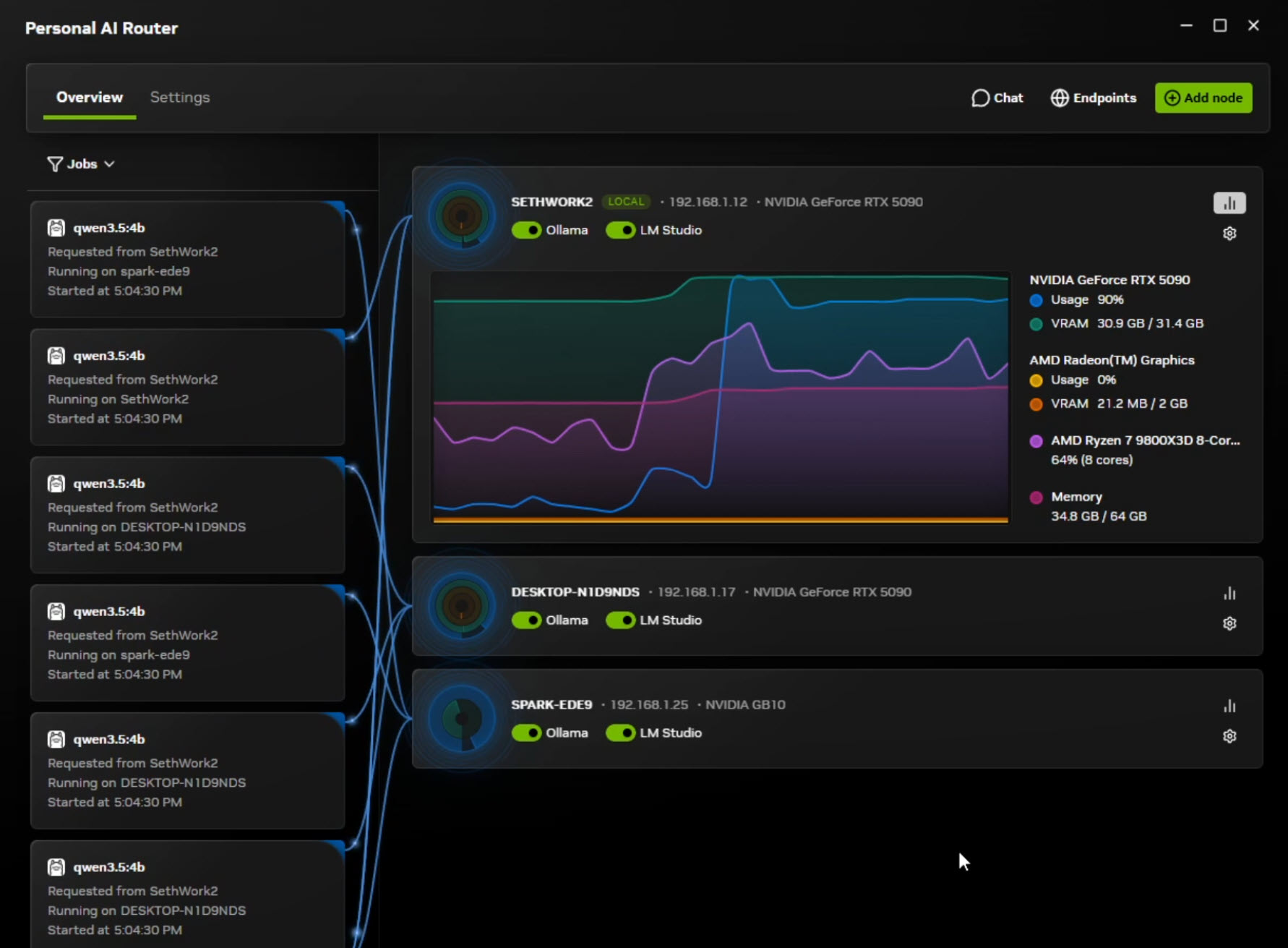
Image source: Wccftech
The tasks best suited for NVIDIA PAIR are those that generate multiple independent requests at the same time. For example, when Hermes Agent receives a task to organize a family mailbox, it spawns five sub-agents to each examine different content, then consolidates the results into an action list. If all five sub-agents use the same model on the same computer, requests could end up in a very long queue. In this case, if there are other paired computers on the local network equipped with the same model, PAIR can send different requests to different machines, allowing multiple computers to process them in parallel.
This also means it’s better suited for scenarios involving multi-agent research, automation workflows, or running multiple local AI tools at the same time.
NVIDIA demonstrates building five sub-agents using Hermes Desktop, with Ollama on each node executing the Qwen 3.6 35B A3B model. When using a single RTX Spark laptop alone, the same task takes an average of 18 minutes. After switching to a three-device cluster composed of an RTX Spark laptop, DGX Spark, and GeForce RTX 5090, the average time is 8 minutes 48 seconds, saving more than half the time:
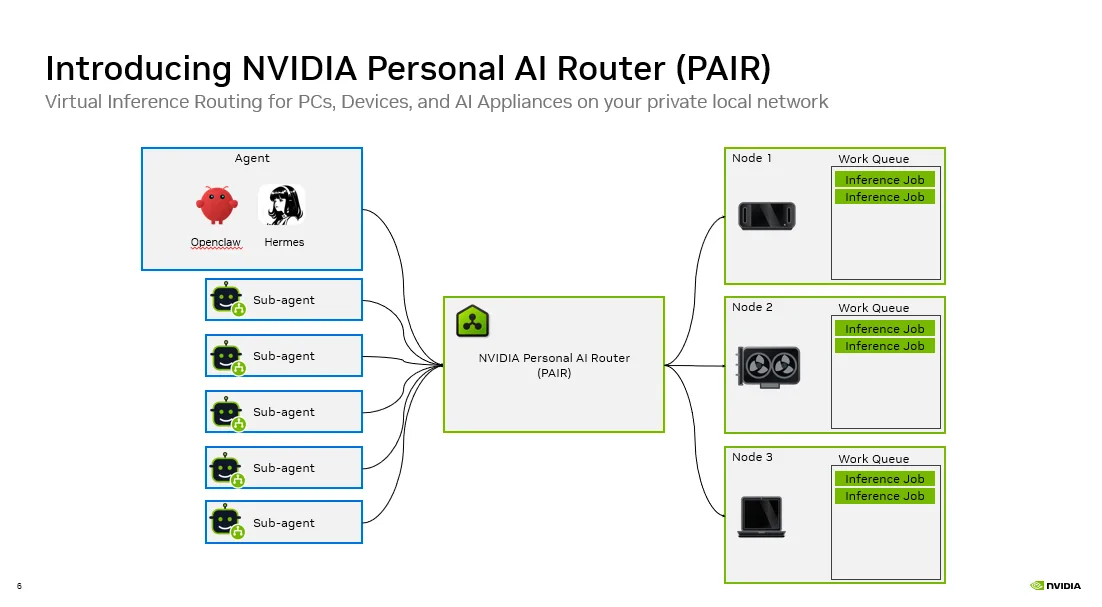
Image source: Wccftech
Of course, while it saves a lot of time, it can’t be said that installing PAIR will definitely make things twice as fast. NVIDIA has specifically noted that this is an unofficial demonstration under specific hardware, models, and settings—not a general benchmark, and there’s no guarantee of linear scaling when adding nodes. Actual results are also affected by factors such as how much independent work can be broken out of a task, model settings, network conditions, and node status.
Foreign media Wccftech The report also shared two demonstration scenarios for the RTX 5090. A task that originally took an average of 6 minutes 18 seconds on a single RTX 5090 was reduced to 3 minutes 48 seconds after being distributed to two RTX 5090s via PAIR.
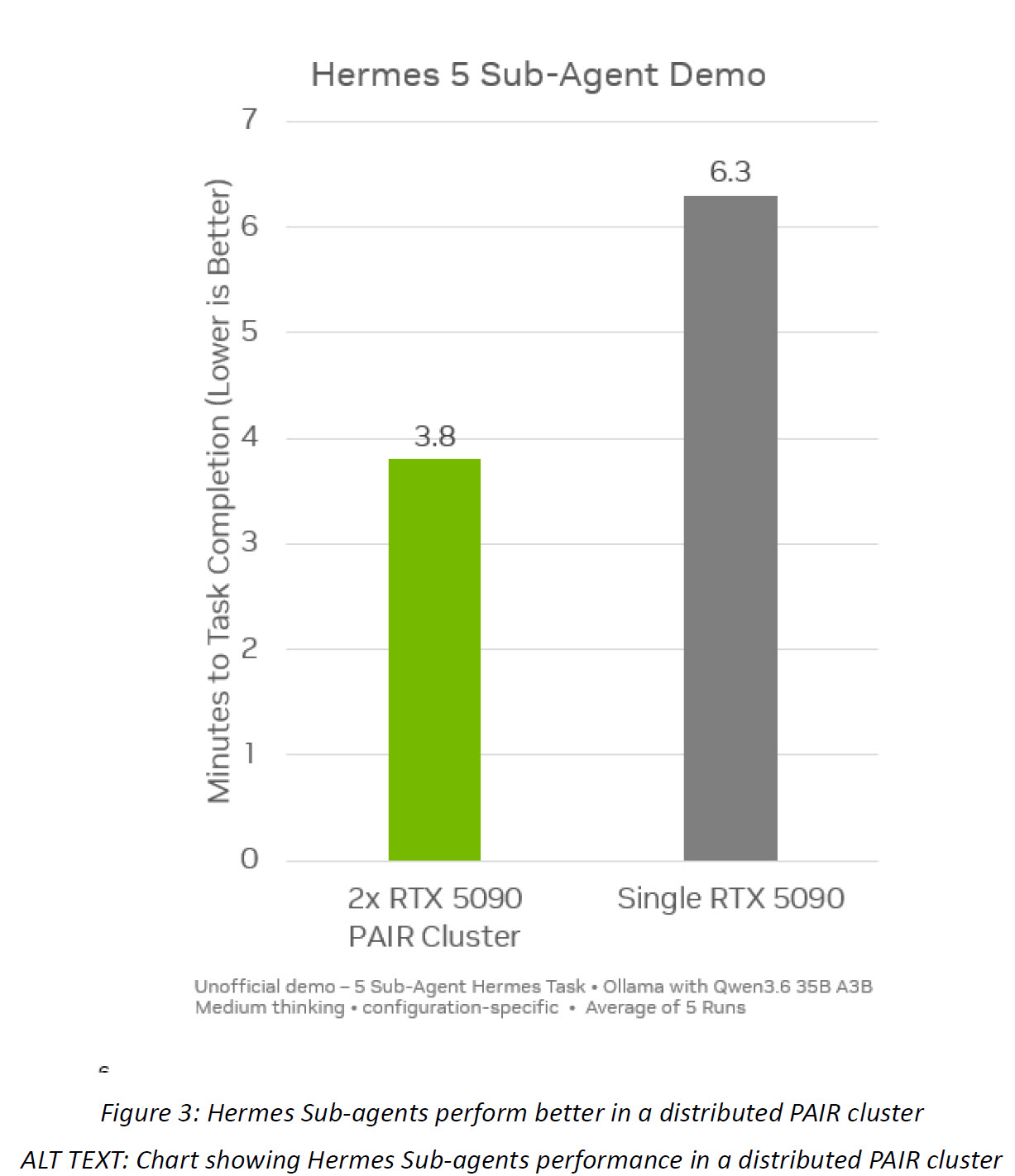
Image source: Wccftech
What’s even better is that computers running different operating systems can also be linked into the same PAIR cluster.
NVIDIA currently provides versions for Windows 11, Linux, and macOS, with installation files for both x64 and arm64 architectures. Windows on ARM remains in experimental support. The official product page lists major hardware including GeForce RTX 20 series and above, RTX PRO based on Turing architecture or newer, DGX Spark, and Apple M4 chips or later. Supported inference engines include Ollama and LM Studio.
NVIDIA PAIR Beta is now available for GitHub Free download, open source under the Apache 2.0 license.
As for the roughly $1,200 per month in cloud API value that NVIDIA mentioned, this is an estimated scenario based on raising idle home computing power to 60% utilization, calculating the number of tokens that can be generated by running Qwen 3.8 27B, and then converting that into cloud API costs. It does not mean that everyone who installs PAIR will actually save $1,200. In addition, NVIDIA also estimated in this scenario that electricity costs would increase by about $120 per month, so your home computer’s hardware, operating time, electricity rates, and actual AI workload will all affect the final outcome.
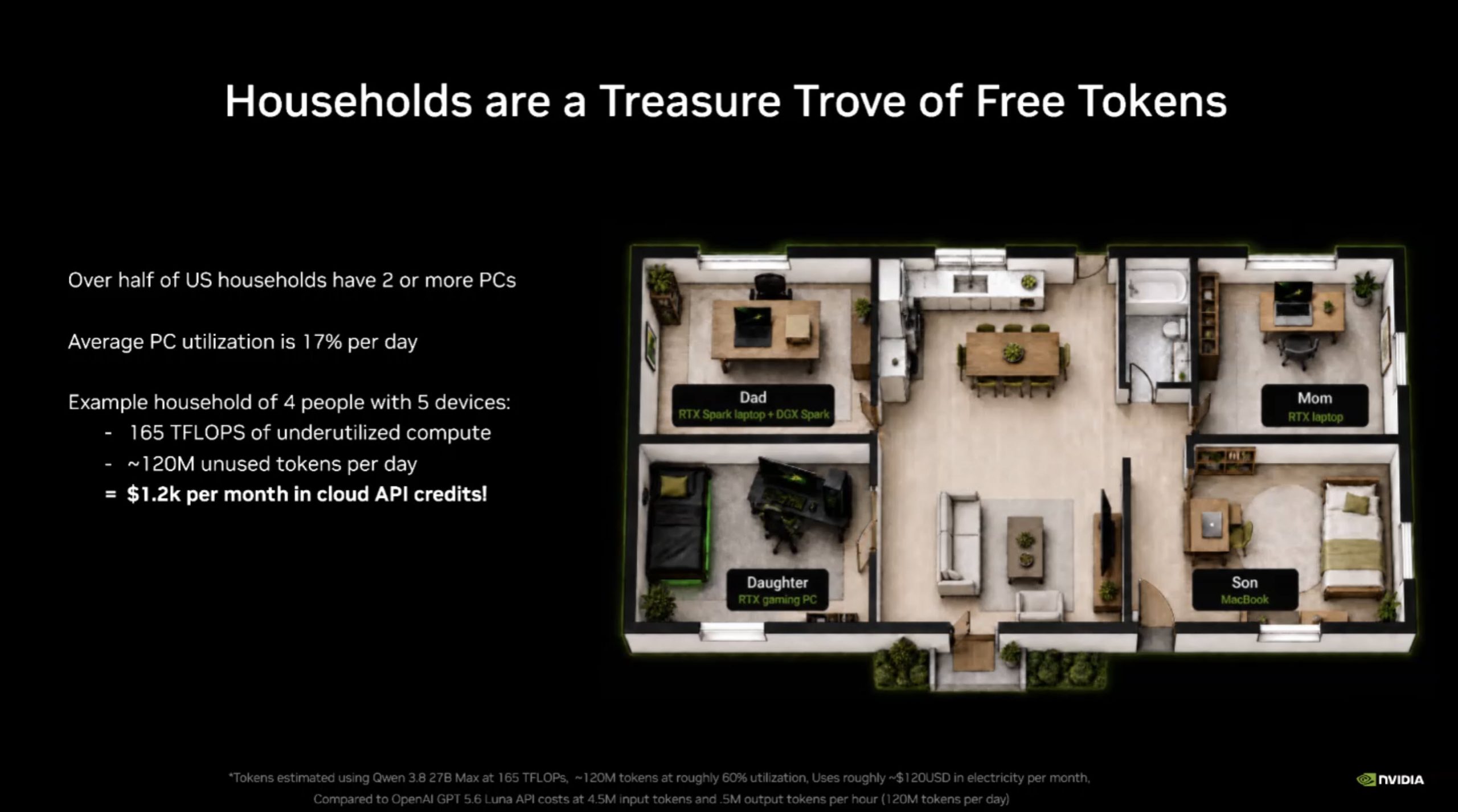
Image source: Wccftech
Source: KOCPC Chinese