


After two years of turbulence — the underwhelming Llama 4 and the disbanding of the FAIR team — Meta is finally back in the open-source camp. CEO Mark Zuckerberg posted on his personal X account (@finkd) on August 10, announcing that the weights of Muse Glimmer are now open. It’s a 30B-parameter dense model that can run entirely on a single consumer GPU or Mac. In the same post, he also teased that the weights of Meta’s latest flagship foundation model, Muse Spark 1.2, will be released soon.
Today we’re also opening the weights for Muse Glimmer, a great 30B parameter dense model that can run locally. Soon we’ll also release the weights for Muse Spark 1.2, our latest foundation model. Meta is a strong supporter of open source and I’m proud of these releases. Congrats…
— Mark Zuckerberg (@finkd) August 10, 2026
Beyond Zuckerberg’s announcement, Alexandr Wang, head of Meta’s Superintelligence Lab (MSL), quickly confirmed on X: “There’s a big announcement today — we will be releasing an open-weight version of Muse Spark 1.2 soon.” He added that Muse Glimmer is licensed under Apache 2.0 and can run on a regular computer with 24GB of GPU memory.
1/ big announcement today: we will be releasing an open weight version of muse spark 1.2 soon.
we also are releasing muse glimmer, a 30B agentic model with open weights under apache 2.0. muse glimmer can run on 24GB of VRAM without losing agentic reliability. 🧵
— Alexandr Wang (@alexandr_wang) August 10, 2026
What Is Muse Glimmer
Muse Glimmer is the first open-source model from Meta’s Superintelligence Lab, focused on “always-on local agentic workflows.” It’s a 30B-parameter dense model with multimodal capabilities and a dedicated perception encoder that understands both text and images. It’s suited for local agents, function calling, local coding, and use cases like LLM-as-a-judge.
2/ just like much larger models, muse glimmer can operate as a fully capable agent via planning, tool calls, checking its own results, and failure recovery. pic.twitter.com/CMnroWLTe8
— Alexandr Wang (@alexandr_wang) August 10, 2026
For training, Glimmer was distilled from the flagship Muse Spark. Meta first used Muse Spark’s outputs for logit distillation in pretraining, then added intermediate training on long-context, agent-dense tasks, and finished with supervised fine-tuning plus reinforcement learning — packing reasoning, coding, and tool-calling abilities into a 30B footprint. The weights are live on Hugging Face under Apache 2.0, allowing commercial use, modification, and redistribution.
Muse Glimmer – Hugging Face
Meta’s move here targets local execution. The official blog notes that most AI deployments still rely on cloud and network connectivity; running models locally means they work anywhere, even offline, and personal data never leaves the device. Compared with other major labs tying flagship models to cloud APIs, Glimmer effectively moves the agent runtime onto developers’ own machines, saving per-call API token costs.
The Key to Fitting in 24GB: Quantization and Speculative Decoding
The biggest obstacle to running a 30B model on consumer hardware is memory. Meta’s official blog says the model needs over 55GB of memory at full precision — far beyond any consumer GPU. Meta uses quantization to compress the weights to around 4-bit, shrinking the language model itself below 20GB, then fits the KV cache, vision encoder, and the speculative-decoding drafter into a 24GB or 32GB memory budget.
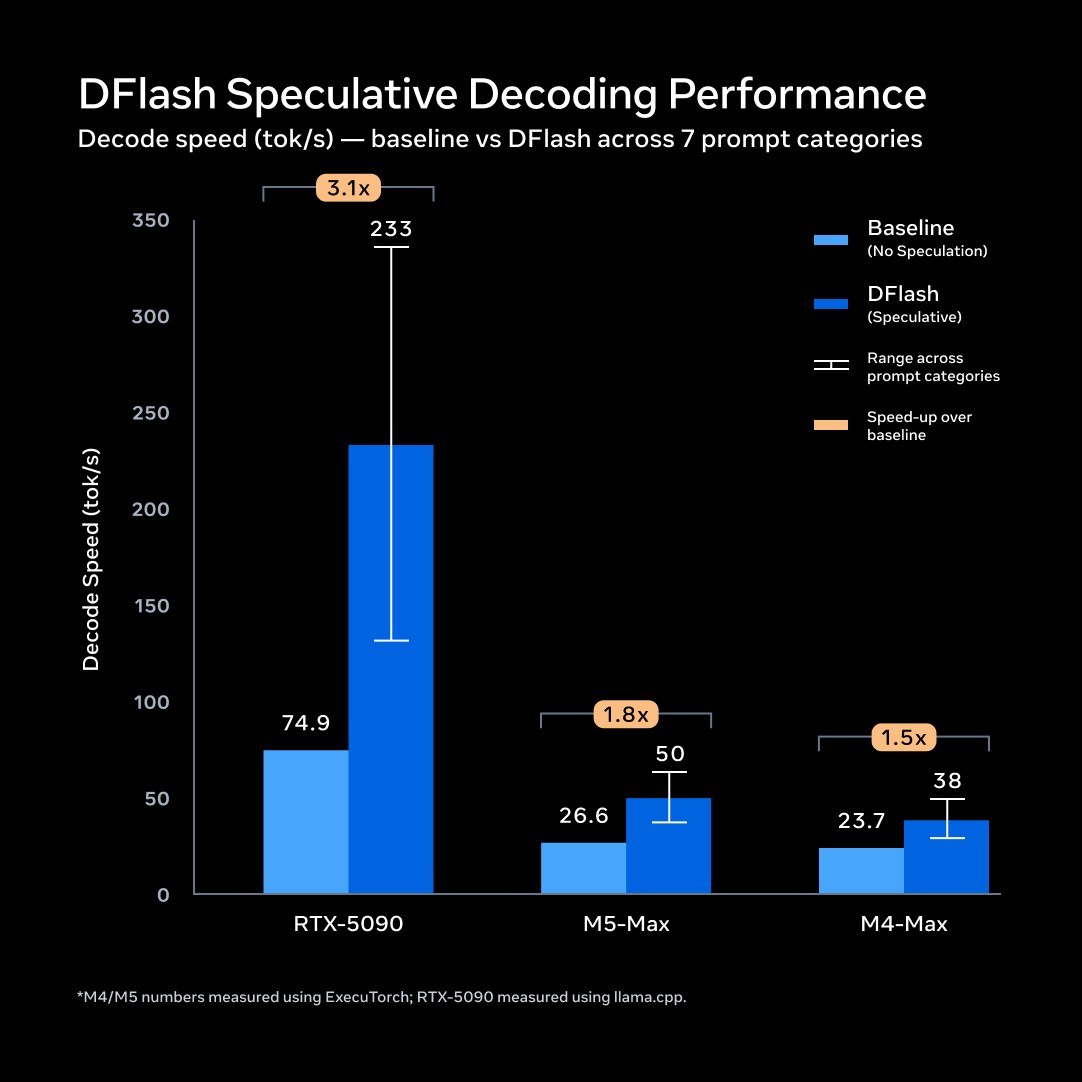
For speed, Glimmer ships a lightweight drafter built on the DFlash architecture that proposes whole batches of tokens for the main model to verify in parallel, bypassing the token-by-token bottleneck. Meta’s measured numbers: 3.1× faster decoding on an RTX 5090, 1.8× on M5 Max, and 1.5× on M4 Max. NVIDIA’s official blog adds that Glimmer supports context lengths beyond 120K and reaches 20K tokens per second throughput on Blackwell Ultra.
Which Hardware Can Run It: From 12GB to 58GB
Unsloth compiled the minimum hardware requirements for each quantized version of Muse Glimmer 30B, in total memory combining RAM and VRAM (Macs use unified memory). The 2-bit version (UD-Q2_K_XL) needs as little as 12–14GB, matching an RTX 4080-class GPU; 3-bit needs about 14–15GB; the officially recommended 4-bit version (UD-Q4_K_XL or NVFP4) needs 17GB+, achievable on a Mac with 32GB; 6-bit needs 20–22GB, matching an RTX 5090 or a 48GB Mac; 8-bit and full precision need 34GB and 58GB+ respectively.
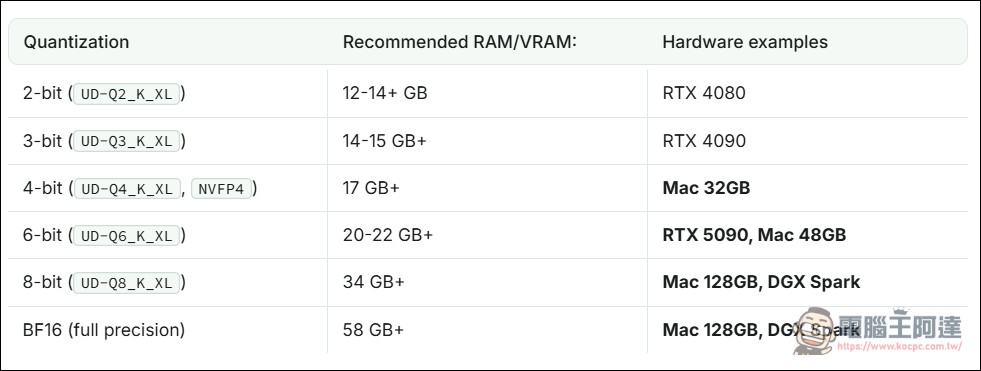
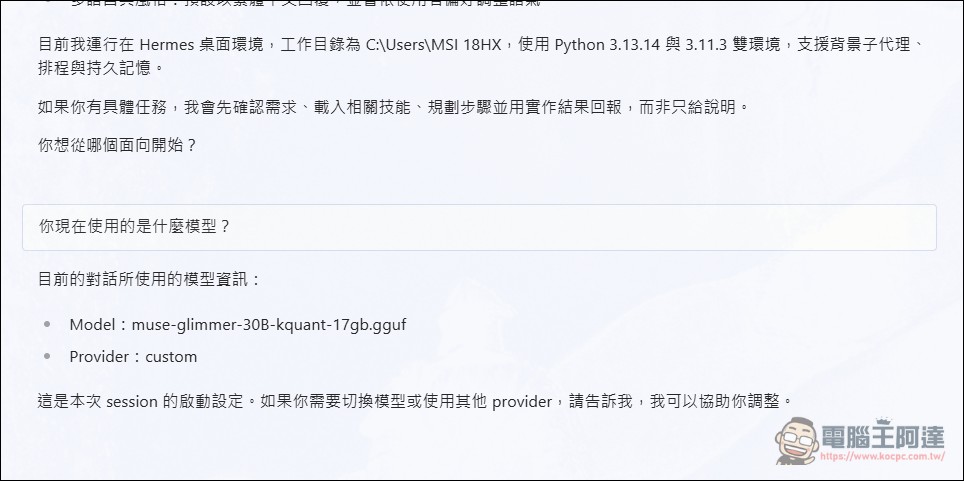
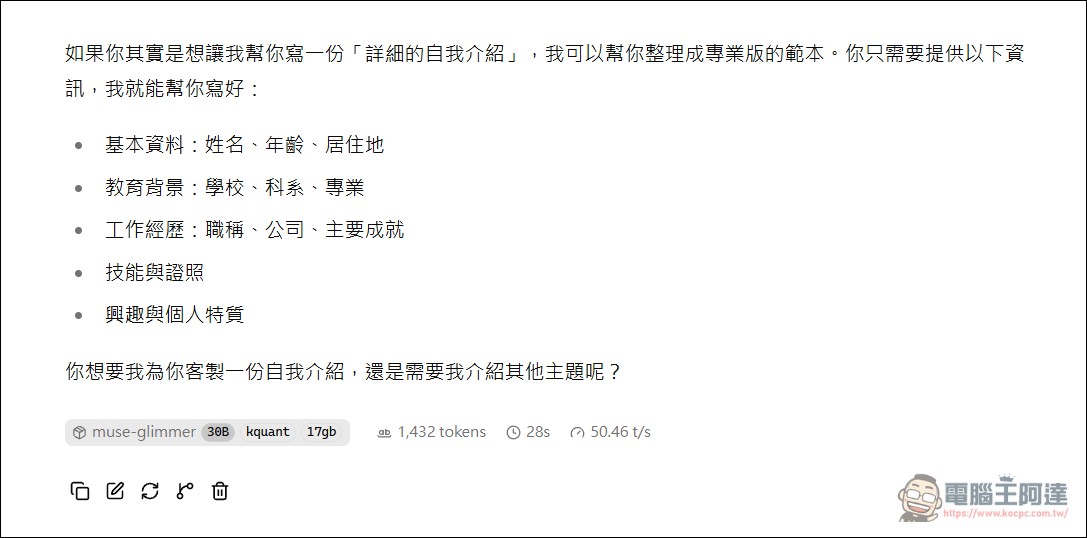
Looking at actual file sizes, the 4-bit language model itself is about 15.9GB; add the ~1.6GB dflash drafter for speculative decoding and the ~1.4GB vision encoder, and the whole stack comes to nearly 19GB. For smooth 4-bit on a GPU, 24GB VRAM (RTX 4090 / RTX 5090 class) is the safe practical target — the exact number Alexandr Wang guaranteed on X. A 16GB VRAM GPU can run 2-bit at full speed, or force 4-bit by offloading part of the weights to system memory at reduced speed. For Mac users, go by unified memory: a 32GB model runs 4-bit fine; Unsloth also notes 18GB devices or pure-CPU environments can run it, just with slower generation. In my own testing on an RTX-5090 Laptop GPU, I got 50+ t/s (with a 128KB context), and it performs quite well for work on HERMES.
Performance Positioning: Going Head-to-Head with Gemma 4 and Qwen 3.6
In its official blog, Meta compares Muse Glimmer with peers including Google’s Gemma4-31B and Alibaba’s Qwen3.6-27B, claiming competitiveness on agentic tasks, reasoning, and multimodal benchmarks — particularly strong on end-to-end task execution (SWE-Bench, MCP-Atlas, τ-Bench) and tool-calling reliability.
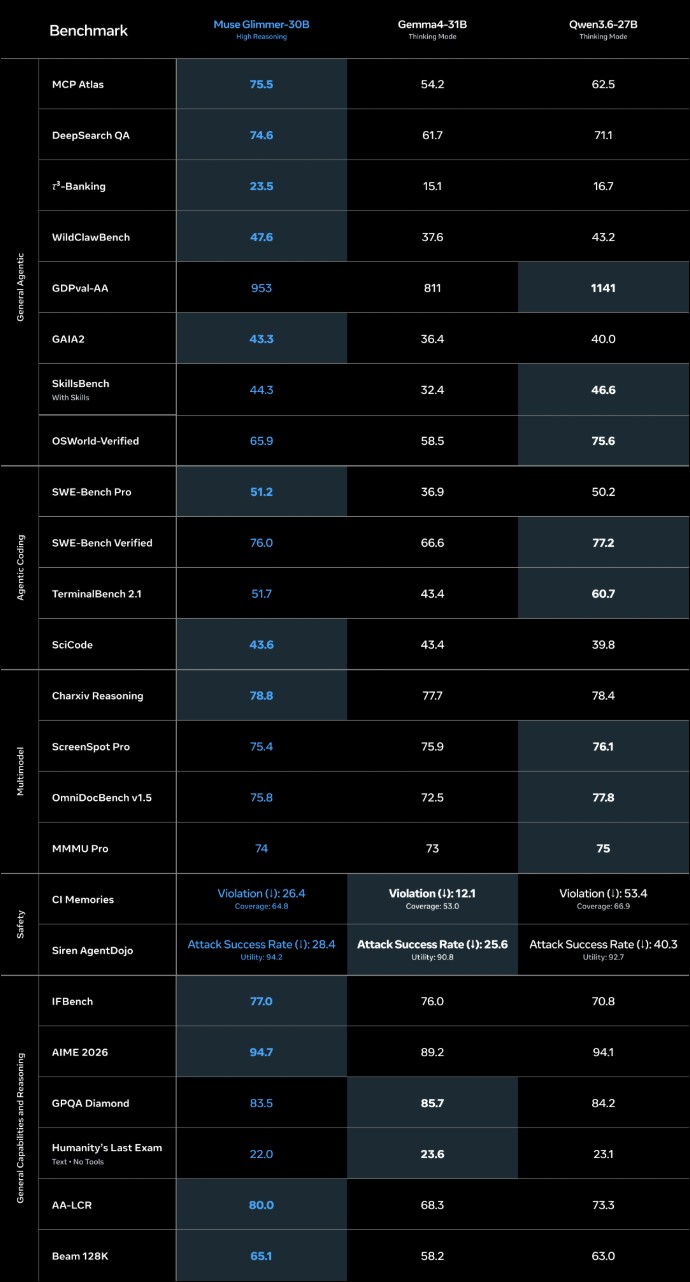
On agentic capability, Glimmer puts real work into tool-calling resilience. When a tool call fails or returns an unexpected result, the model diagnoses and retries instead of aborting the flow. It also supports reasoning modes at different strengths, letting developers switch between speed- and quality-oriented configs. Training data covers 100+ languages, and it’s compatible with agent orchestration frameworks including OpenClaw. Alexandr Wang specifically stressed that Glimmer does not sacrifice agentic reliability at 24GB of VRAM. For safety, Meta evaluated it under its own Advanced AI Scaling Framework, concluding that Glimmer doesn’t meet the Frontier AI threshold, with chemical/biological, cybersecurity, and loss-of-control risks all rated low-to-moderate.
One-Stop Support from Ollama to vLLM
This release has a more complete support ecosystem than past open-source drops. Ollama, LM Studio, and Unsloth will offer one-click run solutions soon; vLLM and SGLang support large-scale deployment; Together AI, Fireworks AI, and OpenRouter provide hosted APIs. Unsloth says it worked with Meta and Hugging Face to implement llama.cpp support, so Glimmer runs on 18GB devices and can be fine-tuned directly. On edge devices, llama.cpp, MLX, and ExecuTorch are covered, with AMD, Arm, Dell, Intel, and NVIDIA all contributing performance tuning — NVIDIA also offers a NIM container for deploying straight into existing GPU environments. Meta also released developer docs and guides for building custom agent frameworks.
Flagship Goes Open Source Too: Muse Spark 1.2 Weight Release Teased
What got the community even more excited than Glimmer itself is the Muse Spark 1.2 open-sourcing plan teased simultaneously by Zuckerberg and Alexandr Wang. Muse Spark is MSL’s main model line — the terminal coding agent “Muse Code” launched on August 5 is powered by Muse Spark 1.2, with the ability to plan changes across large codebases, write code, and verify results. Muse Spark 1.1 was previously served via the Meta Model API, Meta AI, and OpenRouter, but only as cloud APIs. Once Spark 1.2’s weights open up, developers can run a flagship model on their own hardware — the biggest signal Meta has sent the open-source community in 16 months since the Llama 4 backlash.
Summary
Muse Glimmer is available for download on Hugging Face right now; the release date for Muse Spark 1.2’s weights hasn’t been announced yet. For developers, a 30B-class, Apache 2.0, single-GPU agentic model with full ecosystem support will start showing up in local agent projects soon — and the open-sourcing of Spark 1.2 is the more exciting next step to watch.
Source: KOCPC Chinese