


For just $999 (about NT$32,500), an openpilot device can give older cars that don’t support advanced driver assistance lane centering, adaptive cruise control, and even a so-called “hands-off” “FSD-like” experience. Now, the device is facing its most severe regulatory test since its inception. The U.S. National Highway Traffic Safety Administration’s (NHTSA) Office of Defects Investigation opened a preliminary evaluation (No. PE26007) into openpilot and comma.ai on September 21, because five crashes involving the device caused three deaths and up to 11 injuries, and the crash pattern is highly consistent: vehicles with openpilot installed crashed at high speed into stationary or slow-moving vehicles in the same lane.
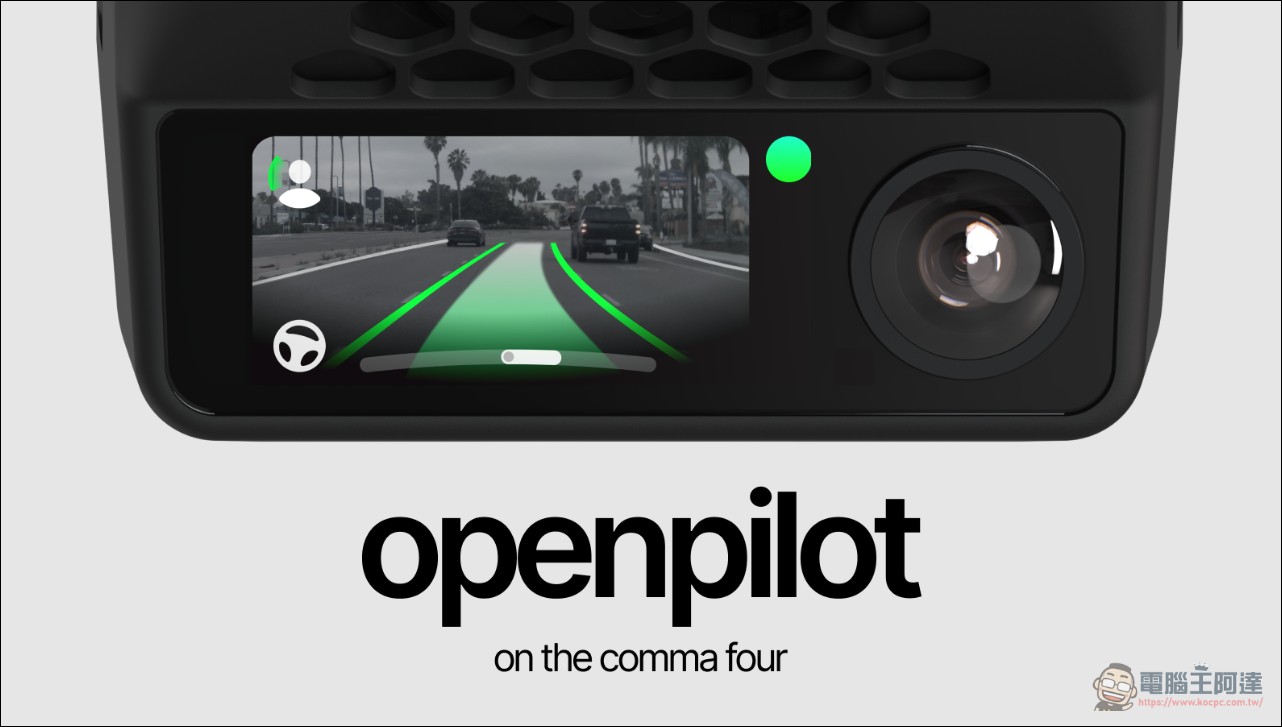
comma.ai was founded in 2015 by the well-known hacker George Hotz. Hotz first became known for cracking iOS and PlayStation, and in 2015 he turned his attention to driver assistance, first modifying his own Acura to get a hands-off driver-assistance system running, originally intending to sell it to Tesla to replace Mobileye. In 2016, after the NHTSA issued a special order regarding its first product, comma one, Hotz killed the product outright, open-sourced openpilot and all the hardware designs on GitHub, and began selling hardware under the “development kit” label. That model has continued to this day. A-Da also tried this system years ago, and it was about L2 level.
The latest-generation comma four launched in November 2025, priced at about $999, connects to a vehicle’s CAN bus as an add-on, supports more than 350 models including Toyota, Honda, and Hyundai, and offers lane centering, adaptive cruise control, forward collision warning, lane departure warning, and other features. The company claims more than 30,000 vehicles already use its device, with over 400 million miles (about 650 million kilometers) driven cumulatively, and says its hands-free driving mileage is second only to Tesla’s. Even more hardcore owners don’t buy the hardware at all, running this open-source system directly on a phone to hand-roll a smart-driving setup for older cars that don’t support advanced assistance. Hotz himself has now stepped back from the company’s day-to-day management.
Another contrast is that comma has taken a more conservative approach to driver monitoring than most competitors: its devices have driver-facing cameras to monitor attention, and it does not claim “Full Self-Driving” like Tesla. In Consumer Reports’ 2020 driver-assistance rankings, openpilot even beat all OEM systems to earn the top rating. It has long been described as “the Android of ADAS”—open, cheap, and highly tinkerable—and what it ran into this time is the blurry line between open-source software and safety responsibility.
NHTSA opens investigation: 5 crashes, 3 dead, 11 injured, all the same type of collision.
rely on NHTSA’s public investigation documentsThe Office of Defects Investigation (ODI), through accident reports obtained under the Standing General Order, consumer complaints, and proactive outreach to police, identified 5 crashes involving comma devices. Officials have confirmed that in multiple incidents the device was on or engaged, and a preliminary data review indicates that openpilot “may not adequately detect or respond to vehicles in the same lane.”
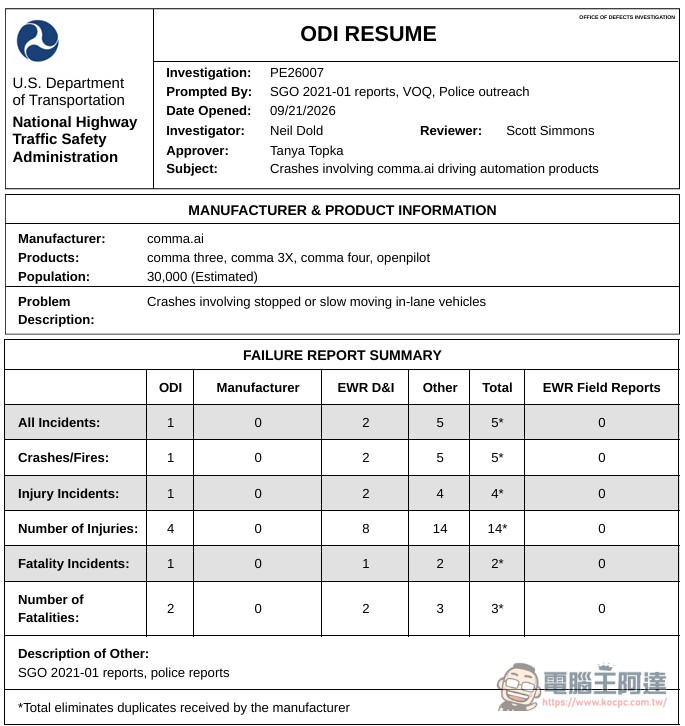
Four of the accidents injured 11 people in total, some seriously; two accidents caused 3 deaths.Foreign media conduct an item-by-item comparison. After reviewing NHTSA’s public crash data, some details of the incidents were reconstructed: In September 2025, a 2020 Honda Accord with openpilot engaged rear-ended a stationary vehicle ahead at 82 mph (about 132 km/h) on a Missouri highway, causing serious injuries and hospitalization; in July 2026, a 2021 Toyota Corolla struck a stationary passenger car at 56 mph (about 90 km/h) on a highway near Mona, Utah. Each followed the same pattern: highway speed and a car stopped in the lane ahead.
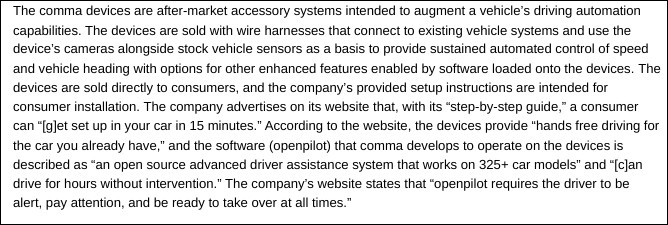
NHTSA’s targets this time include comma’s latest three generations of hardware (comma three, comma 3X, comma four) and openpilot itself, estimated to cover about 30,000 devices. The agency also cited comma’s own marketing copy as supporting evidence, including slogans such as “bring hands-free driving to your existing car,” “15-minute self-install,” and “can go for hours without intervention,” which stand in stark contrast to the statements in its fine print requiring drivers to remain alert at all times and be ready to take over.
Fatal Accident Reconstruction: Crashing into an Unoccupied Police Car While Running a FrogPilot Fork
The most serious publicly documented incident occurred in February 2026 in Ascension Parish, Louisiana. A 2022 Toyota RAV4 crashed on a highway into an emergency response vehicle that was parked in a lane with its warning lights on; the emergency vehicle was unoccupied at the time, and two passengers in the rear seat of the RAV4 died at the scene. In the incident report, comma said the device “appeared to be running third-party software that is not official comma software,” meaning a fork modified by community developers based on the open-source openpilot code. FrogPilot。
Another case also involved a fork. NHTSA explicitly stated that of at least 5 accidents, 2 were related to modified software, including this fatal accident. A major focus of the investigation is which version of the code the vehicle was running at the time of the incident. This also complicates liability: popular community forks such as FrogPilot and sunnypilot are built on the same driving model and codebase as openpilot, and NHTSA said that if an accident involves a modified version, it will evaluate components shared between the fork and the official version.
In fact, openpilot’s official website itself acknowledges that the system has limited performance when dealing with stationary vehicles. The system allows use on any road, with a maximum set speed of up to 90 mph (about 145 km/h), but it lacks the ability to recognize traffic lights and stop signs. And “not seeing stationary vehicles” is precisely a long-standing weakness of camera-based vision systems. In 2021, Tesla Autopilot was investigated by NHTSA over multiple crashes into stationary emergency vehicles, ultimately ending with an OTA update recall covering about 2 million vehicles.
comma’s Offense and Defense: “We May Not Be Obligated to Reply”
In response to a regulatory investigation, comma said that every one of its incident reports begins with the same statement: providing information “does not indicate agreement with NHTSA’s interpretation, nor does it acknowledge that comma has an obligation to respond to the order.” When asked whether the accident vehicle was within the system’s operational design domain, comma uniformly entered “unknown,” on the grounds that the company neither manufactures vehicles nor is responsible for the manufacturer’s driver-assistance system.
In the rear-end collision involving a Honda Accord, comma even specifically noted in all caps that the adaptive cruise control at the time was “being handled by the Honda system.” In other words, comma sells a device that takes over steering and vehicle speed and markets it as hands-free driving, yet when something goes wrong, it pushes braking responsibility back onto the automaker. Another detail is an alternative account of the Missouri accident: Honda itself also submitted a report on the same accident, citing the police report and litigation to state that the driver had set cruise control to 80 mph and then fallen asleep. This highlights the regulatory challenge of aftermarket driver assistance: the device provides a “reduce driver workload” capability, but drivers often use it beyond the system’s boundaries.
Conclusion
This preliminary evaluation could take months, and it will ultimately go one of two ways: the case is quietly closed, or it escalates to an engineering analysis and then to a recall demand. The problem is that when the software is an open-source project that anyone can fork and modify on GitHub, regulators will probably first have to figure out how the word “recall” is even supposed to work (after all, the crash was not caused by Comma’s device, and the driver’s use of it was also problematic). The investigation is still at the preliminary evaluation stage, and NHTSA will decide whether to escalate the follow-up process. For more than 30,000 openpilot users, this investigation is a belated wake-up call: assisted driving is ultimately only “assistance.” That stationary car in the highway lane—whether it involves a factory system or open-source equipment—still requires the driver to hit the brake. After all, even a powerhouse like Tesla has crashed in Taiwan, and “assisted driving” does not insure your life in any way.
Source:1 / 2
Source: KOCPC Chinese