


Recently, Starbucks officially announced that it is discontinuing the AI-powered automated inventory tool co-developed with NomadGo and requiring all North American stores to return to manual management. Since its rollout to over 11,000 North American stores in September 2025, the tool has repeatedly experienced issues such as misread labels and missed items, ultimately forcing it to be discontinued less than nine months after launch.
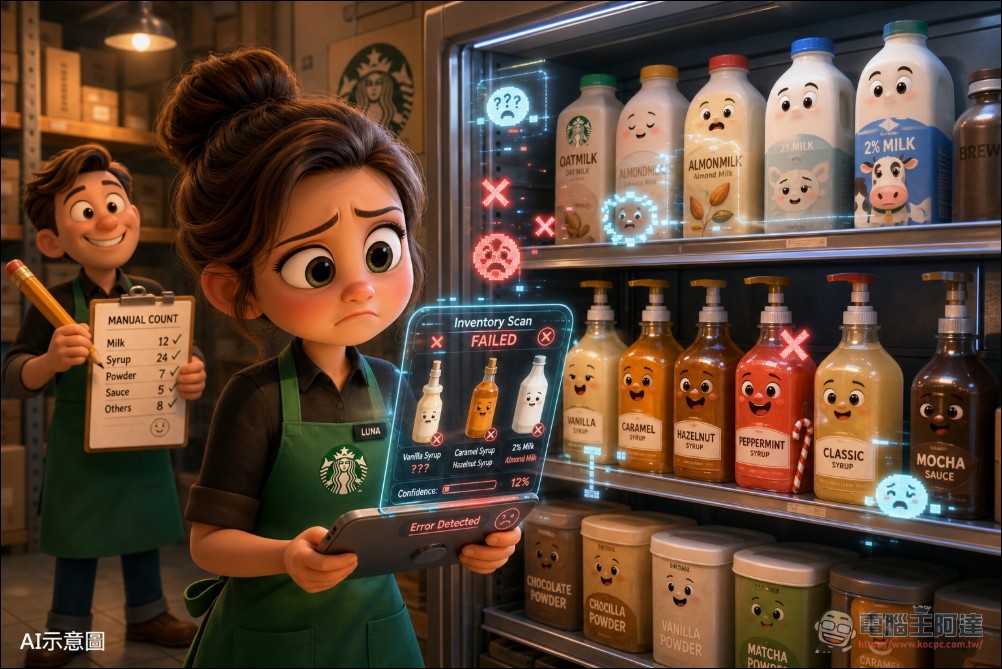
Starbucks Abandons AI Inventory Tool After Frequent Errors, Declares It a Failure
How AI Inventory Management Tools Work
NomadGo’s AI inventory management tool combines computer vision, 3D spatial intelligence, and augmented reality (AR) technologies. Employees use handheld tablets to scan refrigerators and shelves, and the system automatically calculates in-stock quantities of beverage ingredients such as milk and syrup in real time. The tool was designed to let stores track inventory status in real time, speed up restocking, and allow staff to step out of the back room and focus on serving customers.
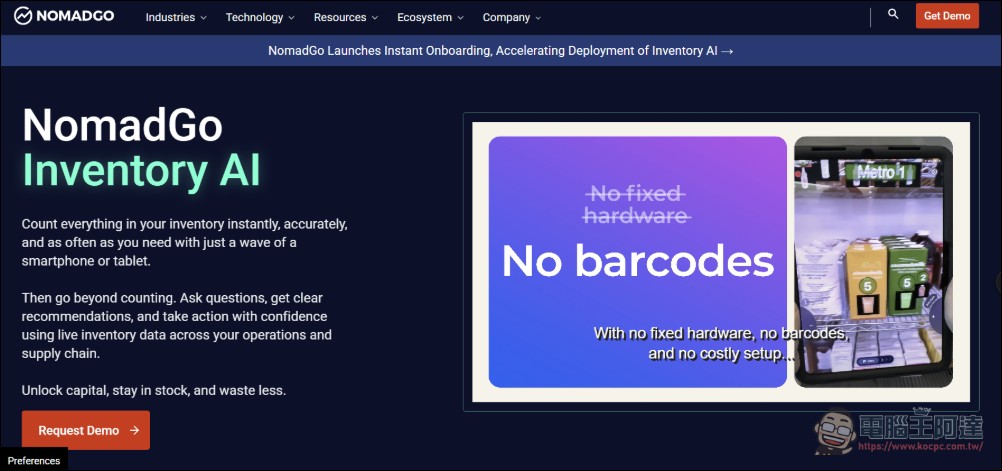
Frequent errors forced the tool to terminate.
However, after the tool officially went live, problems began to surface one after another. Internal documents obtained by Reuters revealed that the system would occasionally confuse similar types of milk and even miss scans. A promotional video Starbucks had released earlier already exposed a hidden risk in the system: as an employee scanned the shelves, a bottle of mint syrup was completely skipped by the system. Upon hearing that the tool was being discontinued, one Starbucks employee commented, “Thank you for discontinuing automatic inventory counting! The concept is great, but execution is truly full of challenges.” In an internal communication, Starbucks announced, “Effective immediately, the automatic inventory counting feature will be terminated… Beverage ingredients and milk will return to being counted in the same way as other inventory categories in the store.”
Connection to CEO Brian Niccol’s Revitalization Plan
This decision to abandon AI and the ‘…’ led by CEO Brian NiccolBack to Starbucks“closely related to the revitalization plan. Since taking office in September 2024, Niccol has repeatedly emphasized that product shortages have negatively impacted performance, and has called for concrete improvements to store operations. Starbucks posted a 4% same-store sales increase in the first quarter of 2026, and Niccol’s measures—streamlining the menu, reconfiguring café seating, and launching AI employee assistants such as Green Dot Assist—are gradually showing results.
NomadGo, addressing the failed partnership, only stated that it “continues to learn from customer and user feedback,” without directly responding to the specific reasons behind the tool’s failure. The company had previously claimed its technology could achieve 99% accuracy and complete shelf scans within 30 seconds, but actual performance fell far short of expectations.
AI is not a panacea.
Starbucks stated that it will shift to a more frequent daily replenishment mechanism and continue optimizing supply chain operations. The company reiterated its core goal: “As long as a product is on the menu, customers should be able to order it.” Overall, this is a typical case where AI technology has encountered challenges in real-world commercial scenarios. Although the concept is forward-looking, the complexity of the retail environment—such as distinguishing similar products and missed scans—means that AI accuracy has yet to meet acceptable standards, ultimately forcing a return to traditional manual methods. The Starbucks case may serve as a reference for companies looking to integrate AI into their workflows.
Source: KOCPC Chinese