


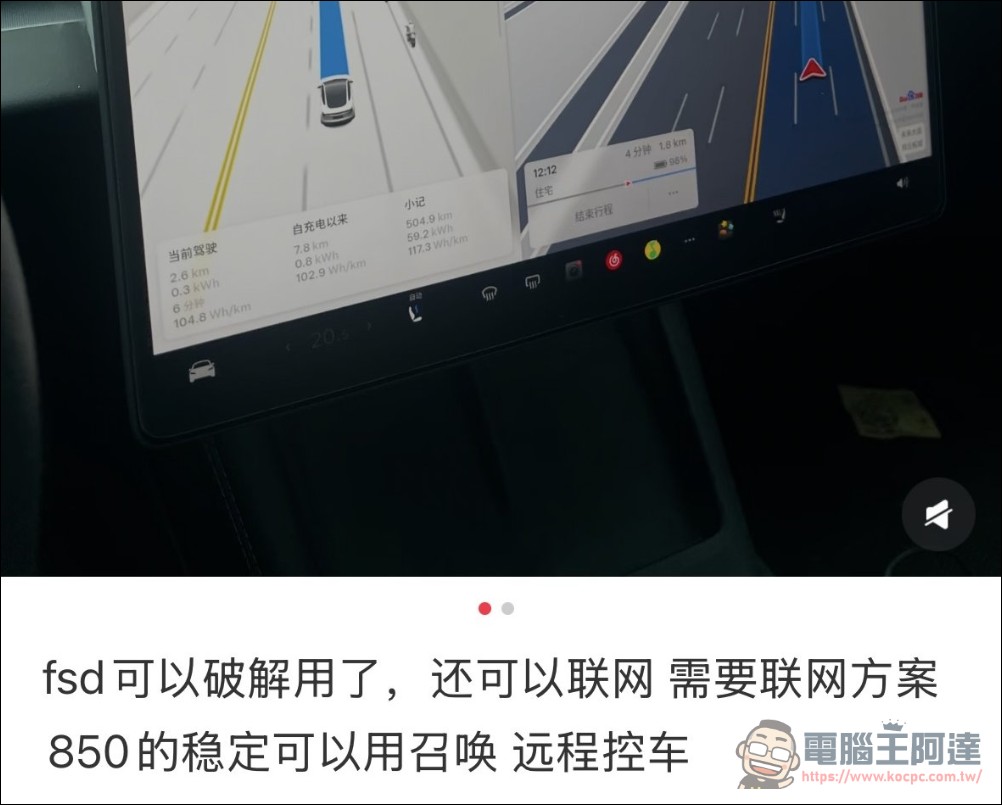
Although China’s Tesla made a high-profile announcement last year that it would open FSD, it was stopped by China’s regulatory policies. Although there has been news that it will open up, there has been no official news. Therefore, an emerging gray business has emerged in the Chinese car owner community, using physical hardware to crack the use restrictions of Tesla’s FSD (Full Self-Driving) autopilot system in China, and renting out the cracked vehicles at a price of 100 yuan per hour or 333 yuan a day.
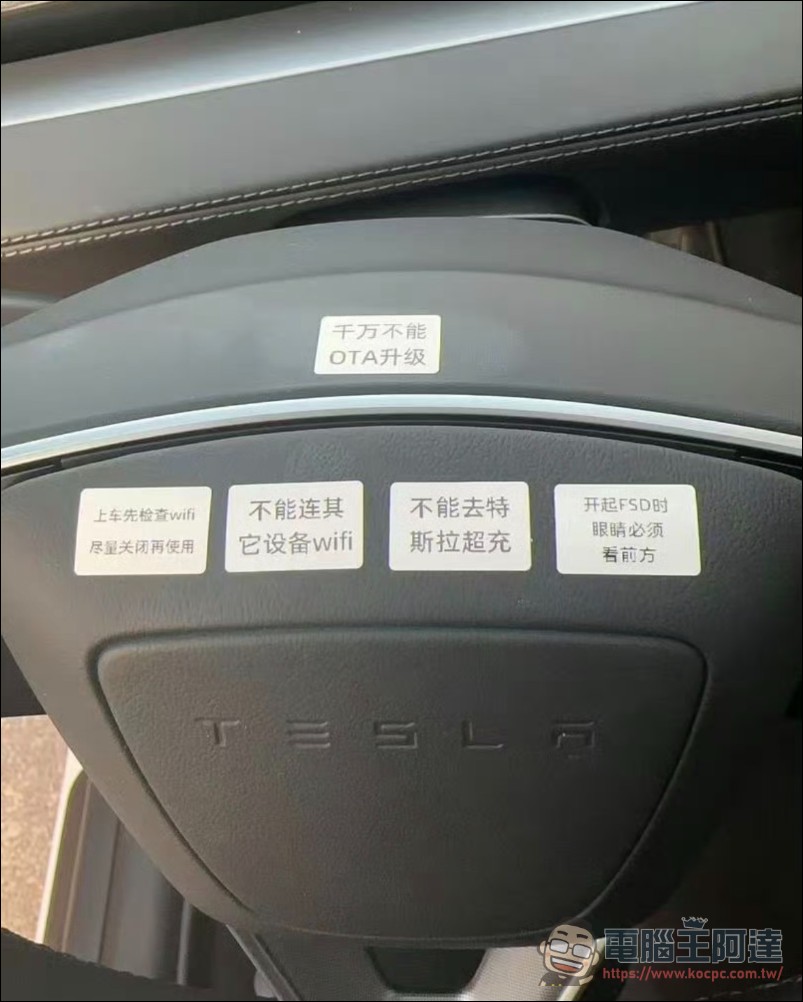
But the hack didn’t come without a price. According to the warning slogan posted by the car owner behind the steering wheel, the cracked vehicle “must not be upgraded OTA”, “cannot go to Tesla to overcharge”, “cannot connect to other devices’ WiFi”, otherwise the crack will be detected and blocked by Tesla, and the overcharging and system upgrade functions will also be permanently disabled.
Crack principle: Raspberry Pi “cheats” into opening FSD
The starting point of this FSD cracking storm can be traced back to late March 2026. A project called “FSD Modification” on the GitHub platformOpen source projectsThe cracking method was exposed and quickly spread to the Chinese car enthusiast community.
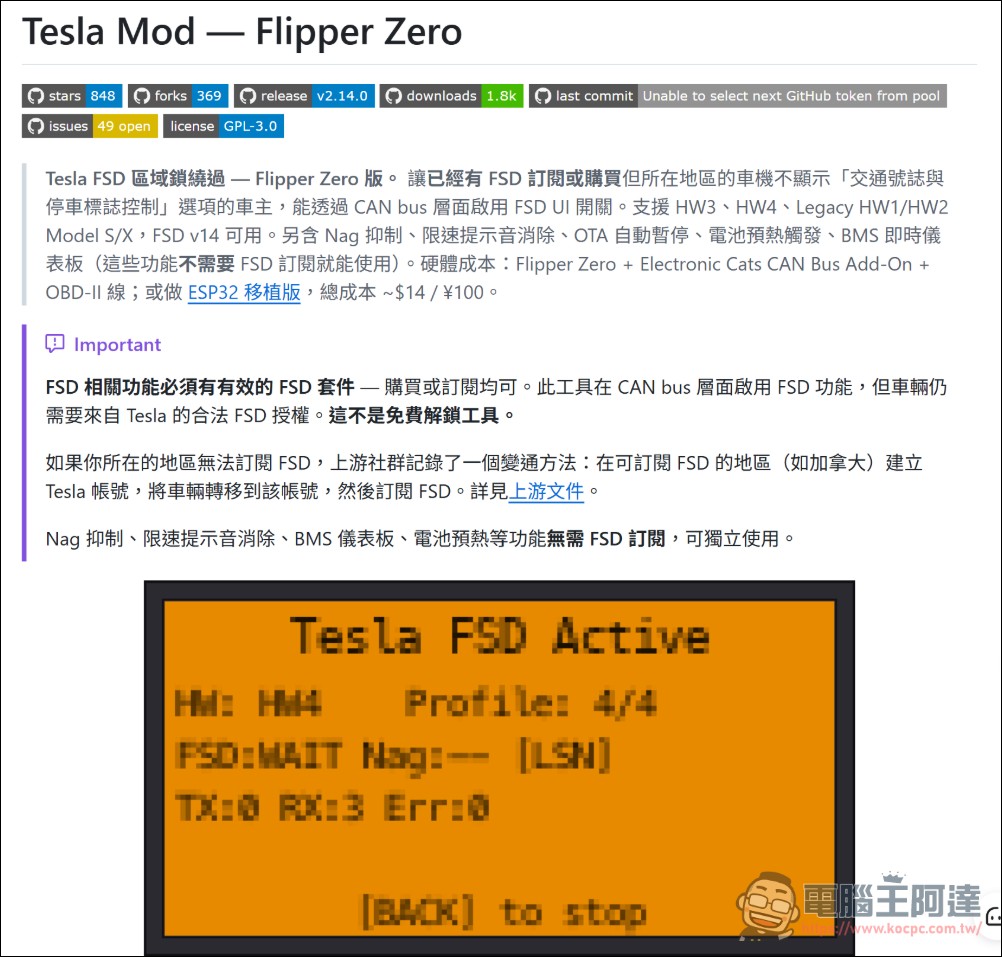
The cracking principle is not to generate the FSD function from scratch, but to connect the vehicle’s CAN bus (Controller Area Network) through the Raspberry Pi development board, send specific CAN signals to bypass official authorization, and trigger the hidden permissions of the FSD that are already preloaded in the vehicle. An intelligent driving engineer explained: “The CAN box is like a signal converter, which sends an ‘open door message’ to Tesla. After the car recognizes it, it thinks it is officially authorized, and modifies the value of a certain register to release the FSD function.
To put it simply, this crack is limited to models that have paid for FSD but have not yet enabled it. If FSD was not purchased at the beginning, it cannot be “made out of nothing.”
Tesla launches massive crackdown on FSD crack in April
In mid-April 2026, Tesla launched a large-scale sweep operation. According to multiple foreign media reports, Tesla uses OTA remote updates to simultaneously remotely disable cracked vehicles in six countries including China, Europe, the United Kingdom, Japan, and South Korea, so it requires disconnection from the Internet or it will be immediately locked).
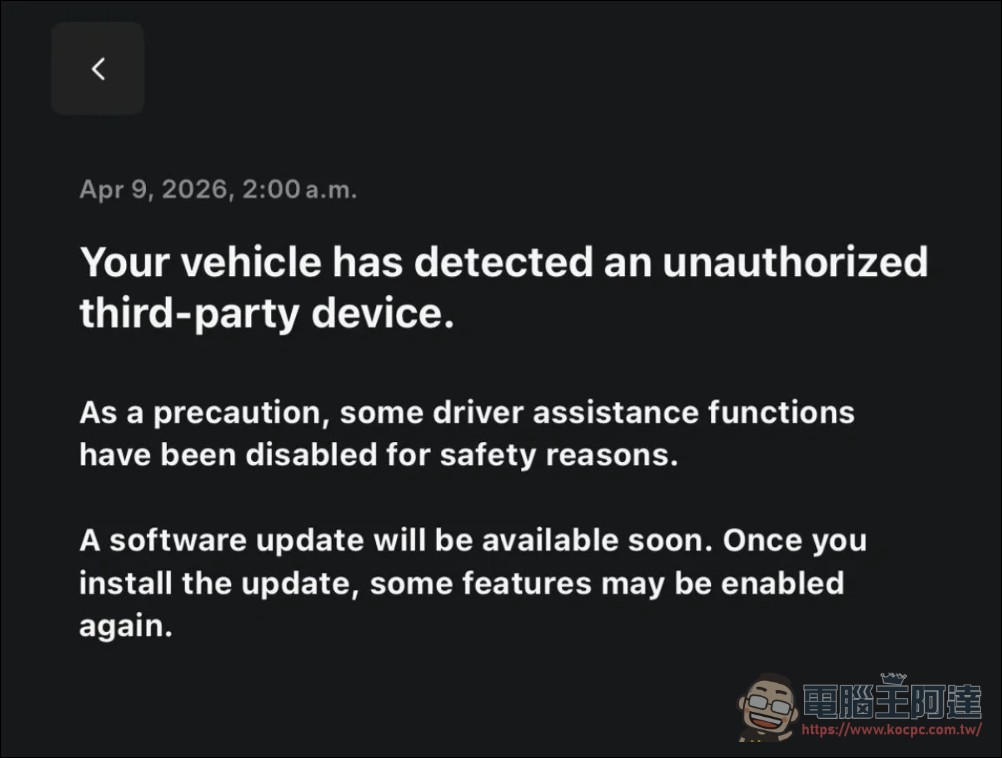
The vehicles were equipped with unauthorized CAN bus devices (which cost approximately $700 to $2,000) that spoofed GPS coordinates to trick the vehicles into thinking they were in FSD-approved markets such as the United States. Tesla’s handling methods are extremely tough: disabling FSD remotely, permanently blocking the accounts of Chinese car owners, no refunds, and no amnesty period. The on-board notification received by the car owner reads: “Your vehicle has detected an unauthorized third-party device. For safety reasons, some driver assistance features have been disabled.”
Tesla also warned that car owners who use such cracking devices must bear full legal responsibility for the accident, and the vehicle will lose its warranty. In South Korea, such behavior is classified as a criminal offense, punishable by up to 2 years in prison or a fine of approximately 13.5 million won (approximately NT$310,000).
The Gray Market Is Back: Cracking the FSD Rental Business
After more than two months, a new cracking model has appeared again in the Chinese Tesla owner community. According to the news on the social platform
最近出现一个新生意,用物理硬件破解特斯拉自动驾驶 FSD,在内地的使用限制。
然后对外每小时 100 或全天 333 元出租。
不过强制破解后,超充、升级就都坏了。 pic.twitter.com/SuiBvrDNKQ
— AB Kuai.Dong (@_FORAB) June 14, 2026
From the photos shared by the car owner, we can see that the back of the steering wheel is covered with warning slogans, including “Never do OTA upgrades”, “Cannot go to Tesla to overcharge”, “Do not connect to other devices’ WiFi”, etc. This means that although this cracking solution can enable FSD, the vehicle will no longer be able to receive official updates, cannot use Tesla Super Charging Stations, and must be completely isolated from the network to avoid being blocked again by Tesla’s back-end system if it detects abnormalities.
Why does this kind of modification demand appear? In addition to some players who want to experience new technologies first, there are also many channels in China that specialize in making Tesla FSD videos for a living. There are also similar channels in Taiwan. There is really no need for ordinary people to take the risk of breaking the warranty to play with such equipment.
Tesla Taiwan officially delivers FSD today
While China’s FSD cracking and leasing chaos continues, good news comes from Tesla in Taiwan. On June 16, 2026, Tesla Taiwan officially submitted the FSD (Supervised) application documents to the Vehicle Safety Inspection Center (Vehicle Safety Center), and fully automatic assisted driving (subject to driving supervision) officially entered the review process in Taiwan.
According to the process, after the Vehicle Safety Center confirms the completeness of the data, it is expected to convene a technical committee to review the application documents and road test plan within 2 to 4 weeks. If the preliminary review is feasible, it will be submitted to the Ministry of Transportation for approval (about 2 weeks), and road testing will be started after approval. Since FSD (Supervised) maintains the SAE Level 2 assisted driving positioning, Taiwan’s current regulations do not require the completion of Level 3 or above autonomous driving amendments first, and can be accepted according to the “New Technology Driving System” inspection mechanism. The fastest time to hit the road may fall in late 2026 to early 2027.
FSD buyout only until June 30
Along with the delivery news, Tesla also simultaneously announced major adjustments to the way FSD is purchased in Taiwan. The FSD one-time buyout plan will stop selling at 23:59 on June 30, 2026. Starting from 0:00 on July 1, the Taiwan official website and Tesla App will no longer allow FSD one-time upgrades to be purchased, and will switch to a subscription system.
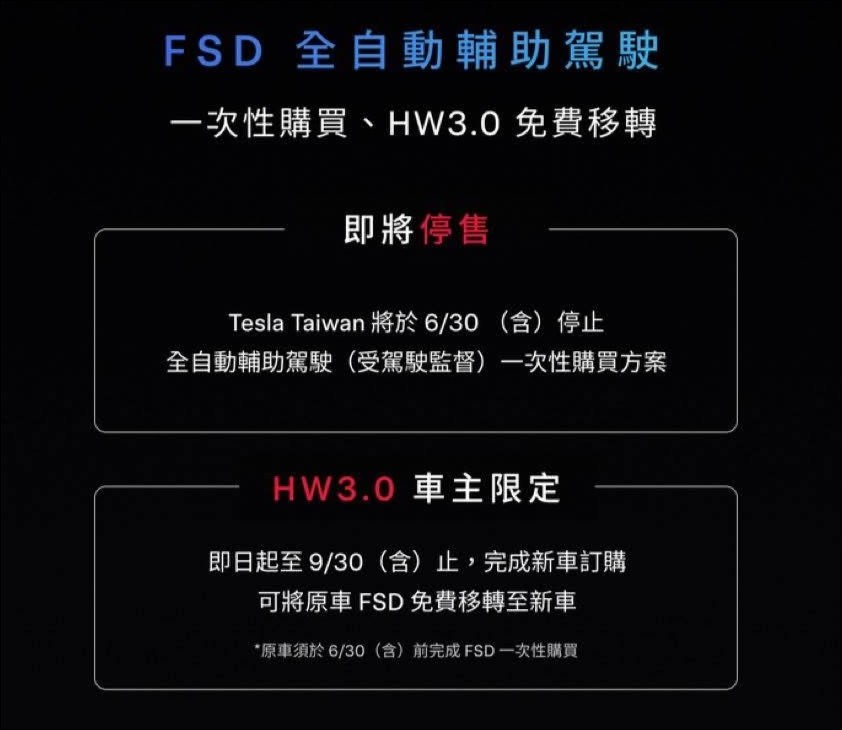
For vehicles that have been equipped with FSD before the deadline, the original lifetime ownership rights will not be affected. Existing car owners who have not yet selected options can upgrade and purchase through the Tesla App before June 30; new car orders that have not yet been delivered can also add FSD options on the order page before delivery. For HW3.0 car owners, Tesla also provides a free FSD transfer plan. If the existing vehicle has been equipped with FSD and the new car order is completed before September 30, 2026, the existing FSD can be transferred to the new car for free.
Although the price of FSD subscription in Taiwan has not been officially announced, but based on the pricing ratio of Tesla’s top-level connection in the United States and Taiwan, the industry estimates that the monthly FSD subscription fee may fall between 2,990 yuan and 3,190 yuan per month; for car owners who have chosen EAP to upgrade the FSD subscription, it may fall between 1,490 yuan and 1,590 yuan per month. The actual cost is subject to the official announcement from Tesla Taiwan.
Source: KOCPC Chinese