


A 7.1 magnitude earthquake occurred in Kumamoto Prefecture, Japan, at around 4:27 pm local time on July 28, 2026, with a maximum magnitude of 7. More than 210,000 people were evacuated, and many people were killed in the Aeon Mall explosion. Many people on the Internet share the Japanese government’s major disaster relief measures. Taiwan is also an area where earthquakes occur frequently, and you can attack the wrong people with rocks from other mountains. This coincides with Taiwan’s first 30-minute mobile network blockage drill in central and northern Taiwan in mid-August, which has caused panic among many heavy Internet users. What Japan’s disaster relief measures for Kumamoto Prefecture are worthy of reference by the Taiwan government and NCC? The following is an analysis and suggestions:
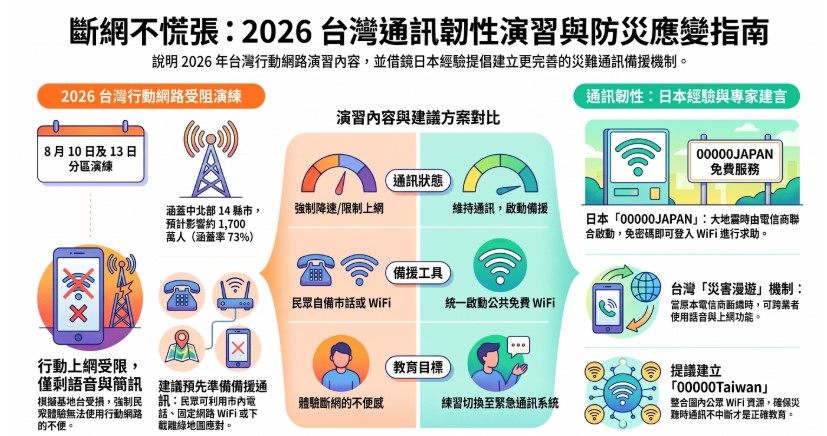
The 7.1-magnitude Kumamoto Earthquake that hit Japan recently caused considerable disasters. Taiwan’s urban resilience drills must learn from the actual crises caused by major disasters or wars. Taiwan is about to conduct its first disaster rescue drill with mobile network communications blocked, and only conducting mobile network speed limits for the drill has caused many doubts. What are the communication resilience measures taken by Japan in response to the Great Kumamoto Earthquake that Taiwan can emulate?Summary video and detailed description:
1. Taiwan’s 30-minute mobile network blockage drill:
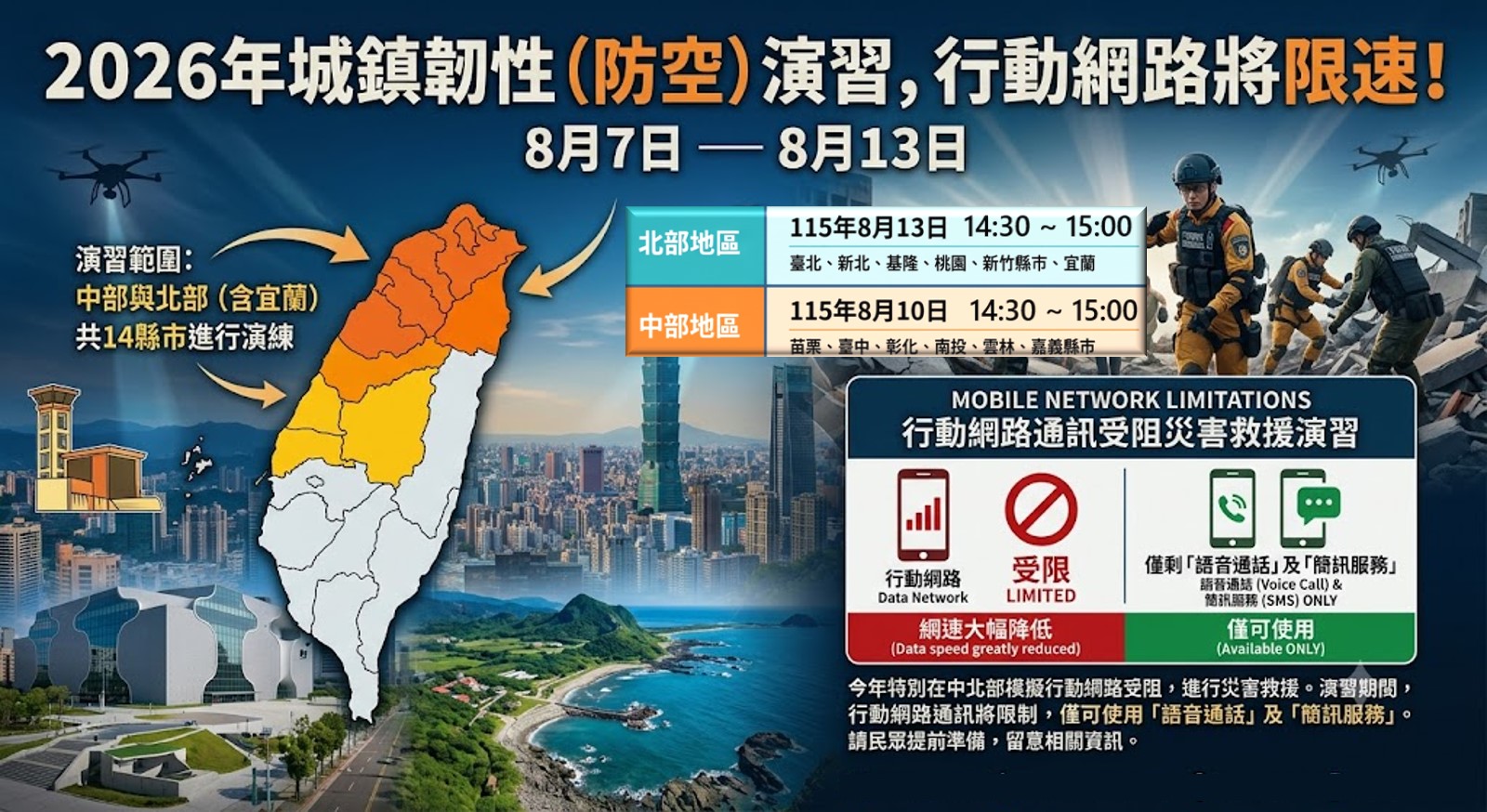
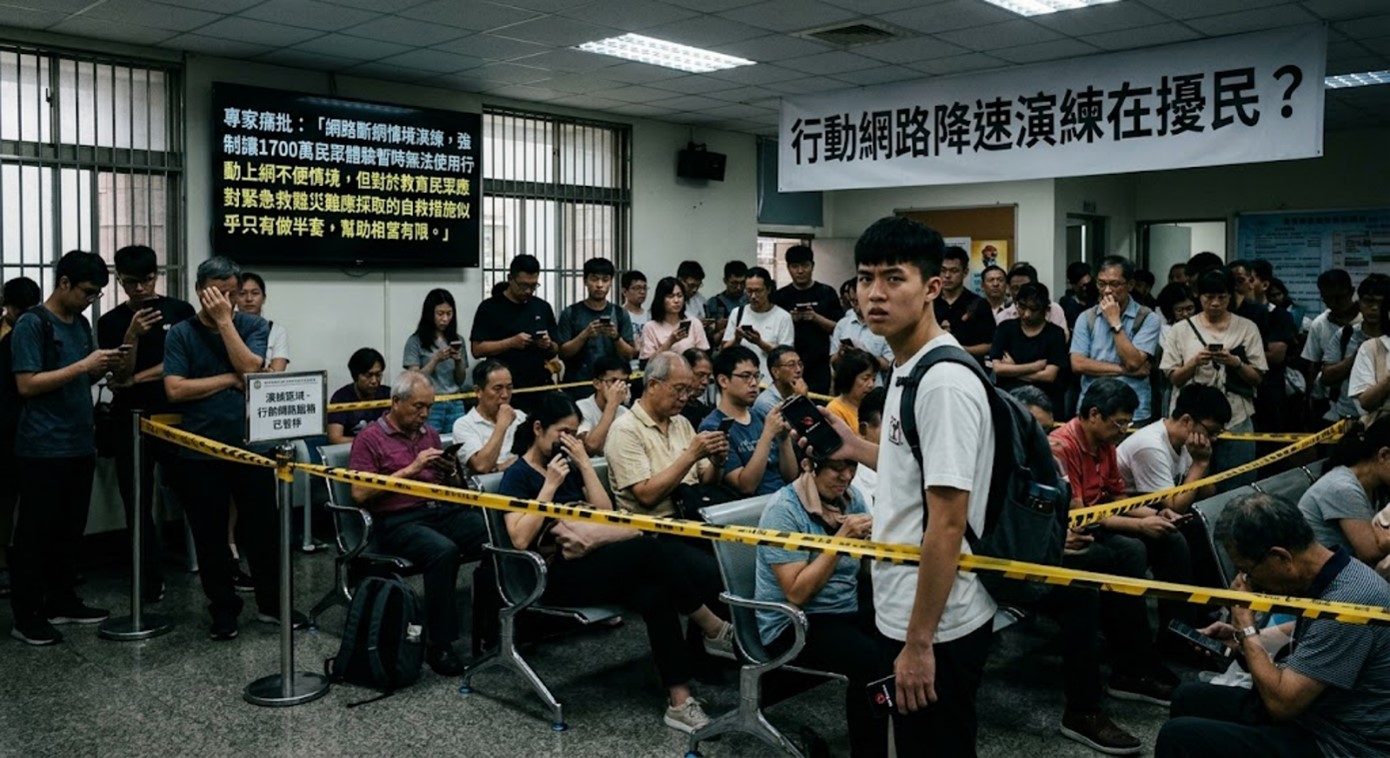
Taiwan will conduct disaster rescue drills on August 10 and August 13, 2026, in a total of 14 counties and cities in central and northern China (including Yilan). During the exercise, mobile network communications will be restricted, leaving only “voice calls” and “SMS services” (see “for details”This article“)。
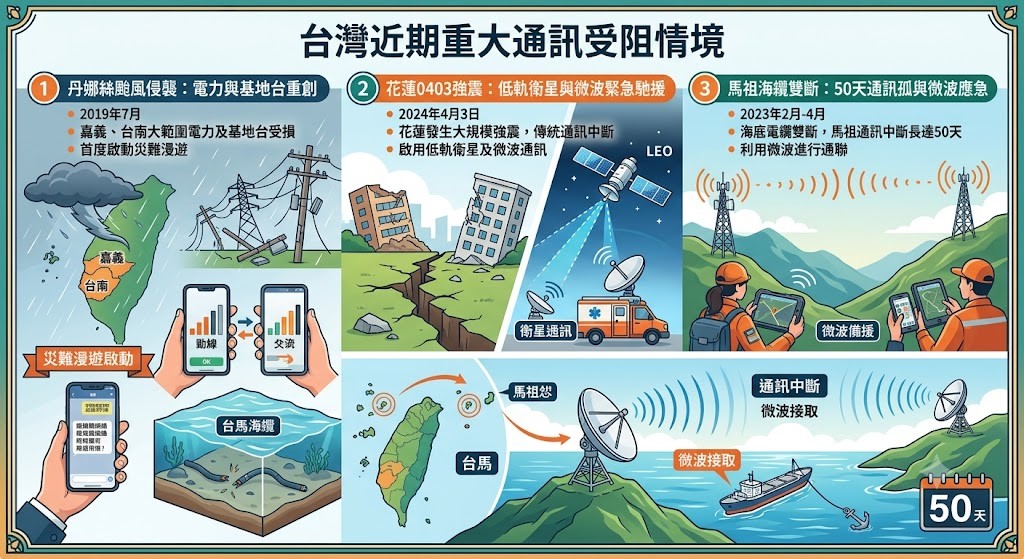
In view of the fact that the southern, eastern and outer islands have experienced actual communication disruptions in recent years, including Typhoon Danas, which caused widespread power and base station damage in the Chianan area, disaster roaming was launched for the first time; the Hualien 0403 earthquake also enabled low-orbit satellite and microwave communications; Matsu also used microwaves for communication due to submarine cable interruptions for 50 days. ..etc., etc., led the NCC and the Ministry of Digital Development to decide to use the 2026 Urban Resilience (Air Defense) Exercise to practice the situation of mobile network communication being blocked for the first time.
Therefore, NCC planned the scope of the exercise based on past disaster experience and foreign practices, and through inter-ministerial consultations, taking overall considerations from aspects such as communication traffic and population density to plan the scope of the exercise. In the first round, it selected the areas with the highest mobile communication traffic in the country for implementation, giving priority to the population. The densely populated central and northern regions are estimated to have a population coverage rate of 73%, affecting approximately 17 million people. It is hoped that the exercise will be used to strengthen the response capabilities of the government and the people. In the future, it is planned to gradually expand the scope of management to all counties and cities across the country to strengthen the country’s communications resilience preparedness. Regarding necessary network communications that the outside world is worried about, NCC stated that public services such as emergency ambulances, ATMs, traffic signals, etc. will not be affected. People can also use local telephones, WiFi and other fixed-line connections to establish backup methods. In addition, it is also recommended that the public download the fire prevention and disaster prevention and police information APP offline maps in advance to facilitate querying relief station and shelter information in the event of a disaster.
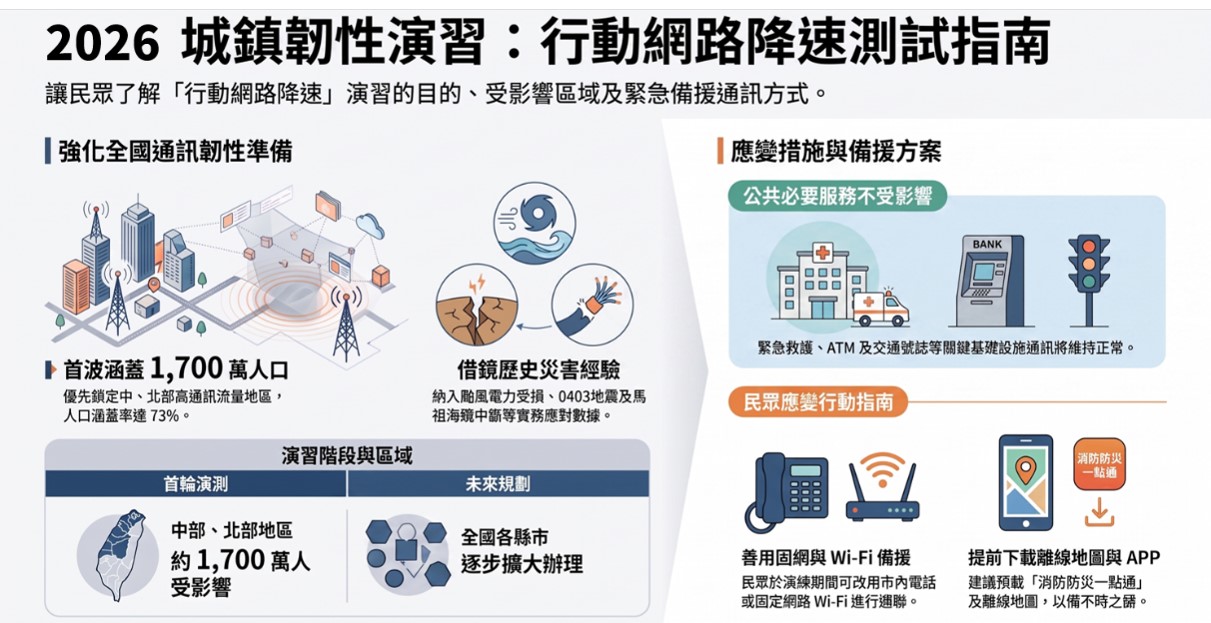
In other words, Taiwan’s first “mobile network slowdown” exercise forced 17 million people to temporarily lose access to mobile Internet, causing many experts to question its effectiveness. The moderator believes that this drill only allows the public to experience the inconvenience of being unable to access the Internet, but it is of limited help in educating the public on self-rescue measures in response to emergency rescue disasters.
2. Japan’s Kumamoto Earthquake: Taiwan’s Urban Resilience Drill Operation Network Blocked Drill Needs Strengthening:
A.Taiwan’s current「Disaster Alert Newsletter」and“Disaster Roaming”Communications Resilience Measures:
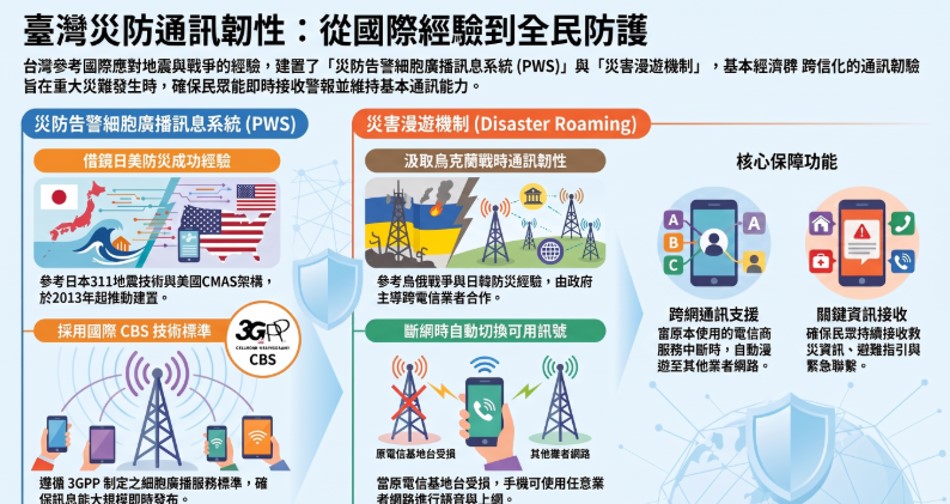
Taiwan and Japan are both countries facing high risks and frequent natural disasters such as earthquakes and hurricanes. The situation in Ukraine during the Russo-Ukrainian War has also become a model for Taiwan’s urban resilience. In response to the need for disaster prevention and resilience in response to natural disasters and communication disruptions, Taiwan has developed the “Disaster Warning Cell Broadcast Message System” (PWS) and “Disaster Roaming” (or disaster roaming) mechanisms in recent years.
The “Disaster Warning Cell Broadcasting Message System” (PWS) is based on Japan’s successful experience in successfully using cell broadcasting (CBS) technology for real-time mobile phone disaster prevention warnings after the 2011 March 11 earthquake. Taking advantage of Japan’s policies at that time and combining the three major telecommunications companies to significantly reduce casualties, the Executive Yuan and the NCC began to promote and build our country’s exclusive disaster prevention and warning system in 2013. This technology is an instant disaster mobile phone warning method developed in Japan after the Great East Japan Earthquake in 2011. It technically follows the Cellular Broadcast Service (CBS) international standard developed by 3GPP and refers to the Commercial Mobile Alert System (CMAS) architecture of the United States.
Taiwan’s “disaster roaming” (or disaster roaming) mechanism draws on Ukraine’s response experience in maintaining uninterrupted wartime mobile communications during the Russo-Ukrainian War, and also refers to Japan, South Korea and other countries’ disaster prevention and resilience practices in response to natural disasters and communication disruptions. “Disaster roaming” is led by the government and invites the assistance of various telecom operators. When a major disaster or emergency occurs, if the telecom operator originally used by the public cannot provide services (for example, the base station is damaged), mobile phones can use this mechanism to allow the public to use the network of any telecom operator and still use voice calls and Internet functions, ensuring that they can continue to receive “disaster relief information, evacuation guidance, and emergency contacts.”
B. Other rocks from the Great Kumamoto Earthquake in Japan:Japan’s “00000JAPAN” free WiFi service.
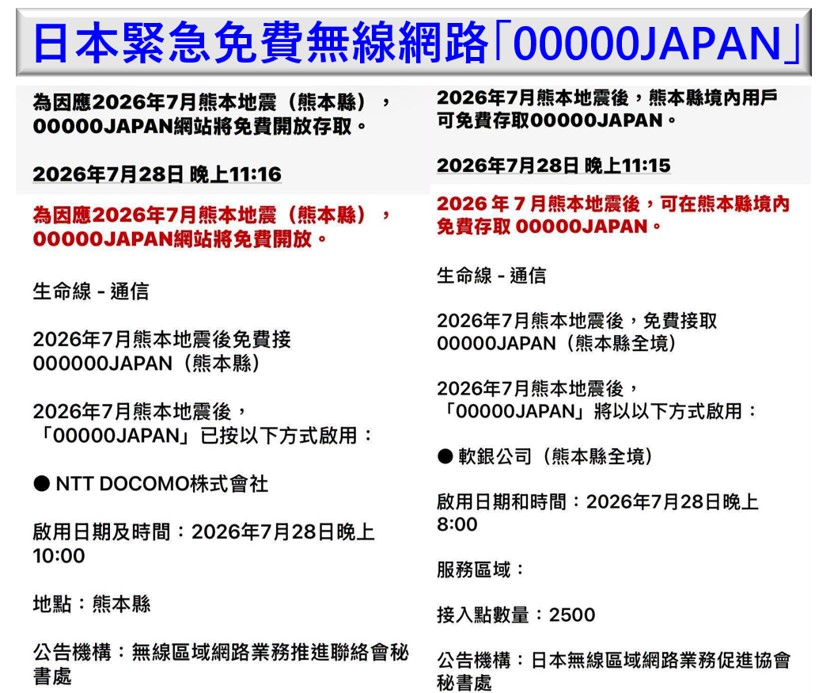
The recent earthquake in Kumamoto, Japan, not only caused communication inconvenience to local residents, but also caused a catastrophe to international tourists. On the day of the earthquake, many Taiwanese people who were traveling in Kumamoto reported on Threads that they were unable to return to their hotel or tourist destination due to traffic congestion and their travel was interrupted, and they asked for help. This shows the importance of mobile networks or backup plans when disasters occur.In response to the problem of communication interruptions caused by major earthquakes, Japan has once again launched the [Emergency Free Wireless Network “00000JAPAN”]. The two major Japanese telecommunications companies provide people throughout Kumamoto Prefecture with free WiFi Internet access services to meet the emergency Internet needs of local people and tourists.
“Japan Emergency Free Wireless Network “00000JAPAN” (Five Zero Japan)” is a free disaster public Wi-Fi service jointly launched by major telecommunications companies in Japan when major disasters such as major earthquakes or typhoons occur. When communications in disaster areas are blocked, people and tourists can simply turn on their mobile phone’s Wi-Fi and click on the network to connect directly without entering a password or registering.
“00000JAPAN” (originated in April 2014, was developed based on the lessons learned from the communication outage of the Great East Japan Earthquake in 2011, and was first used in an actual large-scale disaster in the Great Kumamoto Earthquake in April 2016. This is a unified free Wi-Fi service provided by Japan in the event of a large disaster or communication outage. No matter which telecommunications company you use, you can use it for free, aiming to help everyone check information and report safety to family and friends when a disaster occurs.
⚠️ Note: It is not available everywhere in Japan. You must be near a Wi-Fi hotspot open to 00000JAPAN to connect. In addition, since it is not encrypted, please do not use it to log in to online banking or enter important personal information such as credit cards.
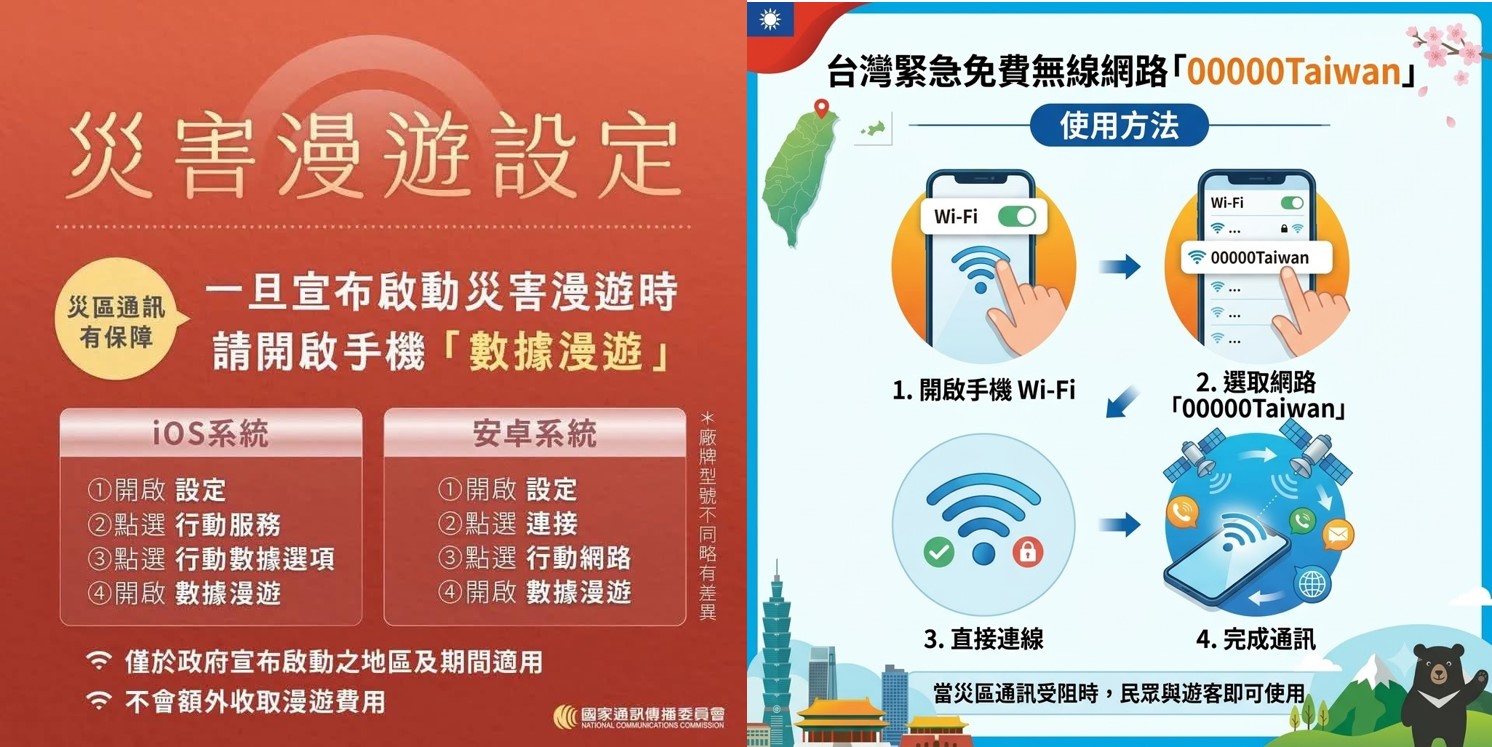
Taiwan already has iTaiwan and Taipei Free free Internet services, and Chunghwa Telecom currently has deployed more than 50,000 CHT Wi-Fi public hotspots across Taiwan. It should not be difficult for Taiwan to follow Japan’s example in establishing “Emergency Free Wireless Network “00000JAPAN””. It is recommended that the NCC and the Ministry of Digital Development can learn from this example to make up for the shortcomings of “disaster roaming”.
As for the “mobile network slowdown” exercise implemented for the first time in Taiwan, it only forced 17 million people to temporarily lose access to mobile Internet, and was unable to truly educate the public to activate Internet backup measures. The moderator suggested that NCC should integrate Taiwan’s public WiFi service resources and integrate [Taiwan Emergency Free Wireless Network “00000Taiwan”]. Allowing Taiwanese people to practice using [Taiwan Emergency Free Wireless Network “00000Taiwan”] or [Disaster Roaming] when communications are interrupted, so that the mobile network will not be interrupted or slowed down, is the correct way to establish communication resilience education for all.
Source: KOCPC Chinese