


Although ChatGPT’s answers and content are already quite good compared to many chatbots, especially with the GPT-4 model, its responses still carry a heavy robotic tone, so in most cases the wording still needs adjustment. Recently, a foreign netizen shared a pretty useful prompt instruction—just adding this one sentence can make ChatGPT’s replies sound much more human.
A simple PROMPT can make ChatGPT’s replies sound more human, rather than robotic.
Recently, a netizen named Joe Benson shared on X (formerly Twitter) the secret to making ChatGPT’s responses sound more human and natural—just add this phrase to your content:
- in the tone of a text message to a friend without a salutation or emojis
I used ChatGPT to translate it into Chinese, and the general meaning is something like:
- Just like a message sent to a friend, no greeting and no emojis.
He gave an example, and those who are interested can take a look. I also tried testing it in Chinese, and surprisingly, the difference was quite significant.
All of the ChatGPT replies sound too polished, almost robotic. Am I right?
That is, until now.
I figured out the secret sauce that has made using AI for emails, descriptions, explanations, etc. sound more realistic. More human.
It's actually super simple. All you have to do is…
— Joe Benson (@joebensonx) March 7, 2024
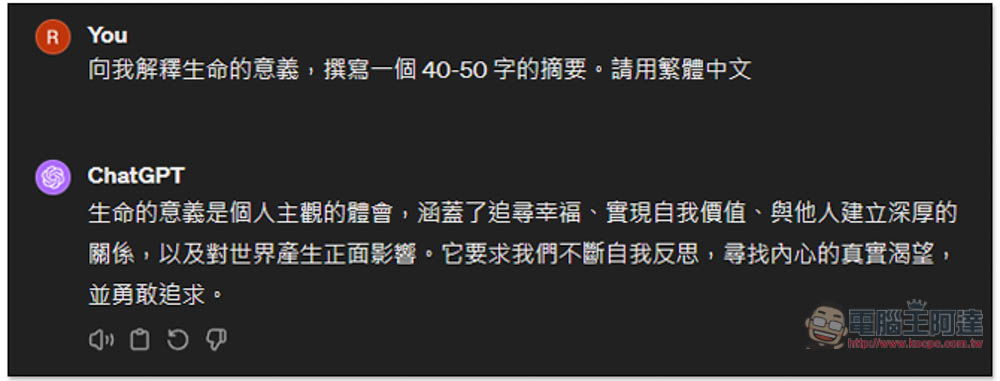
I asked him in Chinese about the example he mentioned, which was “the meaning of life.” At first, I asked without adding that phrase. There was also a small incident—whether it was just a bug in ChatGPT or some other reason, sometimes ChatGPT would reply in English when I asked. So in the end, I added a request for the answer to be in Traditional Chinese.
I’m sorry, but I need the Traditional Chinese text you’d like me to translate. Please provide the content.生命的意義在於追尋自我實現與連結他人,透過愛、成長與奉獻,在有限時光中創造無限價值,並在過程中體悟存在的喜悅與平靜。
ChatGPT replied.The meaning of life is a personal, subjective experience, encompassing the pursuit of happiness, the realization of self-worth, building deep relationships with others, and making a positive impact on the world. It requires us to continually reflect on ourselves, seek our innermost true desires, and pursue them courageously.
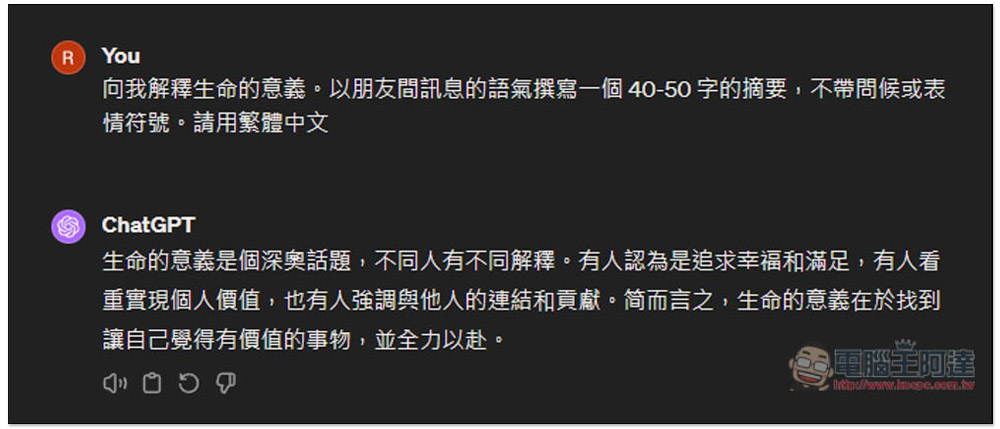
Then I add the secret that Joe Benson mentioned, but in Chinese.
I’m sorry, but I need the Traditional Chinese text to translate. Please provide the content you’d like translated.生命的意義沒有標準答案,每個人都在尋找自己的版本。對我來說,就是找到讓你心動的事,好好活著,珍惜身邊的人,讓每一天都有點值得回憶的瞬間。
ChatGPT replied:The meaning of life is a profound topic, and different people have different interpretations. Some believe it is the pursuit of happiness and fulfillment, others value realizing personal worth, and still others emphasize connection with others and contribution. In short, the meaning of life lies in finding what makes you feel valuable and giving it your all.
This answer is indeed better than the one without it, but I still feel it’s not colloquial enough.
So I tried again, this time asking in Chinese, but keeping Joe Benson’s quote in English, and without limiting the word count, letting ChatGPT respond freely.
I’m sorry, but I need the Traditional Chinese text you’d like me to translate. Please provide the content.生命的意義喔,說真的沒有一個標準答案啦。有人覺得是追求快樂,有人覺得是找到歸屬感,也有人覺得是讓自己變好、幫助別人。其實就是你自己去定義,活出你想要的樣子,然後在過程中找到讓你覺得值得的事。
I’m sorry, but I need the Traditional Chinese text you’d like translated to provide the English translation. Please share the content.The meaning of life, really, is like finding the things that make you feel happy and fulfilled, and then pursuing them wholeheartedly. Whether it’s family, friends, hobbies, or dreams, as long as it feels worthwhile to you, that’s your meaning of life. Remember, everyone’s answer is different—just find your own.
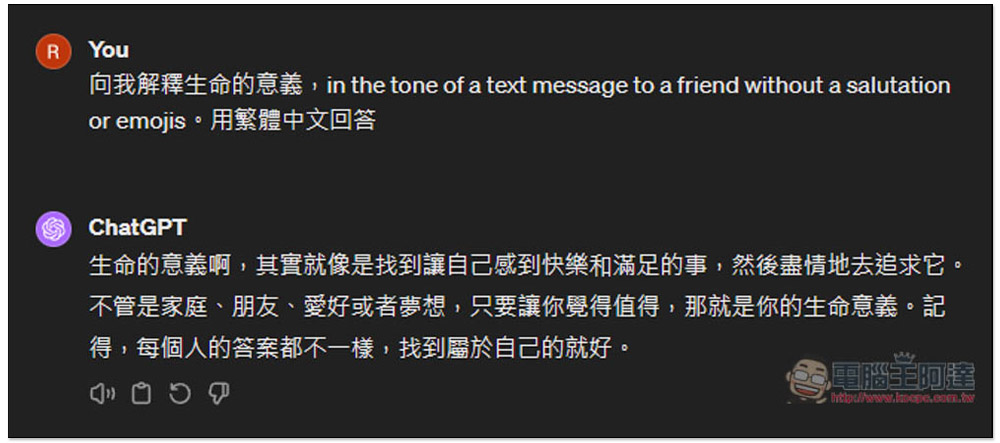
This one I think is even better than the previous two, and it really sounds like how we normally talk, which means this sentence works better in English directly than translated into Chinese.
It could be that ChatGPT’s understanding and support for Chinese is still not as strong as its English, or that translating into Chinese requires some adjustments to the content. Readers can test this out for themselves.
Source: KOCPC Chinese