


foreign media Golem.de I recently wrote an article analyzing how AMD’s Zen architecture has overcome difficulties in recent years and given its opponents a head-on head-on growth in both the desktop and laptop markets. Among them, the performance growth of the Zen architecture in recent years is mentioned. The latest Zen 3 architecture flagship processor Ryzen 7 5800X is more than 80% faster than the original Zen architecture processor Ryzen 7 1800X three or four years ago. It can almost be said that the performance has doubled. This kind of growth rate is staggering. In addition to seeing the process of AMD processors, which were regarded as Intel substitutes in the past, now becoming “really fragrant”, people can’t help but lament that Intel’s performance growth in recent years is indeed unprogressive, which is sad:
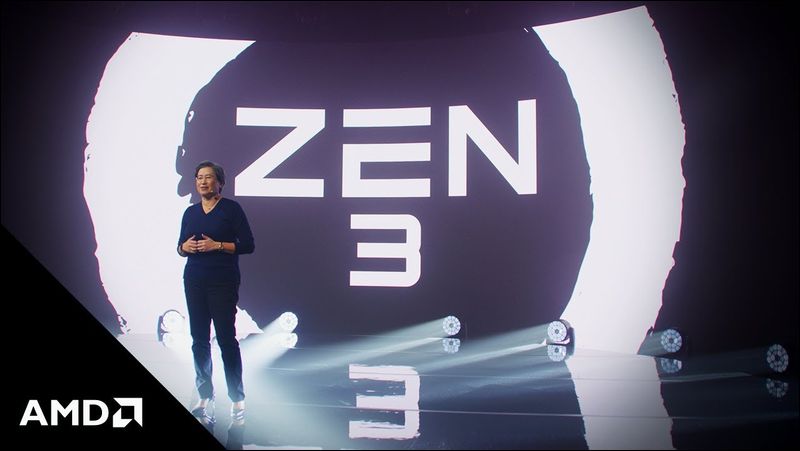
▲AMD has allowed everyone to see the success of the Zen architecture over the years. What is even more interesting is that even the progress of the Zen architecture is obvious to all (Image source)
Before 2016, AMD had some back-and-forth with NVIDIA in the graphics card market, but processors were almost a backwater. The AMD Bulldozer and Piledriver architectures launched to return to glory may have beautiful vision, but the performance is really unbearable.
Although the performance of the Piledriver architecture is not good, fortunately it has made great achievements in overclocking. Even in 2011, the AMD FX-8150 processor became the highest clocked processor in the Guinness World Record with a score of 8.429 GHz. But other than this, there seems to be nothing worth writing home about.
How far does Zen 3 go from Zen? The answer is almost double the performance increase
After AMD struggled for many years and continued to use old tricks to lower prices to attract the attention of cost-effective players, the Zen architecture finally came out. As soon as it was launched, it broke many people’s eyes. Because this new architecture is powerful enough. It is 52% faster than the Piledriver architecture, so it has gradually regained the confidence of many players.
The next Zen 2 and Zen 3 are very powerful, with a performance increase of about 15% faster than the previous generation, so players are pouring cash to help AMD take them off the shelves. Even AMD Yes has become a catchy slogan for many netizens.
Then here comes the problem. Zen 3 is certainly faster than the first generation Zen architecture. But in just three or four years, three different architectures have been replaced. How big is the performance gap? In other words, how much has Zen 3 grown from the first-generation architecture? The answer is 80.9%:
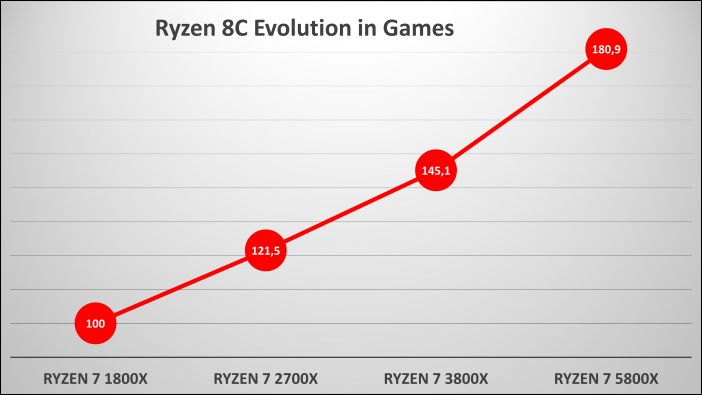
▲Game performance growth chart of AMD Ryzen series flagship 8-core processors of each generation (Image source)
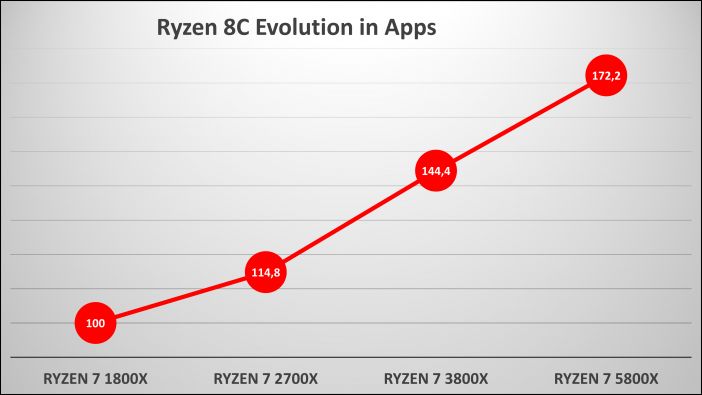
▲AMD Ryzen series flagship 8-core processor software performance growth chart of each generation (Image source)
This data comes from a comparison of flagship processors with several generations of architecture. The first-generation Zen is naturally the Ryzen 7 1800X, while the Zen 3 is the recently released Ryzen 7 5800X. The performance gap between the two is almost double. Considering that Intel has maintained the tradition of improving performance by 5 ~ 10% in each generation since the Sandy Bridge architecture, it is not difficult to see that the magnitude of AMD’s triple jump can be said to be the extent of digging into alien black technology:
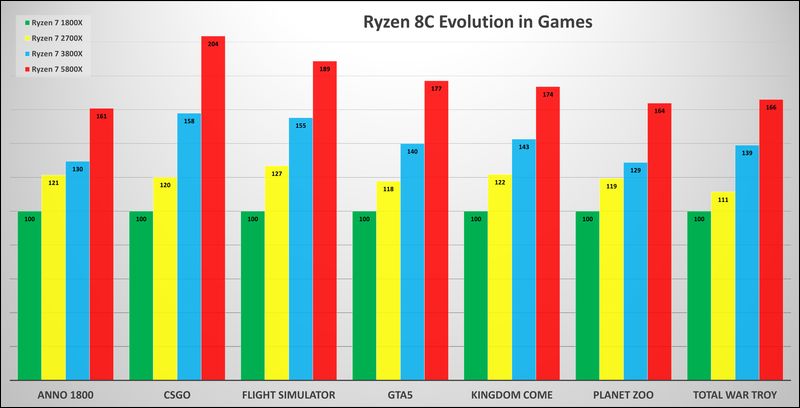
▲The software performance of each generation of AMD Ryzen series flagship 8-core processors, each generation has a considerable performance increase (Image source)
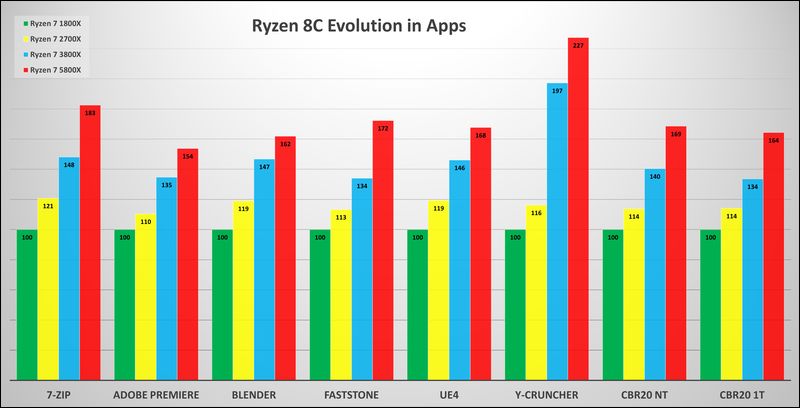
▲The software performance test also has almost similar results (Image source)
On the other hand, the part that affects performance also includes the speed of the memory. For example, Zen supports DDR4-2666, Zen + supports DDR4-2933, and Zen 2 and Zen 3 support DDR4-3200. Memory speed also has a significant impact on the performance of the Zen series processors. If you use a higher-clock memory, the performance will be even better:
▲AMD Ryzen processors have a particularly obvious impact on the performance of high-clock memory (Image source)
Many AMD players may not be using processors with the latest architecture, but given the “increase” in performance growth, it is a good choice to allocate some budget to enjoy the latest technology processors. But in the eyes of Intel users, they probably feel a little resentful that iron cannot become steel, and they may even consider switching to an AMD platform for fun.
However, there may be new platforms coming out at the CES conference early next year, and perhaps what new technologies and products the two parties will launch to attract attention. For players, as long as one company is not the only one, they can see stronger products emerging under the competition between the two parties to encourage each other to make more progress, and players will have a better chance of getting better products.
Source: KOCPC Chinese