


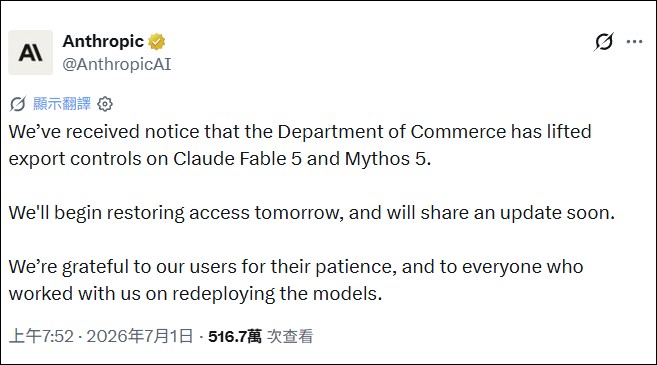
The U.S. Department of Commerce officially announced on June 30 that it would lift the export control order on Anthropic’s two most powerful AI models, Claude Fable 5 and Mythos 5, ending a nearly three-week national security game that shocked the technology industry. Anthropic immediately confirmed on X that it had received the notice from the Ministry of Commerce and stated that model access would be restored from the next day (July 1). This ruling allowed Anthropic’s core products to return to the global market, and also set an important precedent for a new regulatory model between the U.S. federal government and cutting-edge AI laboratories. In just three weeks, from a full blockade to a partial lifting of the blockade to a complete withdrawal, the final outcome of this storm was beyond the expectations of many observers.
The U.S. Department of Commerce fully lifts the ban! Fable 5 and Mythos 5 are officially back
At 5:21 pm (EST) on June 12, the Bureau of Industry and Security (BIS) under the U.S. Department of Commerce suddenly issued an export control order to Anthropic, citing national security authorities and requiring that all foreign nationals (including Anthropic’s own foreign employees) be immediately blocked from accessing Fable 5 and Mythos 5. Because the company was unable to technically differentiate between user nationalities, it was forced to directly take both models offline for global users.
Anthropic 最強模型 Fable 5 / Mythos 5 遭美國禁止外國公民存取,連大神 Andrej Karpathy 也無法使用
The ban covers non-American users, as well as foreign employees within Anthropic. An analysis by the Harvard Law Review pointed out that the letter from the Ministry of Commerce directly defined the AI model itself as a “controlled export item,” which was unprecedented in the history of software export controls and triggered extensive discussions in the academic community on the legal principles of AI regulation.
Dual-track unblocking: Mythos passes first, Fable follows later
The turn of events occurred on June 27. According to reports, the U.S. government sent a letter to Anthropic that day, allowing Mythos 5 to be released first, but only to more than 100 U.S. institutions, including large companies and government agencies. Commerce Secretary Howard Lutnick said in the letter that “appropriate protections are in place” and cited “significant progress” in “intensive daily talks” between the administration and Anthropic. The letter was silent on Fable 5, however, and people familiar with the matter said at the time that negotiations were ongoing.
Just three days later, the Ministry of Commerce announced a complete lifting of the ban. Lutnick officially announced on
Over the past two weeks, we have worked closely with Anthropic to analyze and approve Fable 5 to ensure alignment across the US Government and strengthen America’s leadership in AI. https://t.co/PtVJWyQ9kH
— Howard Lutnick (@howardlutnick) June 30, 2026
Although Fable 5 and Mythos 5 belong to the same Claude family, they target completely different markets. Fable 5 is a general-purpose consumer-oriented model that has deep reasoning capabilities and can autonomously perform complex tasks. It was once the most powerful consumer-grade AI model on the market when it was launched. Mythos 5 is designed for enterprises and network security experts. It is good at identifying security vulnerabilities in code and proactively testing for exploitation. It is this ability that has raised concerns about its misuse by the US government.
A New Model: Federal Regulation is Taking Shape
When Lutnick announced the lifting of the ban, he emphasized that he had worked closely with Anthropic over the past two weeks to “analyze and approve Fable 5 to ensure alignment with various departments of the U.S. government and strengthen U.S. leadership in AI.” Benno Kass, a spokesman for the Department of Commerce, said more bluntly that the government “resolved the national security concerns about Anthropic in just two weeks” to prove the efficiency of the new regulatory framework.
However, Semafor’s analysis pointed out that this incident marks the US government’s pre-emptive review mechanism for the release of cutting-edge AI models being established from scratch. European officials and other U.S. allies have expressed dissatisfaction with Washington’s unilateral decision-making. Many non-U.S. government, enterprise and consumer users still don’t know when these two models will be fully available. Lutnick’s letter clearly limits export targets, lifting license requirements only for U.S. institutions listed in Annex A and their foreign employees. Access regulations for other parts of the world are still to be clarified.
Source: KOCPC Chinese