


At the start of 2025, sparked global AI After the shock,DeepSeek(Deep Exploration…once again became the focus of world media. News recently emerged that the Chinese government, which originally planned not to allow imports of high-end American AI chips to support domestic manufacturers, has “conditionally approved” DeepSeek’s purchase NVIDIA One of the most powerful AI chips currently:H200This decision not only involves technology procurement, but also more profoundly reflects the complex tussle between the US and China over AI chip export controls and semiconductor sovereignty, marking the AI competition’s official transition from a “computational power arms race” into a new phase of “efficiency and resource positioning.”
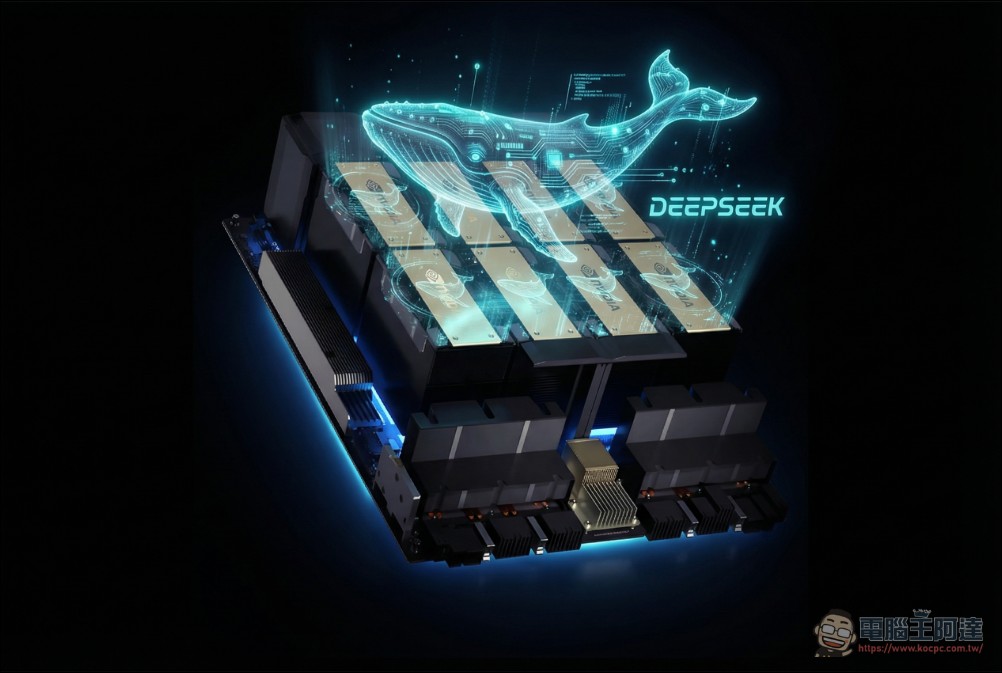
DeepSeek’s Impact: Algorithmic Intelligence’s Counterattack on the Compute Power Myth
In recent years, success in AI was thought to require “astronomical budgets” and “limitless GPUs.” However, last year’s release of DeepSeek-V3 shattered that assumption.
Ultimate cost controlDeepSeek-V3’s training cost is only about $5.58 million, demonstrating remarkable cost-effectiveness compared to the hundreds of millions of dollars typically spent by OpenAI or Google on development.
Technical architecture innovationThrough technologies like MLA (Multi-head Latent Attention) and MTP (Multi-Token Prediction), DeepSeek has demonstrated that world-class reasoning performance can still be achieved through algorithm optimization even with limited hardware. This has directly sparked a reassessment of NVIDIA’s dominant position in the market.
The Power of Open SourceWith the open-sourcing of the DeepSeek-R1 reasoning model, developers worldwide can deploy high-performance AI at a relatively low barrier, enabling DeepSeek’s mobile app to surpass 30 million active users within weeks, making it one of the fastest-growing AI products in history.
The Key to Lifting Chip Restrictions: Why the H200?
But despite DeepSeek’s algorithmic miracles, the hardware gap has always been a bottleneck on the path to Artificial General Intelligence (AGI). Recently, the Chinese government has conditionally approved DeepSeek’s procurement of NVIDIA H200 chips.Newshas become the focus of industry attention. The actual improvements of these chips are as follows:
| Specification items | NVIDIA H20 (China Special Edition) | NVIDIA H200 (True Flagship) | performance gap |
|---|---|---|---|
| Compute Power (FP16/BF16) | 148 TFLOPS | 989 TFLOPS | approximately 6.7 times |
| VRAM capacity | 96 GB HBM3 | 141 GB HBM3e | about 1.5 times |
| Memory bandwidth | 4.0 TB/s | 4.8 TB/s | about 1.2 times |
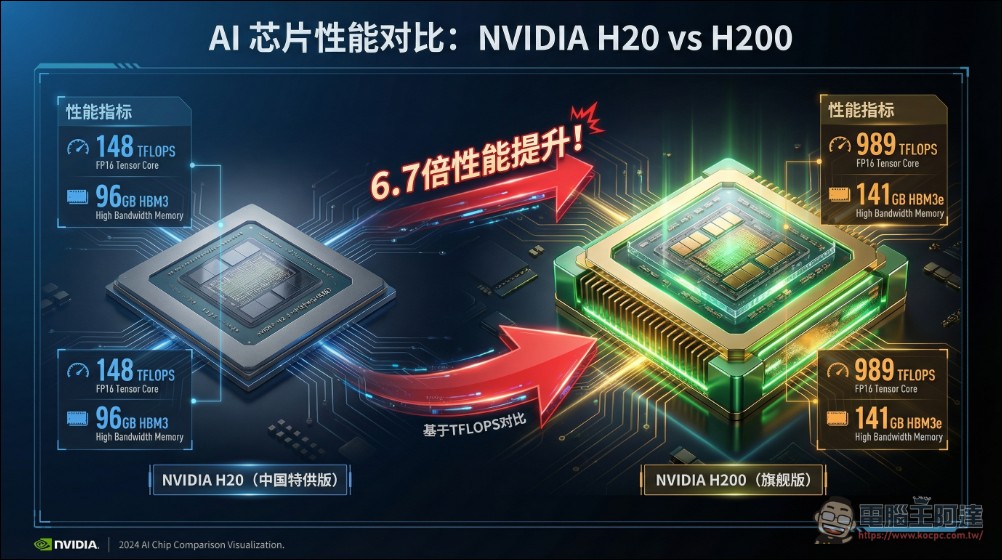
According to latest foreign reports, the US government began relaxing some export restrictions on NVIDIA H200 chips to China in early 2026, but with extremely strict conditions attached. Subsequently, the Chinese government also granted procurement permits to top companies like DeepSeek. The NVIDIA H200’s performance is approximately 6 times that of the currently legally importable H20 version in China. For DeepSeek, which is developing next-generation reasoning models such as the rumored R2 or more powerful V4, this batch of chips is undoubtedly a powerful catalyst that can further shorten training cycles and significantly enhance model complexity.
Since the H200’s core computing metrics are more than six times higher than the H20’s, for DeepSeek this isn’t just about faster speeds—training programs that previously took a year can now be completed in just two months. Additionally, the increased HBM3e high-speed VRAM enables the model to handle longer contexts and significantly boosts inference throughput.
The Computing Power Game Under US-China Rivalry
This procurement approval is not merely a business deal, but rather a calculated political and economic maneuver.
America’s strategic pivotThe US is relaxing H200 exports, on the condition that NVIDIA must ensure adequate domestic supply in the United States, and that Chinese customers (such as DeepSeek) must pass strict end-use verification to ensure the chips are not used for military purposes.
China’s practical trade-offsAlthough China is actively promoting chip self-sufficiency, when facing globally competitive AI unicorns like DeepSeek, the authorities have chosen a flexible approach, approving the purchase of US-made equipment in exchange for technological leadership.
Stability challengesDespite having powerful tools, DeepSeek still faces system instability issues following the global traffic explosion. The frequent outages at the beginning of 2025 remind us that, beyond the model itself, engineering stability of infrastructure remains the company’s biggest weakness.

Conclusion
DeepSeek’s story tells us that future AI competition will not be a simple “GPU count showdown,” but rather a comprehensive test of algorithmic efficiency, cost control, and geopolitical compliance. When this “world’s most resource-efficient” AI company gains access to the “world’s most powerful” H200 computing power, this game will truly enter its most exciting second half.
Source: KOCPC Chinese