


As artificial intelligence and wearable devices become increasingly integrated, a user on X platform named @_seanliu(xiaoan/Sean Liu)The developer recently GitHub Released a remarkable open source project:VisionClawThis model is based on OpenClaw open source AI Assistant specifically for Meta Ray-Ban Smart glassesTailor-made, seamlessly combining Meta Wearables SDK, Google Gemini Live API, and OpenClaw Gateway—the three core technologies—enabling users to experience a true personal AI assistant through voice and visual interaction.
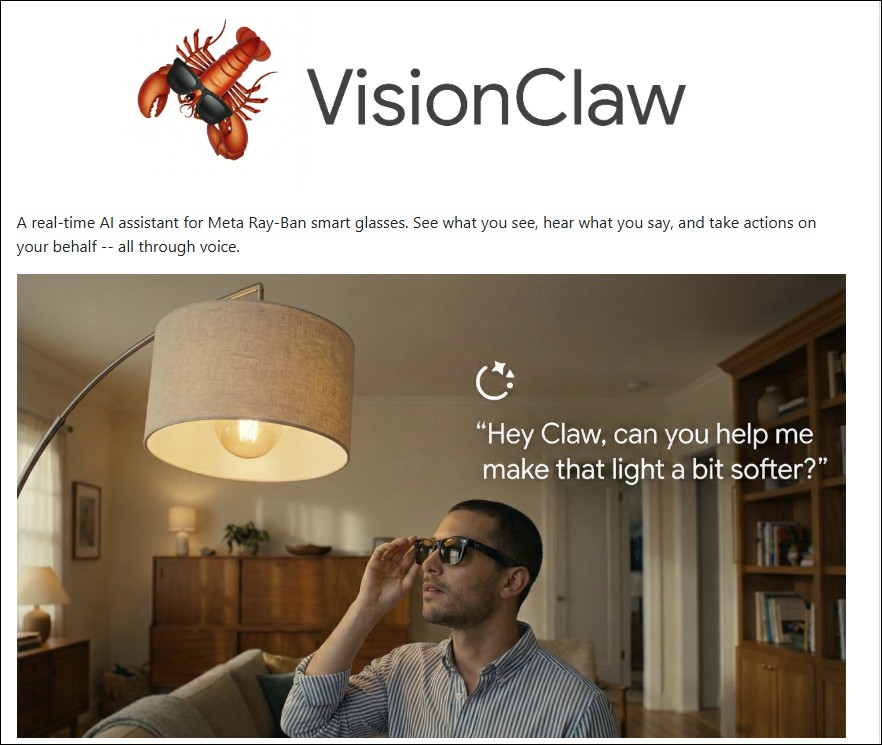
VisionClaw: Your On-the-Go AI Assistant That Can See, Combining Smart Glasses × Gemini × OpenClaw
Three-Tier Architecture: The Complete Intelligent Chain from Sensing to Execution
VisionClaw features a clear three-tier architecture that seamlessly connects the perception capabilities of wearable devices, the brain-level computing of cloud AI, and the execution power of open-source tools.
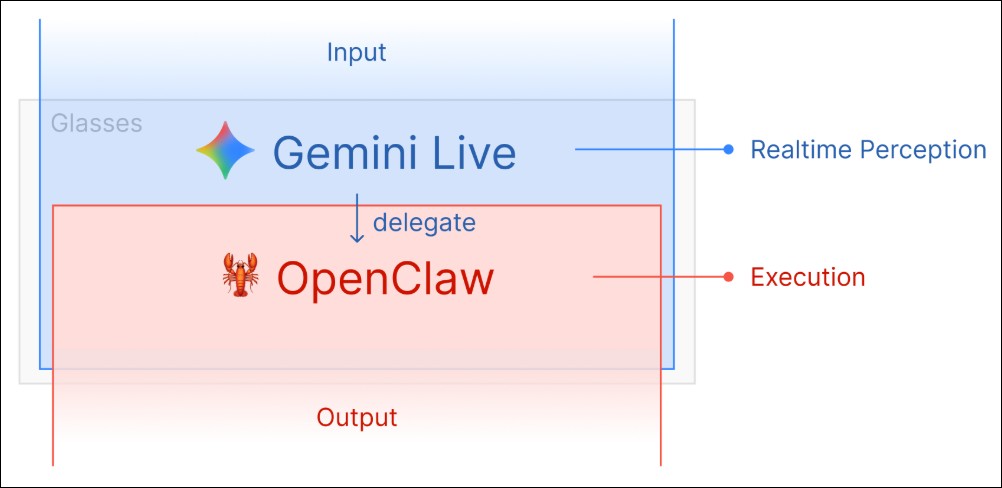
- Perception Layer (Meta Ray-Ban): The smart glasses capture images at approximately one frame per second via the camera, while the microphone continuously records the user’s voice commands. This raw data is then transmitted to the next layer for processing.
- Brain Layer (Gemini Live API): Through WebSocket connections, Gemini can process audio and visual information in real time, achieving millisecond-level response speeds. Notably, this is not the traditional Speech-to-Text (STT) → Large Language Model (LLM) → Text-to-Speech (TTS) pipeline, but rather a more direct, low-latency processing approach that enables a more natural and seamless conversational experience.
- Execution Layer (OpenClaw Gateway): After Gemini finishes analyzing the user’s request, it sends instructions to OpenClaw via the Tool Calling mechanism, which then invokes its 56+ Skills to execute the actual tasks. This design effectively separates AI’s “thinking” from “action,” ensuring every instruction is executed with precision.
Diverse Use Cases: Life, Business, and Learning – All at Your Fingertips
VisionClaw’s application potential is incredibly vast, spanning all facets of daily life:
Scene Recognition: Ask “What am I looking at?”, and Gemini instantly recognizes the surrounding scene through the glasses camera and provides a description
• Message Sending: “Send a message to John saying I’m 5 minutes late” → Automatically complete sending via WhatsApp or iMessage
Voice Shopping: Just say “Buy me some milk” to automatically add it to your shopping list; see a product and order it with your voice instantly
• Lecture Notes: During lectures or meetings, capture slides and audio in real time, then sync to your computer for organized, structured notes
Let AI directly search for products on Amazon based on what it sees.
now my clawdbot lives in my ray-ban meta glasses so i can just buy whatever i’m looking at pic.twitter.com/gWrijyTRhE
— xiaoan (@_seanliu) February 6, 2026
iPhone Mode: Lowering the barrier to entry, welcoming everyone to experience
Not all users own Meta Ray-Ban smart glasses, so VisionClaw has also designed a dedicated iPhone mode. Users can use the iPhone’s camera to simulate the glasses’ visual input and test the complete interaction flow, significantly lowering the barrier to entry.
Regarding system requirements, VisionClaw requires iOS 17.0 or later, Xcode 15.0 or above, and your own Gemini API key. OpenClaw Gateway is optional: installing it enables execution of 56+ Skills.
Technical Specifications: Audio and Video Processing Built for Efficiency
For audio processing, VisionClaw takes PCM Int16 format input at 16kHz sampling rate and returns audio in PCM 24kHz format, ensuring clear voice interaction. For video, the glasses camera’s original 30fps footage is reduced to approximately one frame per second, then compressed at JPEG 50% quality before being sent to Gemini, preserving sufficient visual information without overloading the bandwidth.
The implementation of Tool Calling is also worth noting: developers only need to declare one execute tool, and all complex tasks are automatically routed to OpenClaw for processing, simplifying the overall system’s scalability and maintainability.
VisionClaw GitHub
Summary
The open-source release of VisionClaw is not only a showcase of open-source technology achievements, but also a preview of a new paradigm for AI application development. When hardware, cloud AI, and open-source tools can be freely combined, every developer has the opportunity to become a creator of the next generation of intelligent assistants. This may well be the best embodiment of open-source spirit in the AI era: breaking down barriers and letting creativity flow freely. Personally, I’m also looking forward to a company or author productizing it, which might make OpenClaw benefit more people and become even more user-friendly.
Source: KOCPC Chinese