


The TOP500 supercomputer list changes every month, but the top spot has been occupied by IBM Summit for a long time. By the way, many computing projects that focus on collaborative computing can probably beat its computing power, such as what we have introduced before Folding @ Home Project, during the Wuhan pneumonia pandemic, brought together the computing performance of personal computers from volunteers from all over the world, and surpassed the computing power of the IBM Summit supercomputer. However, this time the list has been updated, and the person at the top of the list has actually changed. The supercomputer “Fugaku” from Japan (written as “Fugaku” in Chinese characters) took the top spot in this month’s list and became the world’s number one. What is surprising is that the core of this supercomputer is actually an ARM processor:
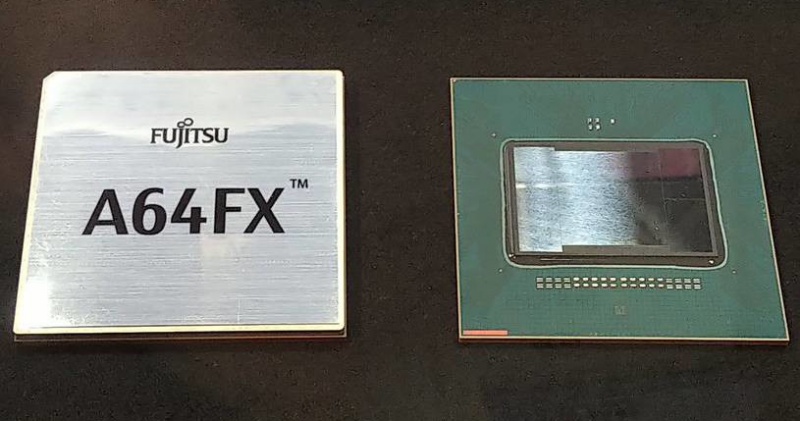
▲The supercomputer Fugaku uses Fujitsu A64FX processor (Image source)
Before this month, the ranking of the world’s 500 fastest supercomputers might have changed, but the number one spot rarely moved. At least IBM Summit has been in this ranking for a long time. This super monster uses a Power9 22-core processor and an NVIDIA Tesla V100 GPGPU acceleration computing card. Its peak computing power is as high as 200,794.9 TFlop/s. It has always been the world’s number one in terms of performance, but today, it has met its opponent.
Japan’s Fugaku successfully overtook IBM Summit and won the first place in the world
Fugaku, a supercomputer from Japan, has a peak computing power of 513,854.7 TFlop/s, directly knocking off IBM Summit, which has been ranked first in the world, and becoming the current fastest supercomputer in the world. What’s even more interesting is that this supercomputer is also a supercomputer using an ARM processor. Fugaku uses the Fujitsu A64FX 48-core processor. According to the TOP500 list, the number of cores in Fugaku reaches 7,299,072. The emergence of Fugaku was also somewhat affected by Wuhan pneumonia:
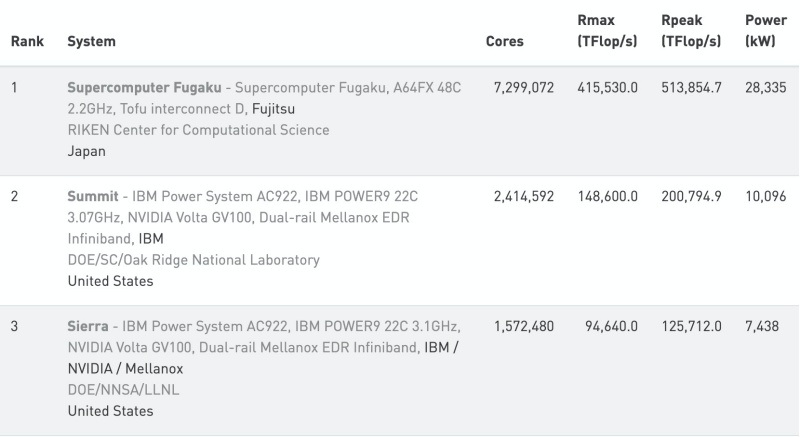
▲Supercomputer Fugaku currently ranks first in the world in supercomputer computing performance, and is also the first supercomputer to achieve the world’s first ranking with an ARM-based supercomputer.
The supercomputer “Fugaku”, like most of the supercomputers on the list, was born for scientific research. The computer is part of the RIKEN Center for Computational Science Research, also known as R-CCS. The organization had a supercomputer called “K Computer” a few years ago, and Fugaku was naturally developed as a successor to “King”. Due to the Wuhan pneumonia pandemic during the development process of Fugaku, Japan has declared a state of emergency several times. Therefore, the computer was originally scheduled to take over the task of “Kyo” in 2021, and now it is being developed and maintained while being put into operation to research related information and data on the virus:
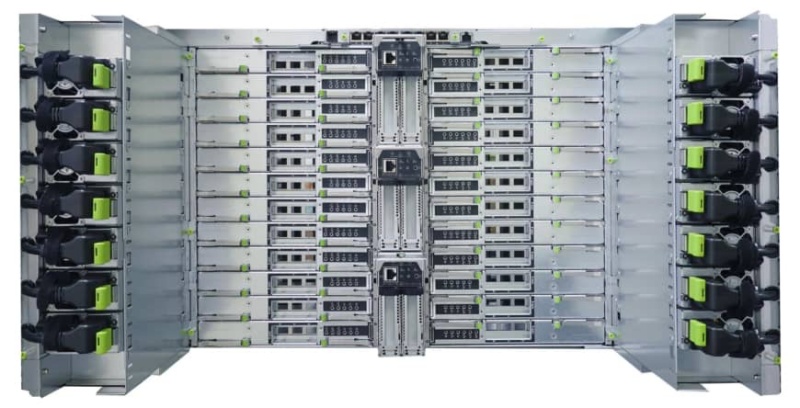
▲Supercomputer Fugaku in the prototype stage (Image source)
Although the plan could not keep up with the changes, Fugaku immediately took the top spot in the TOP500 supercomputers with its powerful computing performance after its debut. It was even selected into the Green500 list of supercomputers last November and won the first place. Unlike the TOP500 rankings, which focus on performance, Green500 mainly evaluates and ranks the power consumption efficiency of supercomputers. Today, Fugaku is no longer number one on the Green500 list, but it still remains in the top ten. It is enough to show that this new world’s most powerful supercomputer using ARM processor is still remarkable in terms of power consumption efficiency.
Supercomputers still mostly use Intel processors, while NVIDIA GPUs are growing in importance
As usual, the TOP500 list also analyzes other information about the supercomputers on the list. In this month’s list, supercomputers using x86 processors are still a large number, with a total of 481 units. Among them, Intel processors dominate with 469 units, and AMD only has 11 units. In terms of the nationality of supercomputers, China still ranks first in terms of number of supercomputers with 226, slightly surpassing the United States, which ranks second. However, in terms of computing performance statistics on a national basis, the United States slightly beats China at 644 petaflops at 565 petaflops. Although there are not many supercomputers equipped with NVIDIA GPUs as accelerated computing cards, there are 135 of them.
There are not many supercomputers like Fugaku that have entered the top 500 with ARM processors. There are only four including Fugaku. Among them, there are 2 supercomputers that also use Fujitsu A64FX ARM processors like Fugaku, and the remaining one uses Marvell ThunderX2 processors:

▲Although ARM processors are not yet common in the world’s top 500 supercomputers, I believe they will have great potential in the future (Image source)
Source: KOCPC Chinese