


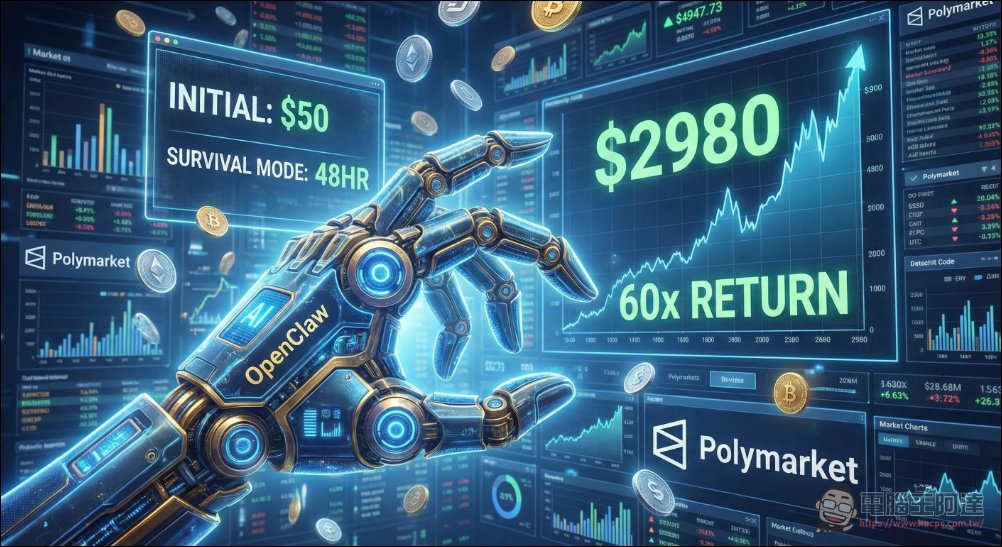
Recently, I believe everyone must have seen a lot about OpenClaw Speaking of related news, though this should be one of the most interesting experiments. A blogger gave an OpenClaw AI agent just $50 and issued a brutal “survival directive”: either earn enough money to cover its own API running costs, or have its balance drop to zero and “die” completely. The result? This OpenClaw turned that $50 into $2,980 in just 48 hours, generating a staggering nearly 60x return.
有一位博主给了一个 OpenCoaw 50 美元,并下达了生存指令:要么赚到足够的钱支付自己的 API 运行费,要么余额归零彻底“死亡”。
结果这只 OpenClaw 在 48 小时内,将 50 美元滚到了 2980 美元。
这个 OpenClaw 的逻辑非常清晰。它每 10 分钟就会扫描 Polymarket 上近千个预测市场,利用 Claude API… pic.twitter.com/SCeK8nZq9g
— 纽约博叔 (@drunclenyc) February 11, 2026
OpenClaw Rakes in $2,900 in Just Two Days to Stay Afloat
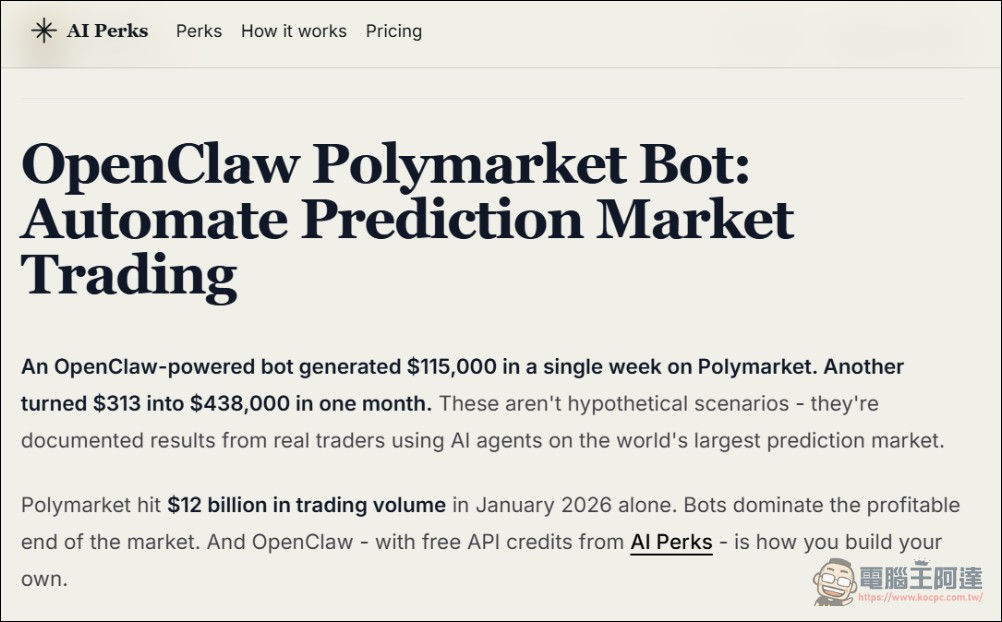
And the OpenClaw he keeps has very clear logic—it scans every 10 minutes. Polymarket Accessing nearly a thousand prediction markets, using the Claude API for logical reasoning, and comparing against external real-world data to find pricing discrepancies. Once it discovers a premium space exceeding 8%, it calculates the optimal position based on Kelly criterion, strictly controlling it within 6% of total capital, then swiftly executes trades. This is not an isolated case. According to AI Perks ReportA trader used an OpenClaw-powered bot on Polymarket to generate $115,000 in a single week, while another turned $313 into $438,000 in just one month. Polymarket’s monthly trading volume surpassed $12 billion in January 2026.
Polymarket and Prediction Market Mechanisms
Polymarket is the world’s largest decentralized prediction market platform, built on the Polygon blockchain. It allows users to make binary yes/no bets on real-world events, covering thousands of markets ranging from US election results and weather forecasts to sporting events. The core mechanism of prediction markets lies in the wisdom of the crowd: when a large number of participants use real money to express their expectations about future events, market prices tend to converge toward the true probability of the event occurring.
Technical Analysis of OpenClaw’s Arbitrage Strategy
Multi-dimensional Data Scanning and LLM Inference
The bot scans nearly a thousand prediction markets on Polymarket every 10 minutes, simultaneously pulling NOAA weather data to validate weather-related markets, sports injury reports to assess team win probabilities, and cryptocurrency community sentiment indicators to determine market trends.
Kelly Criterion Position Sizing
When arbitrage opportunities with premiums exceeding 8% are identified, the system uses the Kelly criterion to calculate the optimal position size. The bot further limits each trade to 6% of total capital, ensuring that even a wrong call won’t cause fatal damage.
Low-cost infrastructure
The entire system runs on a VPS costing just $4.5 per month. Even with a full workflow, the monthly API cost is only $150-400.
Significance Analysis: How AI Reduces Information Asymmetry Between Institutions and Individuals
First, the democratization of information processing capabilities. Traditionally, institutional investors have exclusive research teams that retail investors simply cannot match. But the emergence of LLMs now allows individual developers to build information processing systems with genuine “understanding” capabilities. Second, the lowering of barriers to strategy execution. The “technology asymmetry” threshold is being rapidly erased. What was once a high-frequency arbitrage game accessible only to top-tier quantitative firms can now be entered by anyone with just a $4.5/month VPS.
Risks and Outlook: Is the Bonus Period Short-lived?
Survivor bias is the primary issue. AI Perks admits: “Most traders will see more modest returns.” Not to mention, if you hand over all investment decisions to AI and losses occur, users bear full responsibility themselves. The “exceptional cases” currently seen can indeed be attributed to survivor bias. Additionally, if all players use AI to make similar investment moves, intensifying competition will inevitably compress profit margins. When every corner has AI scanning the same pricing discrepancy, “discovered and gone” will become the norm.
Additionally, regulatory and platform risks should not be overlooked. Anthropic has already begun banning user accounts that violate its Terms of Service by using the Claude API to develop trading algorithms.
Conclusion
The legend of OpenClaw AI trading bot’s 60x returns might just be the tip of the iceberg of this era. It reveals that when AI capabilities become accessible and infrastructure costs approach zero, the power structure of traditional financial markets will be irrevocably rewritten. When the barrier of “technological asymmetry” is lowered, true competition will no longer be about who has more expensive servers, but rather who can design smarter strategies, more precise risk controls, and a deeper understanding of the market.
This article is for informational purposes only and does not constitute investment advice. Cryptocurrency and prediction market trading involve high risks. Please carefully assess your own risk tolerance.
Source: KOCPC Chinese