


Bloomberg reporter Mark Gurman (Mark GurmanRecently dropped several bombshells, with Apple planning to launch a new generation iPad Pro in spring 2027, and this time the upgrade scale could be far greater than expected. According toexpose, new generation iPad Pro Will come in two sizes—11-inch and 13-inch—for a total of four models (two each for Wi-Fi and Cellular). The exterior design won’t see major changes. The two biggest highlights getting the most attention are the processor potentially skipping the M6 chip that was widely expected and jumping straight to the M7 chip, and the vapor chamber cooling system, which would be a first for the iPad Pro.
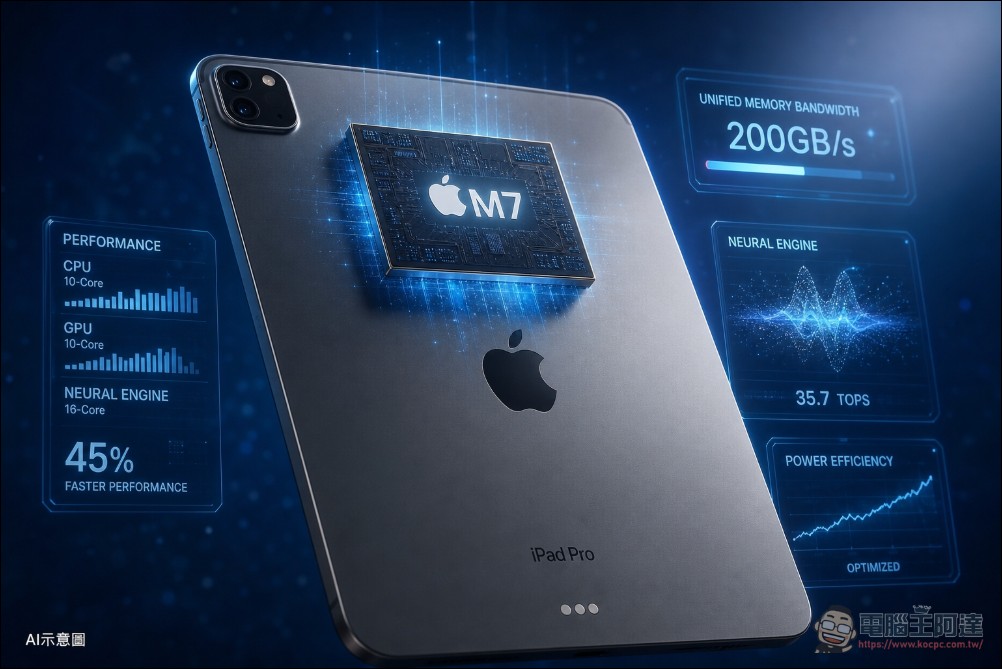
iPad Pro to Debut M7 Chip with Vapor Chamber Cooling: Most Powerful iPad Ever Arriving Spring 2027
M7 Chip Arrives Early, Apple Chip Roadmap Takes Major Turn
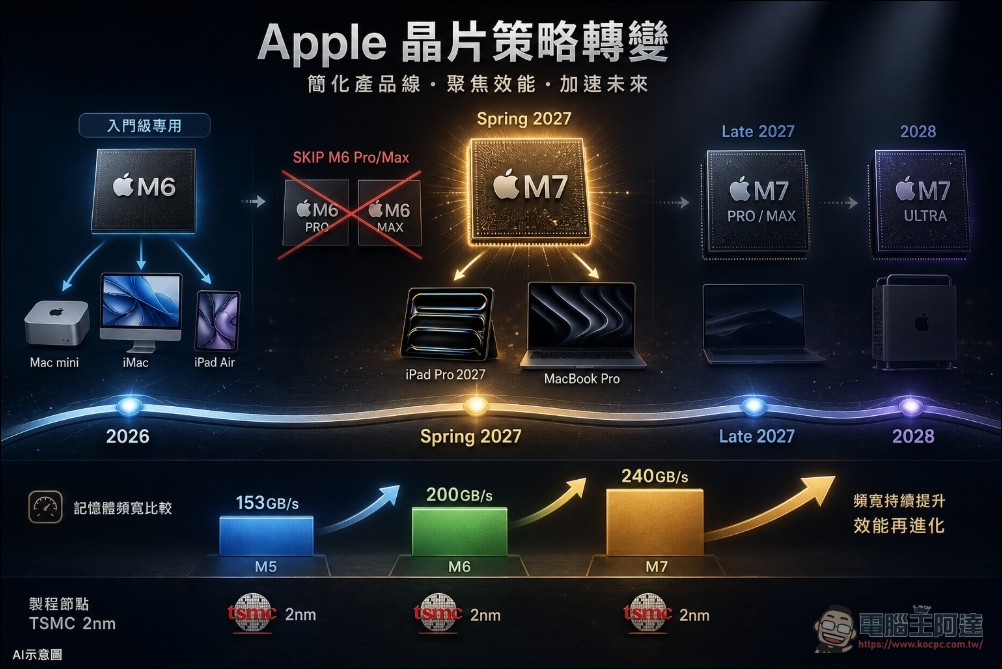
The most surprising news in this leak is the chip-level changes. According to Gurman, the new iPad Pro expected in spring 2027 is expected to feature M7 the chip, rather than the M6 that was originally expected. The backdrop of this change is that Apple has made unprecedented major adjustments to its chip release schedule. The M6 chip will still be launched as planned in the second half of 2026, but Apple may cancel the M6 Pro and M6 Max versions, concentrating all high-end chip R&D resources on the M7 series, with the goal of launching M7 six months ahead of its original schedule.
NEW: Apple is planning a refreshed iPad Pro line in spring 2027, as well as a redesigned entry-level MacBook Pro. It’s also planning its first M7 chip for around the same time. https://t.co/MuivDhD9qc
— Mark Gurman (@markgurman) July 1, 2026
From M1 to M5, Apple followed a consistent pattern with each generation, releasing base, Pro, Max, and eventually Ultra variants. M6 became the first chip series without Pro and Max versions, marking an unprecedented shift in Apple’s custom silicon history.
According to predictions, the M7 chip will be built on TSMC’s 2nm process. The standard version memory bandwidth is expected to reach 240GB/s, representing a more than 50% improvement over the M5 standard’s 153GB/s, and also exceeding the M6’s 200GB/s. The M7’s design focus is clearly oriented toward strengthening local AI computing capabilities. Against the backdrop of global tech giants all ramping up their investments in on-device AI, Apple clearly hopes to accelerate the M7’s market timeline to secure a more favorable position in the competition for device-side intelligent applications.
Vapor chamber cooling makes its first appearance on iPad Pro
Beyond chip upgrades, Gurman reports that Apple is testing a vapor chamber cooling system for the iPad Pro. This technology is nothing new in consumer electronics—Samsung and other Android brands adopted similar liquid cooling mechanisms in tablets and phones years ago, and Apple first introduced it in the iPhone 17 Pro series. But for the iPad Pro, this would be a first-ever.
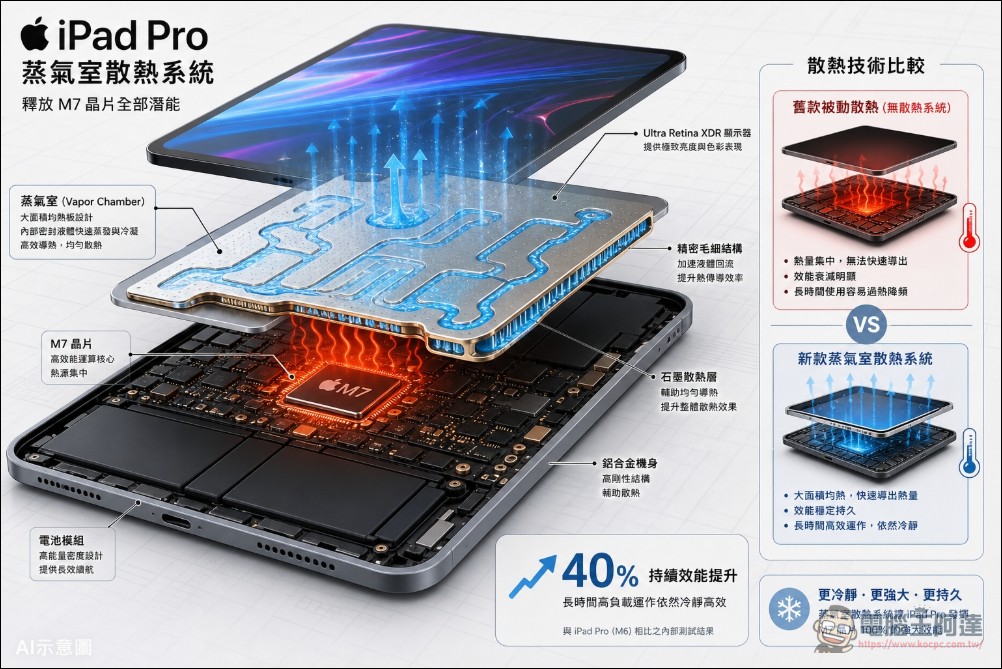
The vapor chamber works through a cycle of liquid evaporation and condensation, more efficiently transferring heat away from the chip area. According to Apple’s official data, the iPhone 17 Pro achieves a 40% improvement in sustained performance under heavy loads after adopting vapor chamber technology. Given that the iPad Pro has a significantly larger body than the iPhone, the cooling benefits would theoretically be even more substantial.
The logic behind Apple’s decision to adopt vapor chamber cooling for the iPad Pro at this time is clear. As M-series chips continue to iterate, the iPad Pro’s computational performance has approached or even surpassed that of some traditional laptops. Users are spending increasingly longer periods on professional tasks like video editing, 3D modeling, and game rendering, which has made heat management under high workloads a growing concern. Passive cooling solutions inevitably suffer from thermal throttling under sustained heavy loads, whereas vapor chamber cooling systems can more effectively maintain continuous peak performance output.
M6 Chip Repositioning: Entry-Level Exclusive
While the M7 is the highlight of this iPad Pro upgrade, the M6 chip itself still has plenty to talk about. The M6 also uses TSMC’s 2-nanometer process, featuring a 12-core GPU (compared to the M5’s 10 cores), with memory bandwidth increased to 200GB/s. However, since Apple has discontinued the M6 Pro and M6 Max, the M6’s positioning will shift from a “high-end chip” to an “entry-level chip,” primarily powering the new Mac mini, iMac, and iPad Air product lines.
In other words, if the 2027 spring iPad Pro ultimately ships with the M6 instead of the M7, that would mean this product uses the same chip as the entry-level Mac—a somewhat awkward positioning for a professional-grade tablet with a starting price over NT$35,000.
Market Challenges Under Rising Price Pressures
While discussing next-generation products, one unavoidable reality is Apple’s recent across-the-board price increases. In June 2026, the iPad Pro’s starting price was raised from NT$32,900 to NT$39,900, an increase of NT$7,000. In the US market, the 11-inch OLED model rose from $999 to $1,199, and the 13-inch from $1,299 to $1,499, each up by $200 (approximately NT$6,500).
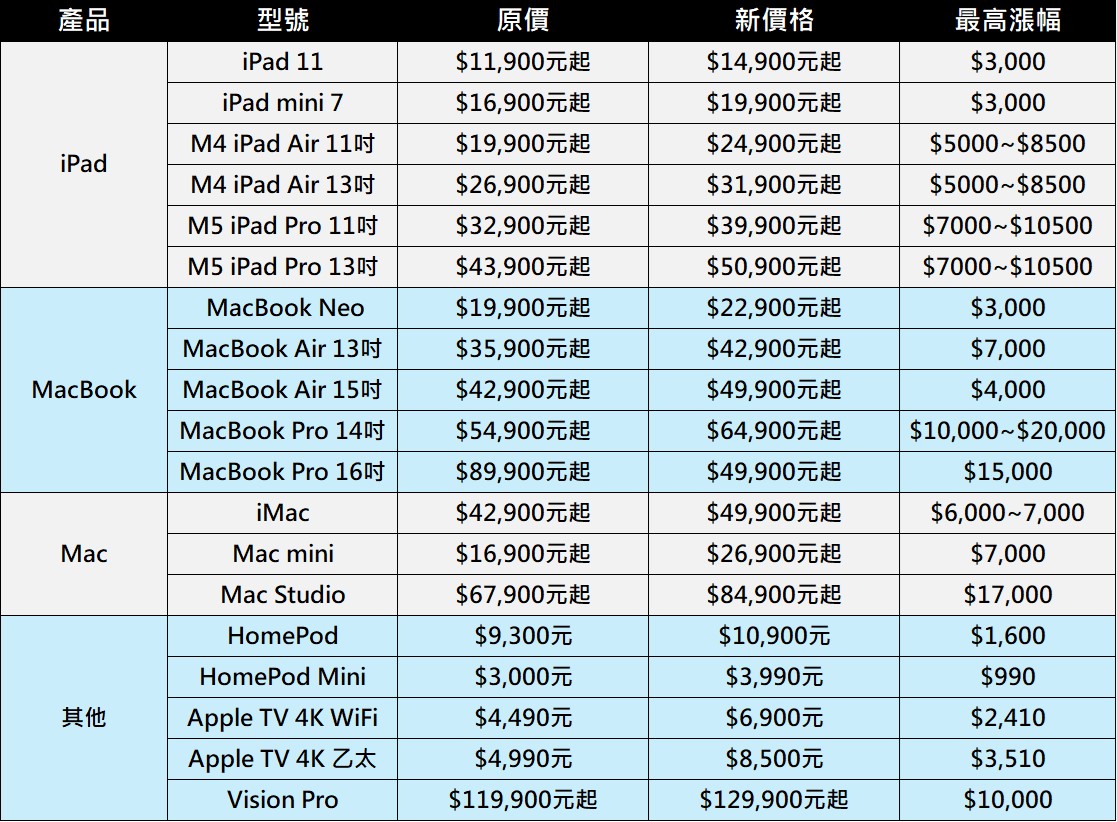
Behind this wave of price increases lies the continuous rise in storage costs across the upstream semiconductor supply chain. Price hikes from memory chip suppliers like Micron have been directly passed through to end product pricing, with Apple CEO Tim Cook recently acknowledging that cost pressure is the main driver of the price increases.
After the price hike, the iPad Pro’s position in the market has become more delicate. The starting price in the five-figure range has pushed this tablet into direct price competition with thin-and-light laptops, forcing consumers to weigh their options far more carefully. While the Android camp has relatively limited influence in the mid-to-high-end tablet market, brands like Samsung and Huawei have been steadily expanding their presence in the productivity tablet segment in recent years, and their price advantage remains a formidable competitive weapon.
The M7 Pro and M7 Max won’t arrive until late 2027
Even if the M7 chip launches ahead of schedule, the high-end versions will still take longer. According to multiple reports, the M7 Pro and M7 Max are expected to arrive only by the end of 2027, with the M7 Ultra not coming until 2028. This means that from the second half of 2026 to the end of 2027, there will be a “high-end chip gap” lasting more than nine months. During this period, professional users will only have the M5 Pro/Max and the entry-level M6 as their Apple chip options.
NEW: Apple has shaken up its Mac chip strategy. It plans to launch a base M6 chip and then jump ahead to the M7, M7 Pro, M7 Max and M7 Ultra, skipping higher-end M6 processors. https://t.co/jHLIDY3Qo3
— Mark Gurman (@markgurman) June 25, 2026
For users considering getting a MacBook Pro, the current situation is indeed awkward. The M4 Pro models currently on sale are performing reliably, and the flagship MacBook Pro with M5 Pro/Max and a touchscreen is expected to arrive between late 2026 and early 2027. However, the entry-level MacBook Pro with M7 won’t come until spring 2027, with the M7 Pro/Max high-end models another six months away.
Source: KOCPC Chinese