


SpaceXAI officially released Grok 4.5 to the public on July 8, 2026, marking xAI’s first large language model specifically optimized for software development and AI agents. Unlike previous Grok iterations that positioned themselves as general-purpose conversational chatbots, Grok 4.5 clearly pivots toward knowledge work and automated agent scenarios, signaling Elon Musk’s AI team is adopting a more vertical strategy in the fiercely competitive LLMs market.
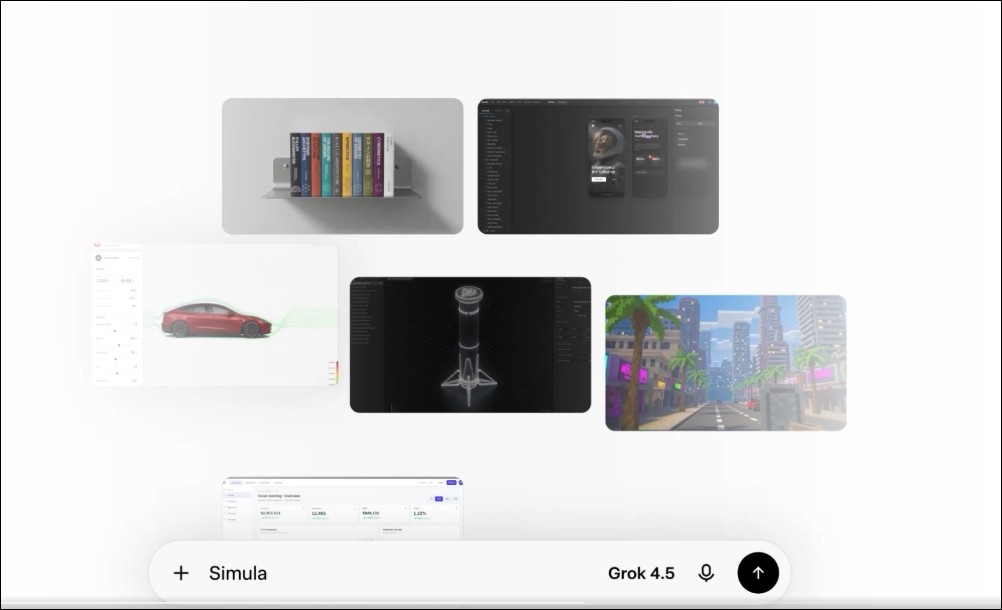
According to SpaceXAI officials, Grok 4.5 is “the first model trained specifically for coding and agents,” emphasizing its “cutting-edge intelligence combined with leading speed and cost efficiency.” This model was jointly trained by SpaceXAI and Anysphere, the developers of Cursor, with deep integration of both parties’ data and engineering resources serving as Grok 4.5’s most critical competitive differentiator. It also claims to surpass Opus 4.8 and GPT-5.5 across multiple benchmarks.
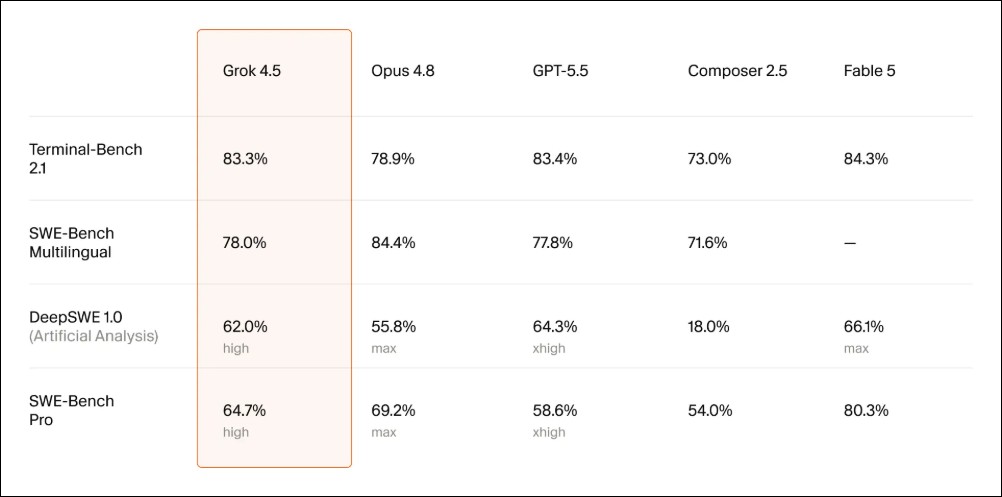
Model Architecture and Training Specifications
Grok 4.5 employs a Mixture-of-Experts (MoE) architecture with a base parameter scale of 1.5 trillion, making it the largest deployed model in the xAI V9 series. Compared to Composer 2.5, launched in June 2026, Grok 4.5 is clearly positioned at a higher intelligence tier. Both will coexist at different weight tiers, serving user segments with varying cost and performance requirements.
Announcing Grok 4.5, our first model trained specifically for coding and agents. It was trained with Cursor and offers frontier intelligence at leading speeds and cost efficiency.https://t.co/i8HpU7w64k pic.twitter.com/oBjGtTsoNc
— SpaceXAI (@SpaceXAI) July 8, 2026
The most notable aspect of the training process is that Grok 4.5 incorporated “trillions of data tokens from Cursor.” As the fastest-growing AI code editor in the market, Cursor’s dataset not only contains raw source code but also records real interaction traces between developers and AI agents: including how to debug, how to break down tasks, how to use tools, and how to revise strategies from failures. This kind of “human-Agent collaboration” data is a valuable training signal that pure static code repositories cannot provide.
Cursor BlogFurther notes that, unlike Composer 2.5, which focuses exclusively on pure programming tasks, Grok 4.5’s training data is deliberately more diverse, incorporating high-quality STEM tasks, research papers, and other knowledge work content. This allows the model to develop proficiency not only in software engineering but also in fields such as law, finance, and data science.
Reinforcement Learning and Distributed Agent Training System
Another technical breakthrough of Grok 4.5 lies in its training approach. The Cursor team revealed that they “used reinforcement learning on difficult problems in real-world environments encompassing software engineering and broader knowledge work.” These training environments are not artificial benchmarks, but real tasks designed to be “difficult enough that even frontier models would fail.”
More notably is how the training environment itself is constructed. Cursor developed a “distributed agent system” where a large number of AI Agents autonomously build, test, and refine each training environment. Engineers only need to define the problem and how to verify the solution—the rest of the environment details are automated by the Agents. The team noted that “some of these environments, if built by the team, would originally require hundreds of engineers spending several months.” This system became a key flywheel for “using the previous generation of models to accelerate the next generation’s progress.”
Starship Engineers Shift Strategic Focus to AI Development
Weeks before Grok 4.5’s official release, an organizational reshuffle revealed SpaceX’s strategic upgrade for its AI business. Elon Musk confirmed on X in late June 2026 that SpaceX had dispatched “dozens of senior Starlink and Starship engineers” to join the Grok development team to help achieve technical breakthroughs for this AI model.
To be clear, I’m not saying the Grok v9 foundation model will be mind-blowingly better than anything, but it will be a solid workhorse in the same league as Opus.
And the SpaceXAI cadence of model and harness improvement is speeding up tremendously, particularly due to a few…
— Elon Musk (@elonmusk) June 28, 2026
The significance of this deployment goes beyond personnel supplementation; it also reflects an internal resource reallocation at SpaceX. Starship, as SpaceX’s next-generation interplanetary transportation system, and Starlink, as its global satellite internet service, have consistently been the company’s two top priorities. Detaching top engineers from both flagship programs to the AI division signals that xAI and Grok have evolved from “byproducts” into core strategic assets of the SpaceX group.
SpaceX hopes to “step up the pace in the AI race and compete with industry leaders.” Compared to AI-focused companies like OpenAI, Anthropic, and Google DeepMind, xAI has still had a gap in model capabilities and market adoption. The deep integration of Grok 4.5 with Cursor, along with top aerospace engineers joining the effort, signals that Elon Musk’s camp is ready to launch a more aggressive market offensive.
Pricing and Availability
Grok 4.5 is now live across all of Cursor’s platforms, including desktop, web, iOS app, CLI tools, and SDK. Grok 4.5 usage quotas are included in both Cursor’s individual and team subscription plans. Plus, for the first week after launch, they’re offering double the usage as a launch promotion.
In terms of pricing, the Grok 4.5 base model costs $6 per million input tokens (approximately NT$195), offering competitive pricing compared to mainstream models like GPT-4o and Claude Sonnet. An “fast variant” option is also available at $18 per million input tokens (approximately NT$585), suitable for real-time interaction scenarios where latency is more critical.
Cursor emphasizes that Grok 4.5 and Composer 2.5 belong to “two different model weight tiers,” and both will receive support simultaneously. Composer 2.5 will continue to be available, and new models of this size will continue to be released in the future, allowing users to choose the most suitable model based on task complexity and budget.
Industry Significance and Market Landscape
The launch of Grok 4.5 marks a new phase in AI model competition: shifting from “who has more parameters” to “who has more authentic training data and richer human collaboration data.” Cursor, as a platform where hundreds of thousands of developers interact with Agents daily, has built a data moat that competitors find nearly impossible to replicate. While OpenAI and Microsoft have GitHub Copilot’s data, Cursor’s interaction model leans more toward complete Agent task execution rather than mere code completion.
Another trend worth watching is the deep integration of products and models. Grok 4.5 isn’t being offered as a general-purpose API for all developers—instead, it’s being prioritized to deliver an optimized experience within Cursor. This vertical integration model mirrors Apple’s chip strategy: hardware, software, and services designed by the same team, producing an optimized overall experience. In the AI era, this means the lines between models, tools, and user interfaces are becoming increasingly blurred.
For xAI and SpaceX AI, Grok 4.5 simultaneously serves a dual mission of technical demonstration and commercial deployment. Technically, it proves that aerospace-grade engineers from Starship and Starlink can contribute value in the AI domain. Commercially, through its bundling with Cursor, it attempts to establish a clear path from “model capabilities” to “paying users.” At a stage where most AI companies are still burning cash, this productivity-tools-focused approach may prove more sustainable.
Source: KOCPC Chinese