


The Wuhan pneumonia epidemic has caused many major technology manufacturers to be overwhelmed, and many products scheduled to be launched have been postponed. This also includes Intel’s Comet Lake processors. This series of processors is known as Intell’s new force to resist AMD’s invasion. In theory, the performance and energy efficiency should be very powerful. However, recent gossip has not spared this new series of processors. A Lenovo engineer shared a comparison chart of radiator efficiency on his Weibo, but others found that the processor used in this comparison platform is the Core i9-10900F processor that is not yet available on the market, and found that PL1 is 170W and PL2 is 224W. This evidence directly reminds people that the reason why Intel has delayed the Comet Lake series processors is probably because the current power consumption problem has not been solved. If released according to these specifications, perhaps the Comet Lake series will become the legal successor of the Pentium Charizard:
▲Intel Comet Lake 10 core processor is actually a fire dragon? (Image source)
In recent years, AMD processors have been gaining ground over their competitors in the market with their better performance and lower purchase costs. For Intel processors, although they may not be completely defeated, they will certainly be ugly. In order to regain face, Intel has been looking for new processor architecture and process improvements. And what is most likely to become one of the counterattack calls recently is the Comet Lake processor. This series will become an important product for Intel to compete with AMD in the mainstream market. However, the launch of this series of processors has been repeatedly delayed, although on the one hand it may be related to the current Wuhan pneumonia epidemic. However, some think Intel may be worrying about something else. For example, the power consumption of the processor cannot be reduced.
When it comes to processor power consumption, we have to think of the fact that Intel once advocated a clock-first strategy in the past, but instead produced the Intel Prescott processor with the title of “Fire-breathing Dragon”. High power consumption often brings another level of problems, that is, the temperature of the processor will also rise. When the temperature is high, Intel’s system protection set up to prevent the processor from burning out will activate, pushing down the performance and allowing the processor to have more heat dissipation capacity. In this way, no matter how powerful this series of processors is, when its temperature reaches a certain level, the system protection will come out and apply the brakes to prevent the processor from overheating, which will instead limit the original strength of the processor:
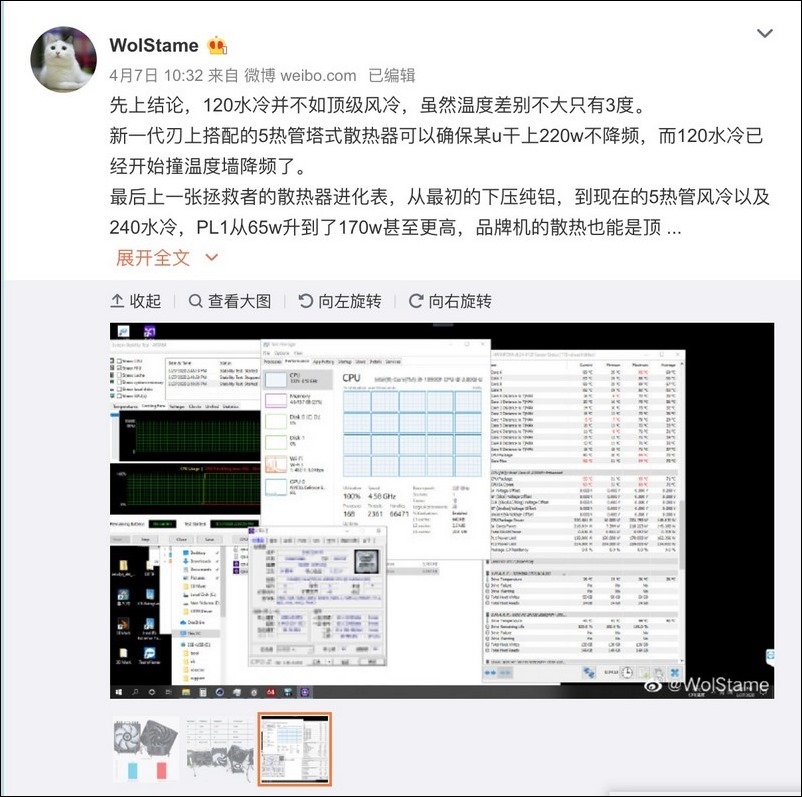
▲At first, it was just a discussion about the cooling device, but who knew that information about unlisted processors was accidentally revealed (picture taken fromWeibo)
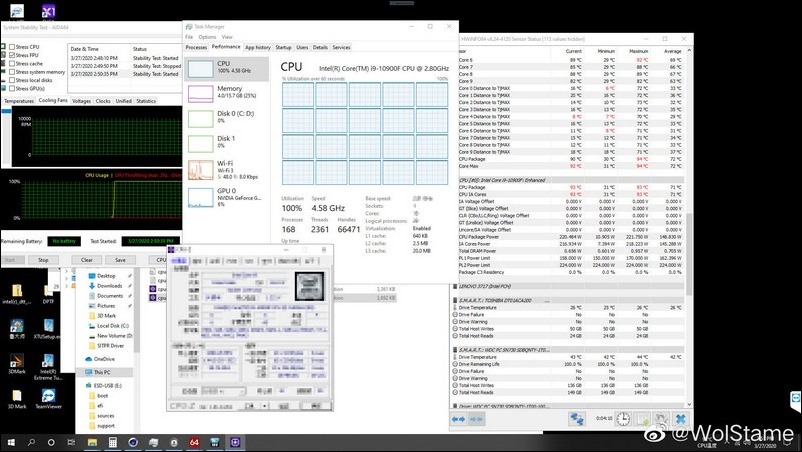
▲When all cores are fully loaded and all cores reach a clock speed of 4.58 GHz, PL2 sees 224W (Image source)
According to the currently known information, Core i9-10900F’s PL1 is 170W and PL2 is 224W. PL here represents Power Limit, which is the power consumption limit of the processor. Usually the values of PL1 and PL2 will be quite close to the final TDP value set by the original factory. If we take the largest value of PL2, we can speculate that the TDP of the processor will reach 224 W. What is the representativeness of this value? We can compare two products similar to TDP. One of them is NVIDIA’s current flagship graphics card, the RTX 2080, which has a TDP of 225W. The other is AMD’s current high-end processor Ryzen 9 3950X. This 16-core, 32-thread processor has a marked TDP of 105W (up to 146W at the limit). If the Core i9-10900F really consumes as much power as reported, then it can be expected that its heat cannot be underestimated, and ordinary radiators may not be able to suppress it:
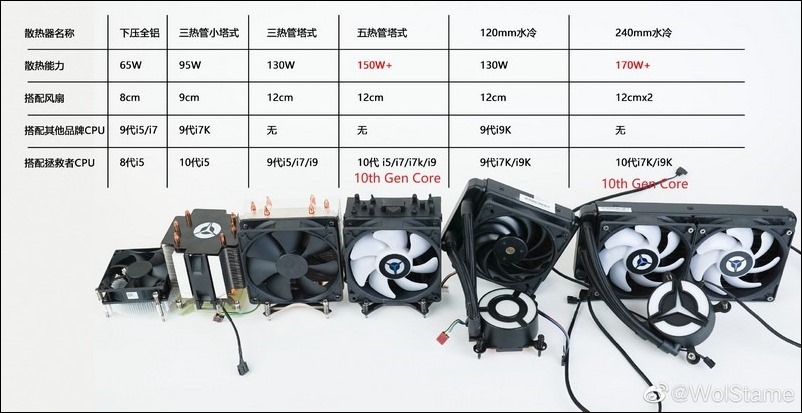
▲This Weibo also compiled a list of the heat dissipation capabilities of some common radiators (Image source)
Judging from these phenomena, we can guess a few messages. First of all, Intel has obviously encountered problems in the processor manufacturing process, but it has to provide more efficient products within a certain period of time. Therefore, even if TDP goes crazy, Intel obviously intends to use various black technologies to suppress it. The full load clock of the new processor is only 4.58GHz, which is worse than the 5GHz of the Core i9-9900KS in the same camp. This may imply that Intel really can’t squeeze out toothpaste. If Intel can really solve this huge problem, maybe we will see a stronger Comet Lake debut.
Source: KOCPC Chinese