


The Wall Street Journal’s latest in-depth report reveals that Apple’s key to successfully avoiding the US government’s 100% tariffs on imported semiconductors last year was agreeing to let Intel produce Mac and iPhone chips. This exchange allowed Apple to save billions of dollars in tariff costs, while giving Intel’s struggling foundry business the most important customer order in the company’s history.
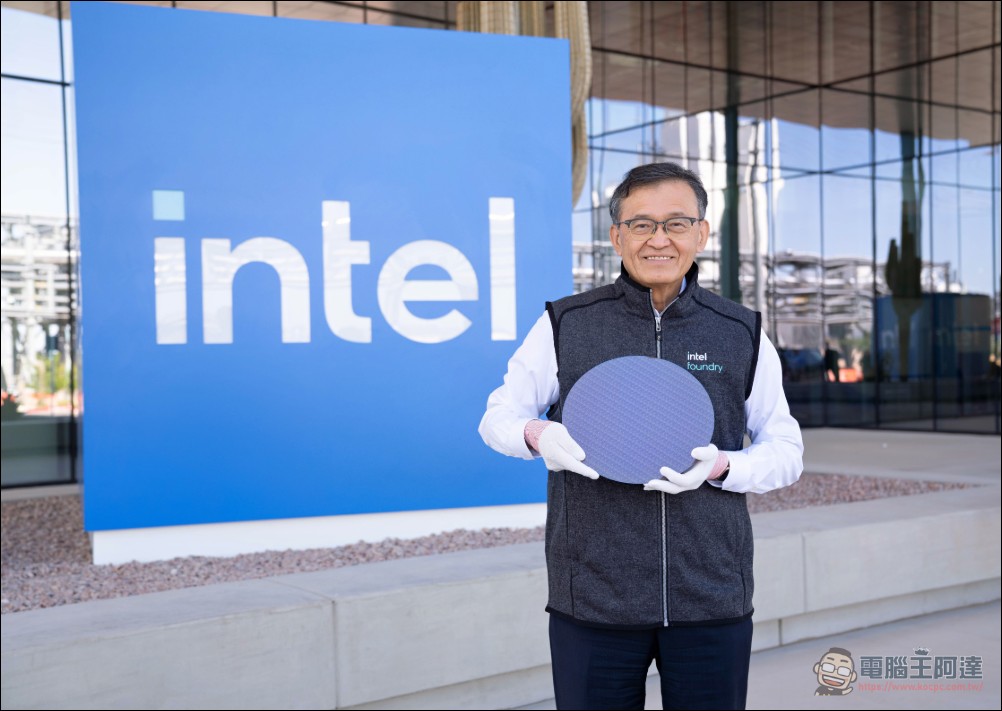
WSJ Exclusive: Apple Secures 100% Tariff Exemption in Exchange for Intel Chip Production
Time rewinds to 2025, when then-US President Trump announced plans to impose approximately 100% tariffs on all imported semiconductors—a policy that directly threatened Apple’s core product lines. The chips for iPhones and Macs relied almost entirely on production by TSMC in Taiwan. Once the tariffs took effect, Apple’s product costs would rise significantly, ultimately passing the burden to consumers and causing iPhone and Mac prices to soar.
WSJ reported that Apple CEO Tim Cook urgently traveled to Washington at the time, doing everything possible to lobby the Trump administration to abandon the tariff plan. In talks between Cook and Trump, Commerce Secretary Howard Lutnick, Apple committed to investing hundreds of billions of dollars in the US, ultimately succeeding in obtaining tariff exemptions.
However, the WSJ further revealed that Trump and Lutnick also mentioned another American company during the talks, namely Intel, the struggling chip giant. The White House explicitly pressured Apple, hoping that Apple would use Intel’s foundries to produce some of its chips.
Apple shifts chip production from exclusive TSMC supply to dual suppliers
The details of this deal first came to light in May 2026. The WSJ reported at the time that Apple and Intel had reached a preliminary chip manufacturing agreement, but did not disclose its connection to tariff exemptions. It wasn’t until the WSJ’s latest in-depth report on July 10 that the causal relationship between the two was clearly established: Apple’s tariff exemption was conditioned on the commitment to use Intel’s foundry.
According to sources, Apple plans to have Intel manufacture chips for Mac laptops and iPhones. This signals a major shift from Apple’s long-standing strategy of relying exclusively on TSMC for chip supply, moving toward a dual-supplier model with both TSMC and Intel. This information was actually previously reported by analyst Ming-Chi Kuo.
In mid-June 2026, Trump Post on Truth SocialOfficially announcing that Apple will partner with Intel to design and manufacture chips in the United States, Trump wrote: “I decided to help Intel because we need to design and build our own chips right here in America.” The post sent Intel’s stock surging more than 10% in a single day, reaching a record high.
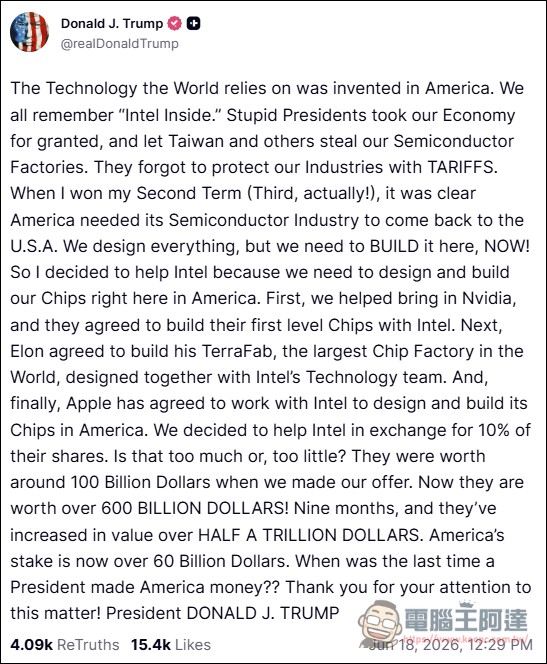
The White House’s Intel Rescue Plan
WSJ’s in-depth report titled “The White House Made Fixing Intel Its Pet Project” outlines how the Trump administration is using tariff leverage to aggressively push for the reshoring of American semiconductor manufacturing. The report notes that the U.S. government had previously invested $9 billion to purchase Intel common stock (Editor’s note: In reality, this was simply the manufacturing facility subsidies that had been earmarked for Intel).Acquire approximately a 10% stakeAs a result, the White House has a strong incentive to ensure Intel can secure orders from major clients like Apple.
For Apple, while this deal means the chip supply chain is shifting from sole reliance on TSMC toward risk diversification, it has also brought tangible tariff exemption benefits. Apple was ultimately never forced to raise its product prices due to semiconductor import tariffs.
For Intel, this order could be the key to reviving its foundry business. For years, Intel has lagged behind TSMC in advanced process nodes, and its foundry services (IFS) have never won over tier-one customers. Now that it has secured an order from Apple, the world’s largest semiconductor buyer, it proves Intel’s manufacturing capabilities and is expected to drive other customers to follow suit. For Intel, while Apple’s order may bring in less revenue than its traditional CPU business in the short term, the strategic significance far outweighs the financial numbers: it demonstrates that Intel Foundry Services is genuinely capable of mass-producing chips for tier-one customers.
Potential impact on TSMC
This development serves as a wake-up call for TSMC. While Apple will still heavily rely on TSMC’s advanced processes (such as 3nm and 2nm) to produce the latest A-series and M-series chips in the short term, Intel’s entry means Apple’s bargaining power will further increase. Looking long-term, if Intel’s 18A and other advanced processes can meet Apple’s standards, TSMC’s dominant position in Apple’s supply chain will face unprecedented and severe challenges.
The Trump administration has previously used tariff leverage to push tech companies to manufacture in the US. According to WSJ reports, Nvidia and Elon Musk’s companies were also steered toward Intel’s chip fabs under similar pressure. This shows that the Trump administration’s semiconductor policy is a combination of trade protectionism and a “Made in America” industrial strategy.
Conclusion
From the WSJ’s in-depth report, it’s clear that Apple’s chip partnership with Intel is a policy exchange under the Trump administration’s 100% tariff threat, not purely a business decision. For consumers, this deal avoided the fate of iPhone and Mac price hikes due to tariffs. For Intel, this is a key turning point for its foundry business, expected to drive more customers to adopt its advanced processes. For TSMC, this marks the beginning of erosion of its monopoly position, and it will face greater competitive pressure when negotiating with Apple in the future. And for the entire semiconductor industry, this event signals that geopolitics has become a core variable that cannot be ignored in chip supply chain planning.
Source: KOCPC Chinese