


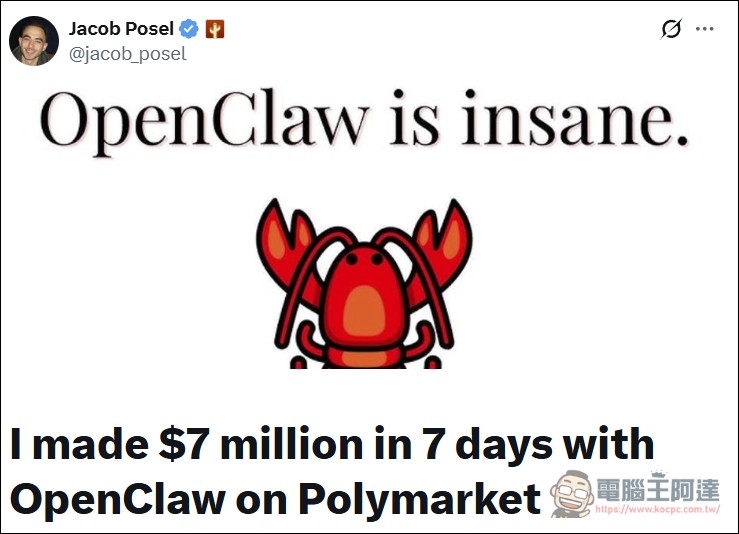
Recently, a humorous post on X sparked widespread discussion and a wave of copycat posts, with an influencer claiming they used OpenClaw AI Proxy bot, at Polymarket It raked in $7 million in just seven days in the prediction market. However, after clicking through, the content was a far cry from the headline, sparking widespread debate over whether OpenClaw can really help its owner make money.
Did Netizens Rake in Millions Using OpenClaw in Crypto, Stocks, and Polymarket?
Because many internet users these days don’t bother reading the actual content, this post was reposted widely. But in fact, after a large blank space below, the author wrote: “If someone writes an article claiming they made money easily with OpenClaw, they’re either lying or the opportunity no longer exists.” It’s a sophisticated jab at the current online chaos—and also the plain truth:

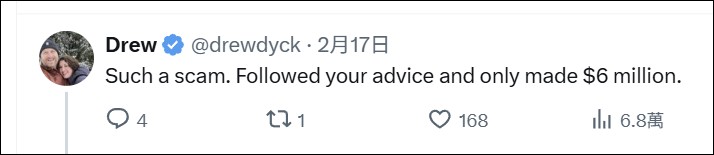
Many people also left joking comments below, saying things like “Made 6 million following his advice,” and there were even more exaggerated ones:
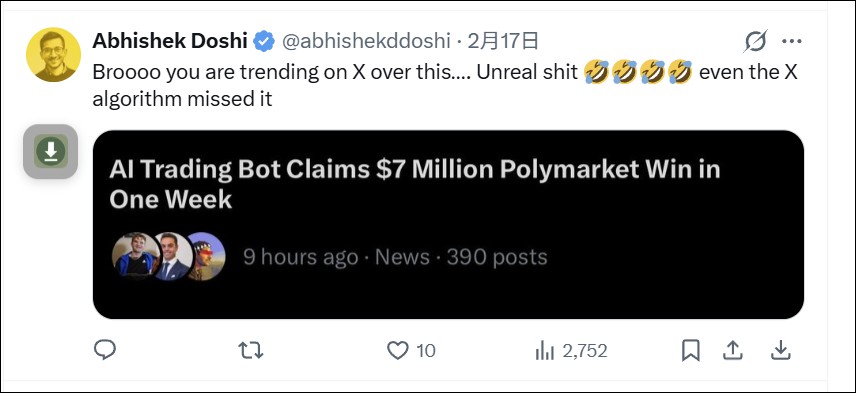
It even trended on X. Basically, a bunch of people shared it without reading the content, causing the algorithm to heavily promote the post.
Quite a few people have imitated it too, just swapping in cryptocurrency and AI, and apparently the results are pretty good XD:

For those interested, feel free to check out the discussion inside—it’s pretty funny. But if you follow X and Xiaohongshu, there are tons of posts these days from people constantly claiming how much money they made from crawfish:
— Jacob Posel (@jacob_posel) February 16, 2026
Real case: people actually made money.
First, we must admit that there are indeed cases of users profiting on Polymarket using OpenClaw. According to Phemex News reportThere was a trader who used the OpenClaw bot to earn $115,000 in one week, with over 13,000 cumulative trades executed, and the bot’s cumulative profit has reached $1 million. Previously, we also reported that someone gave OpenClaw a sum of money and told it to earn API fees on its own, resulting in a profit of nearly 60x.
The profit strategies in these real-world cases mainly rely on a “market maker” (Market Making) model: providing liquidity in Polymarket’s 15-minute short-term markets to earn the bid-ask spread. This is a strategy with a long history in traditional financial markets, only now executed automatically by AI. Separately, a team previously had large models like Gemini, OpenAI, Claude, and Grok compete in investing, and the biggest winner was actually Grok, which most people don’t typically use.
Hands-On Test: The $23 Lesson in Total Loss
However, AI isn’t invincible either.Startup Fortune The reporters decided to conduct a hands-on test. They invested $23 and let the OpenClaw bot trade freely on Polymarket for 46 hours. After 46 hours, the initial $23 was reduced to just $1.50, representing a loss of 93.5%. According to the reporters’ detailed records, the main losses came from “unsellable tokens”: the AI bot bought prediction tokens in certain markets, but when it wanted to sell them, it found insufficient market liquidity and could not find any buyers.

This issue reveals a fatal weakness in automated trading: while AI can make buy decisions based on data, it often fails to adequately consider factors that require experiential judgment, such as market depth and liquidity risk. In market conditions where human traders would stay on the sidelines, AI may enter the market impulsively due to its programmed logic, ultimately trapping funds in a liquidity-starved market.
Why do some people’s AI make their owners a fortune, while others lose everything? The reason is simple: it’s pure survivorship bias. Only those who make money post about it and show off, while countless losing investors mostly keep quiet and silently bear their losses out of fear of embarrassment.
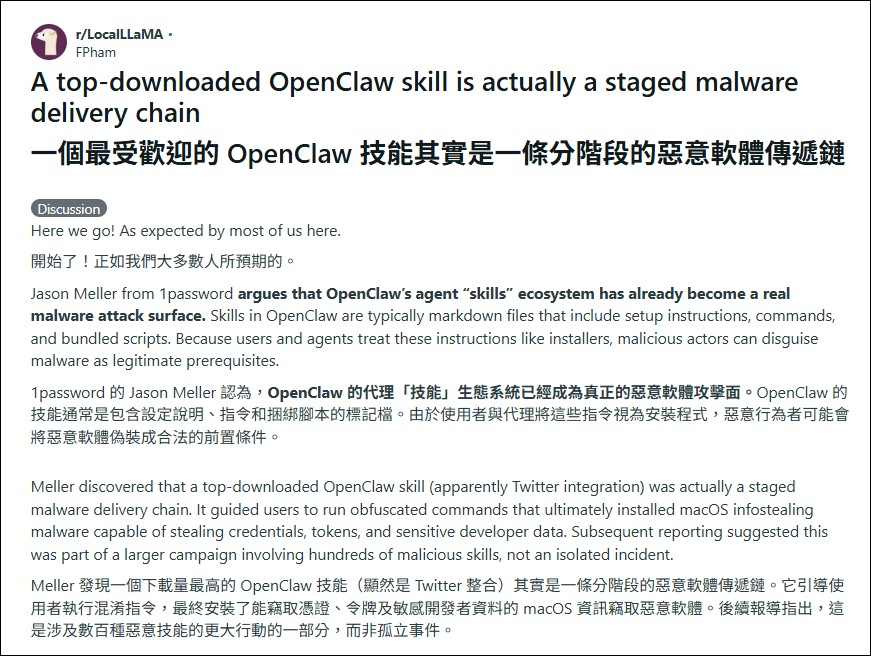
Furthermore, beyond the risk of investment losses, OpenClaw also harbors more serious security concerns. Because it is an open-source framework, anyone can develop and share “Skills” with other users: what was originally a virtue of the open-source community has also become a breeding ground for malicious attacks. According to Reddit users’ShareA “skill” that ranks among the most downloaded in the OpenClaw community actually contains hidden malicious code. Such malicious skills can steal users’ private keys, monitor transaction behavior, and even transfer funds to the attacker’s wallet under certain conditions.
The Surprising Findings from a Large-Scale Vulnerability Scan
More serious problems stem from system-level vulnerabilities.Reddit There are also cybersecurity researchers who conducted large-scale scans of publicly exposed OpenClaw instances, and the results are alarming:
- 36% of OpenClaw community skills contain security vulnerabilities.
- 15% of skills contain explicit malicious instructions.
- Many instances are exposed to public networks without adequate security protection.
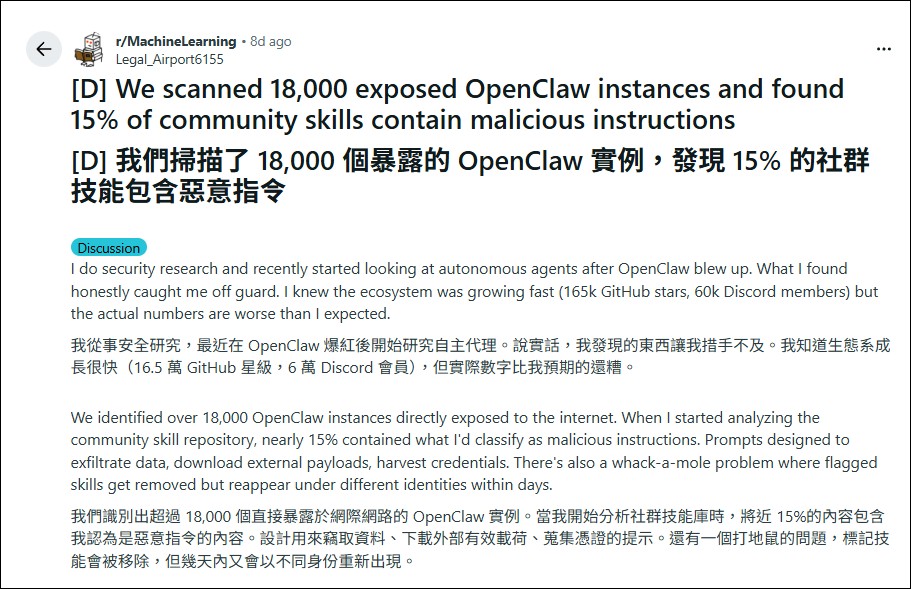
This means that when you connect OpenClaw to your own virtual currency wallet and grant trading permissions, you face not only market risk but also cybersecurity risk. Once you install a skill containing malicious code, your assets could be drained in an instant.
Summary
Technology is inherently neutral—there is no inherent right or wrong. Some use Openclaw to assist with work, while others use it for investing and wealth management. Ideally, because AI never tires, it can continuously track all kinds of data 24/7, 365 days a year. If you know how to train AI to monitor asset trends for you, you may indeed have a chance to profit with a bit of luck. However, even a well-run system can only deliver stable but limited returns under specific market conditions. The rumored weekly gain of $115,000 sounds staggering, but it is built on 13,000 accumulated trades, plus the corresponding time, technical, and risk costs. People don’t go around broadcasting their losses with fanfare; we only ever see the glamorous side.
What is more alarming is that when these “AI money-making” internet memes go viral and everyone is discussing some anonymous internet user’s rags-to-riches story, that in itself is a warning sign. The iron law of financial markets is: when a “risk-free” method is widely promoted, it usually no longer works, or never really worked in the first place (or the person will pose as some “guru” selling courses and software, claiming they can make you a fortune).
For investors considering using OpenClaw or other AI trading tools, our recommendation is:
- Start with a small amount for testing.Don’t invest more than you can afford to lose.
- Review all code.Open source doesn’t mean secure—every installed skill should be carefully reviewed.
- Understand the strategy principlesIf you cannot explain why AI made a certain trading decision, you should not authorize it to use your funds.
- Stay skeptical.Be highly vigilant toward any claim of “guaranteed profit,” whether it comes from a human or AI.
History shows that every technological revolution is followed by a similar gold rush. The California Gold Rush of the 1800s, the dot-com bubble of the 1990s, the ICO mania of 2017, and now it is AI-powered automated trading’s turn. In these frenzies, the ones who truly make steady profits are rarely the prospectors, but the people selling shovels—in today’s world, the self-proclaimed “teachers” who dish out stock tips and sell courses.
For the average investor, instead of chasing elusive AI get-rich-quick myths, it’s better to return to the basics: understand what you invest in, assess your risk tolerance, and keep a long-term perspective. After all, if there really were an AI that could consistently generate $7 million in weekly returns, its inventor probably wouldn’t be in a rush to share it on Twitter.
In this era of information overload, perhaps the most valuable skill isn’t finding “the next big opportunity,” but keeping a clear head in the frenzy and hearing reason through the noise.
Source: KOCPC Chinese