


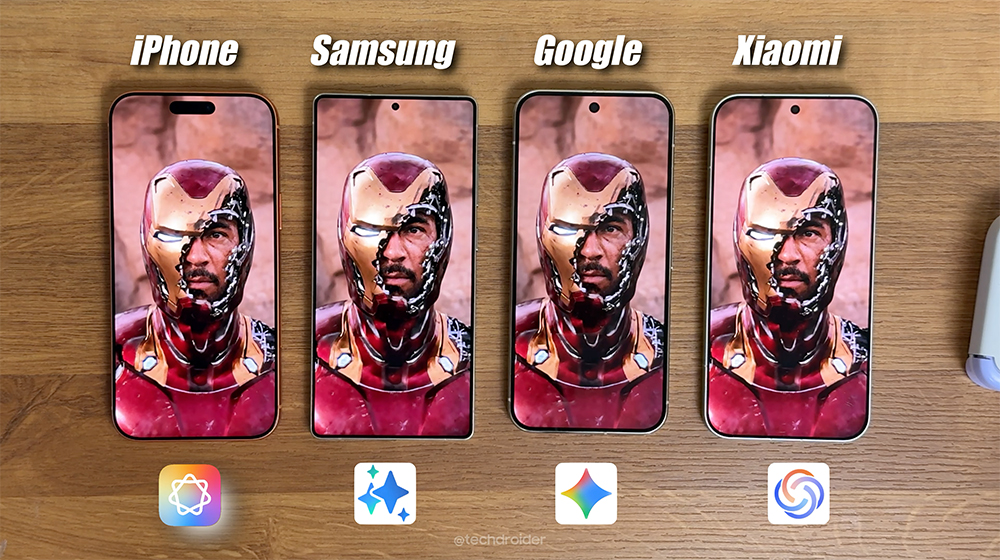
In recent years, mobile phones AI Features are evolving rapidly, and brands have launched smart photo editing tools that let users achieve effects once possible only with professional editing software through simple brushstrokes or taps. But do AI algorithms from different brands really perform the same? Recently, the YouTube channel TechDroider Clips conducted an interesting AI photo editingMeasured, will Apple Intelligence、Samsung Galaxy AI、Google Pixel AI andXiaomi HyperAI was compared in the same test scenario. Using an image of a cracked Iron Man helmet, the AI repair capabilities were tested. The results revealed clear differences in retouching style and ability among the various AI tools, with some even producing laughable outcomes.
▲ Image source:TechDroider Clips
AI Photo Editing Showdown: Apple Intelligence, Samsung Galaxy AI, Google Pixel AI, and Xiaomi HyperAI, Tested Head-to-Head
AI has become one of the most important features of smartphones in recent years. Beyond voice assistants, real-time translation, and text generation, image processing is also one of the most fiercely competitive battlegrounds for brands. Features such as object removal, background generation, and image inpainting can now be completed with a single tap via AI, making them incredibly convenient for everyday users.
▲Image source:TechDroider Clips
Recently, the YouTube channel TechDroider Clips uploaded a video that puts the AI photo-editing features of several mainstream smartphone brands to the test. The AI tools compared include Apple’s Apple Intelligence, Samsung’s Galaxy AI, Google Pixel’s Magic Editor, and Xiaomi’s HyperAI. Using the same image as the test sample, the video observes each AI’s judgment and generation results during editing.
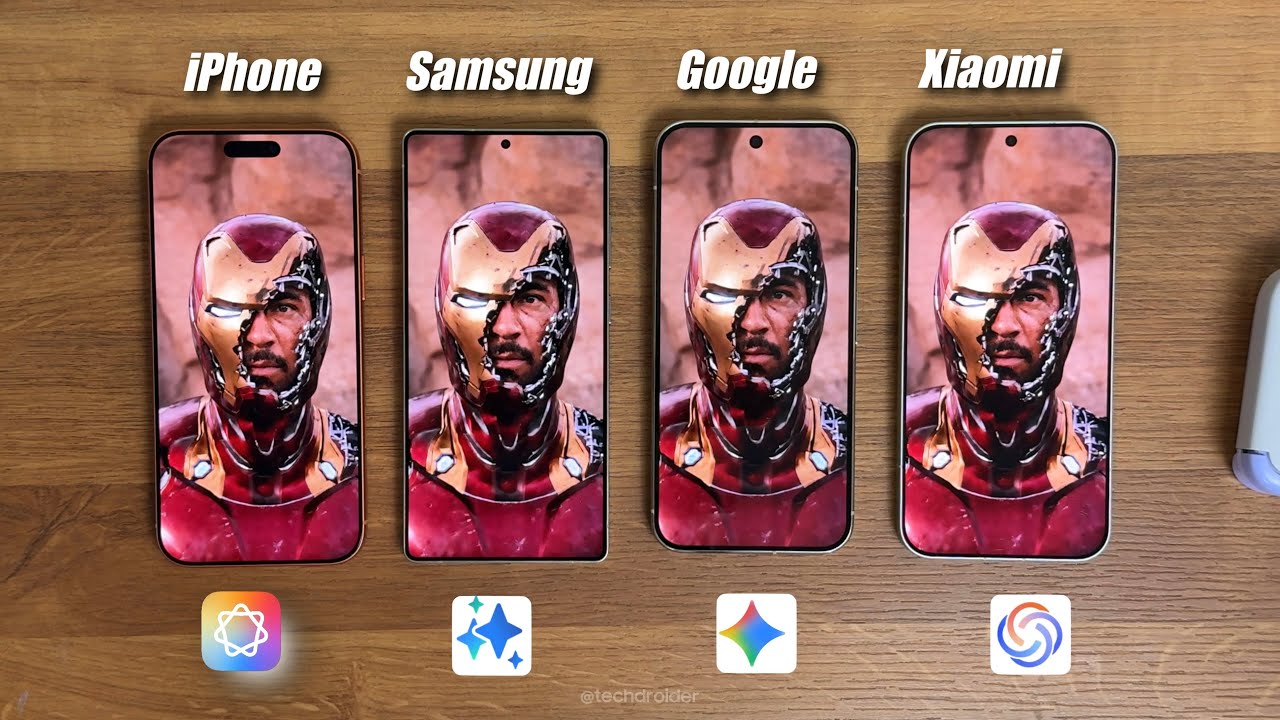
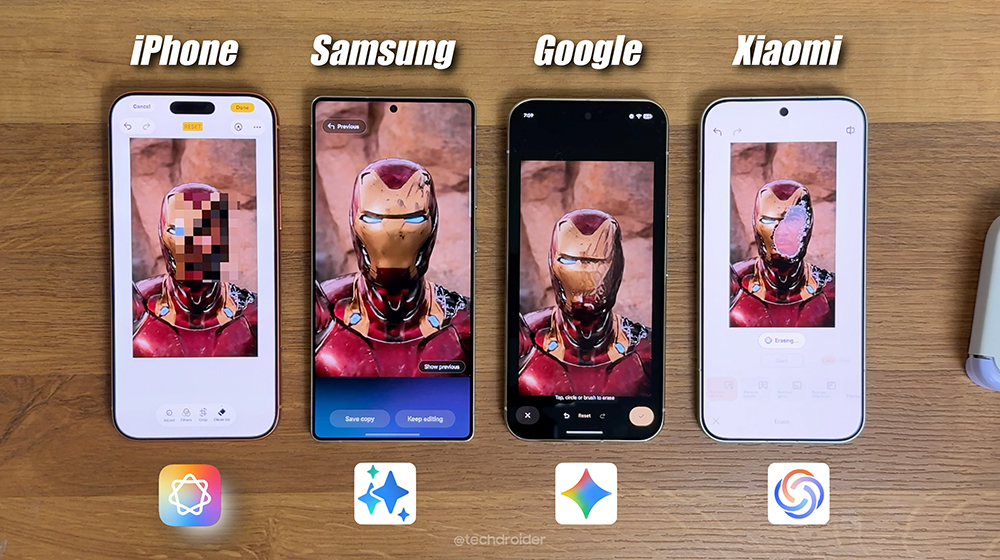
This test image is quite interesting—it depicts a cracked Iron Man helmet. The visor is damaged, revealing Tony Stark’s face. The test method uses an AI image editing tool to paint over the facial area, letting the AI automatically fill in the helmet to see which algorithm can produce the most plausible restoration.
▲Image source:TechDroider Clips
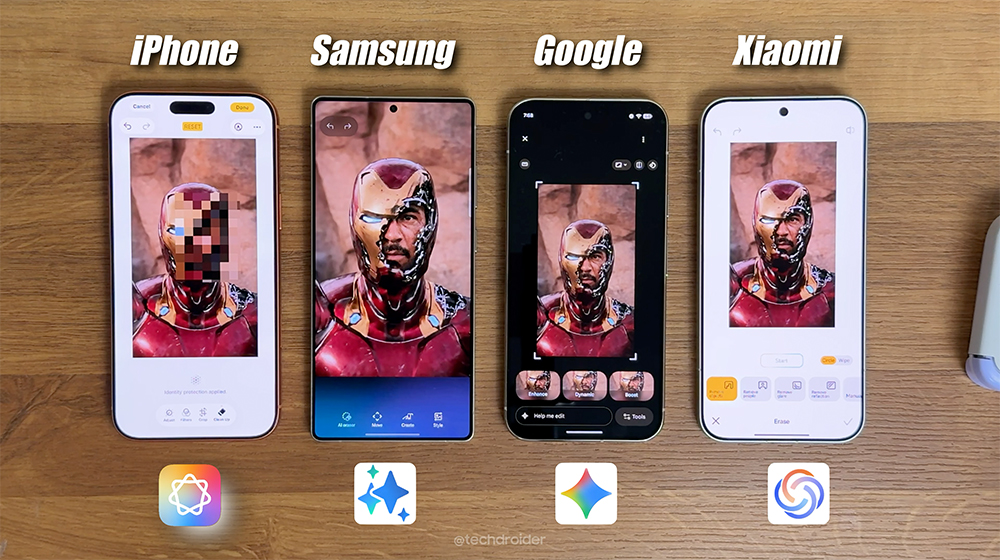
First up is Apple Intelligence. Apple has been heavily emphasizing Apple Intelligence’s features in recent years, especially adding many intelligent features to photo editing and generation. However, in this test, Apple Intelligence’s results left people somewhat amused and exasperated.
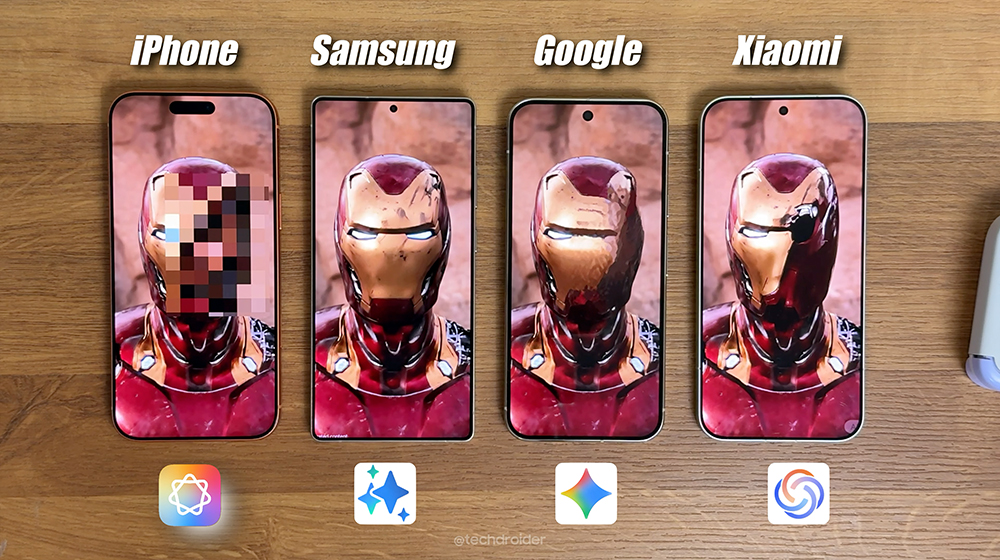
When the system tried to repair the Iron Man helmet, the AI seemed unable to figure out how to generate a reasonable structure, and ultimately produced large mosaic blocks directly over Tony Stark’s face, looking like intentional blurring. This result is clearly far from the restoration goal and is obviously a complete failure.
▲Image source:TechDroider Clips
Next is Samsung’s Galaxy AI. Samsung has actually been investing in AI image editing for quite some time, with features like generative editing, object moving, and background fill already quite mature. On the same Iron Man helmet image, Galaxy AI’s performance is noticeably more natural. The AI is able to understand the helmet’s original structure and attempts to restore the metallic surface and shape.
Although you can still tell it’s AI-generated in the details, the overall visuals are fairly reasonable and look closer to a complete Iron Man mask. From the video demonstration, Galaxy AI’s restoration result was the closest to the ideal outcome in this test.
Next up are the AI photo editing tools on Google Pixel. Google has long held strong technical expertise in the imaging AI space, and features like Magic Eraser and Magic Editor have been widely praised by users.
However, in this test, Pixel AI’s performance landed in the middle. Magic Editor did successfully fill the missing areas of the helmet, but the generated surface texture looked rather flat and the color differed slightly from the surroundings. The overall result resembled a body repair job that was only halfway done, with the eye area simply patched over with metal. It still looked fairly natural from a distance, but the retouching marks remained noticeable up close.
▲Image source:TechDroider Clips
Finally, there’s Xiaomi’s HyperAI. In recent years, Xiaomi has been actively strengthening its AI capabilities, particularly by continuously adding new features for image generation and intelligent photo editing. In this test, HyperAI’s AI Magic Eraser Pro feature actually did quite well restoring the red metal part of the helmet, and the texture looked quite metallic and glossy.
However, some details still have issues. For example, the eye area still retains holes and was not fully filled in. Another obvious problem is that the AI filled the golden areas on the helmet directly with red, causing the color ratio to be wrong and making it look significantly different from the original design.
▲Image source:TechDroider Clips
Through real-world testing like this, we can see that although mobile AI photo-editing features are already quite powerful, there are still notable differences between brands. When generating images, AI must understand scene structure, material textures, lighting, and color relationships—judgments that are actually highly complex. Because each company trains its models differently and uses different datasets, the final results naturally vary.
On the other hand, AI photo editing is not just a technical race. Manufacturers also factor in ease of use and generation speed when designing features. Some systems lean toward quickly filling in the image, while others prioritize restoring fine details. These design choices also shape the user’s real-world experience.
Further reading:
Source: KOCPC Chinese