


every time iOS A new version is launched. In addition to features and fixes, most iPhone There is actually only one thing that users are most concerned about, and that is whether battery life will be affected. After all, after updating the system, if the battery life drops significantly, no matter how many new features are added, it may make people feel uneasy to use it.
exist iOS 26.3 After the launch, the well-known foreign YouTube channel iAppleBytes also shared the battery stress test results earlier, using a unified environment and high load conditions to examine the battery life of multiple iPhones after the update. This test not only reflects the generation gap in hardware, but also gives users who are still using older models a more specific reference. If you are hesitating whether to update, or are curious about where your phone’s performance falls, the results of this test are worth learning more about.
▲Picture source:iAppleBytes (YouTube)
Will upgrading to iOS 26.3 save more battery? How long do the batteries of 6 iPhone models last?
Apple has officially launched iOS 26.3, version number 23D127. Like most system updates, in addition to bug fixes and stability improvements, battery performance is still the focus of user observation. Many people have this experience. After updating the system, the phone seems to consume more power. However, this is often related to background re-indexing data, photo analysis or app optimization, so testing usually takes a while after the update.
▲Picture source:iAppleBytes (YouTube)
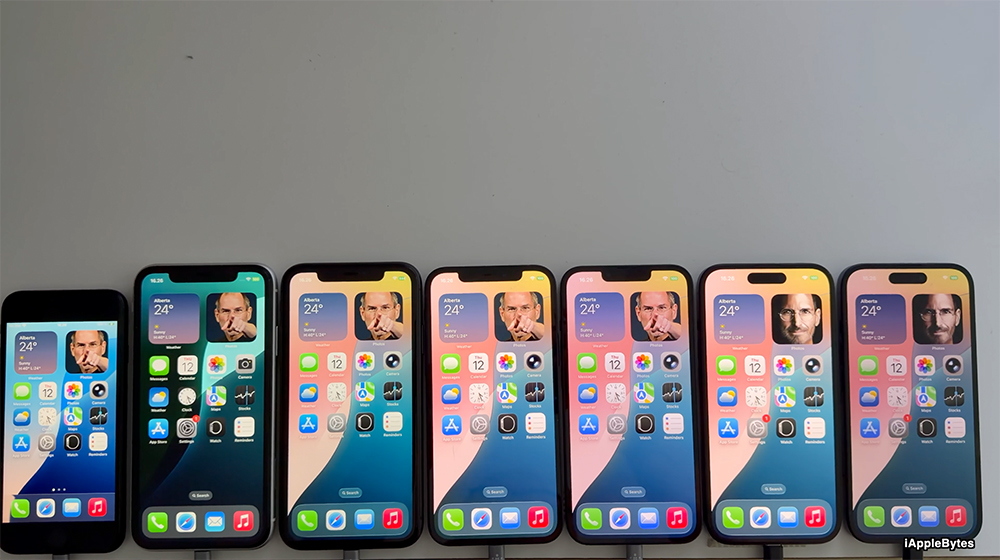
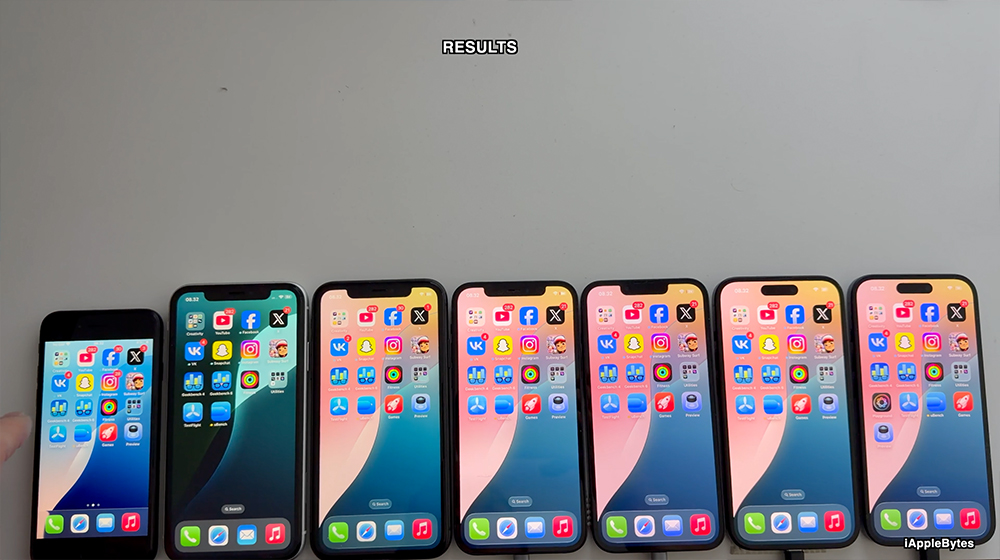
iAppleBytes adopted a more rigorous process this time. All test machines were left for about 26 hours after the upgrade to confirm that there were no background programs running continuously and the system was stabilized before running the test to try to eliminate short-term interference factors.
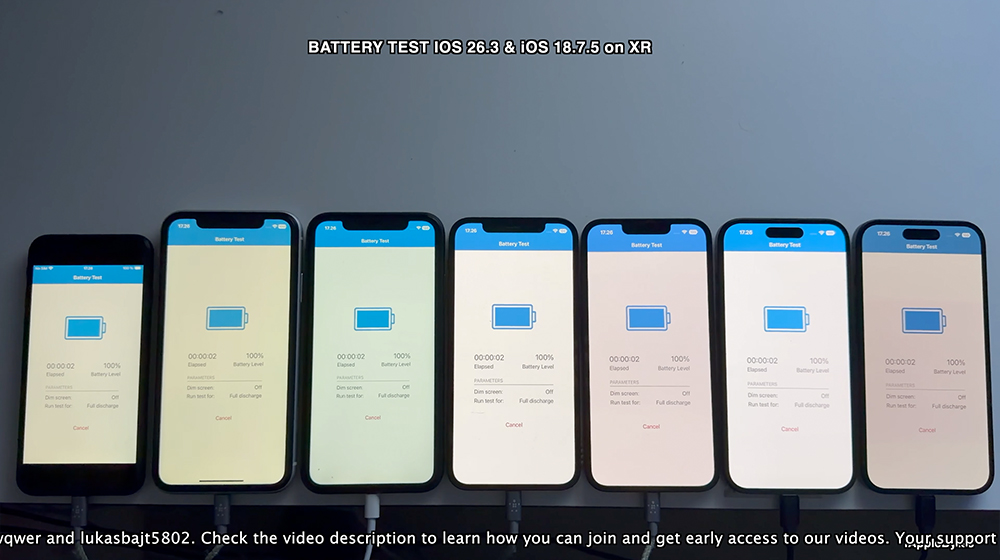
This battery life test uses the Geekbench 4 battery stress tool. The core concept of this tool is simple, which is to simulate extreme usage scenarios through continuous high-intensity computing. During the test, the phone will continuously execute algorithms and keep the screen on, leaving the processor in a high-load state for a long time. Although it is different from the daily usage patterns of social media, watching dramas or taking photos, the advantage is that it can establish a consistent comparison benchmark.
▲Picture source:iAppleBytes (YouTube)
All devices are set to the same conditions:
- Screen brightness is fixed at 25%, auto-brightness is turned off
- Connect to the same Wi-Fi access point
- Make sure there is no background activity
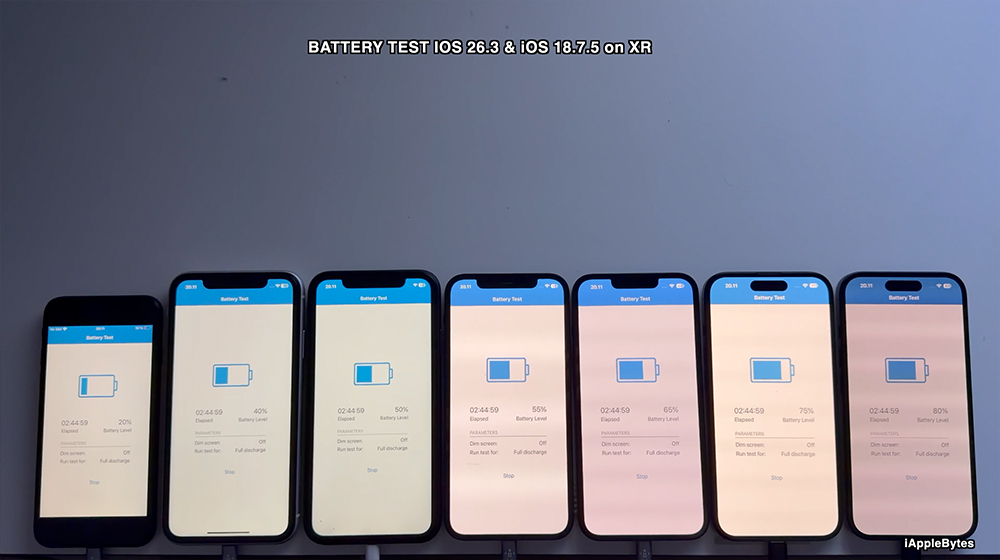
Geekbench’s scoring logic is calculated based on the amount of work completed and time spent during battery discharge. The higher the score, the stronger the battery life. If the score difference reaches 2 times, it usually means that the battery life performance is close to the multiple difference. The test mode is divided into complete discharge and partial discharge. The complete result from 100% to 0% has the highest reliability.
▲Picture source:iAppleBytes (YouTube)
iOS 26.3 battery life measurement results compiled at once
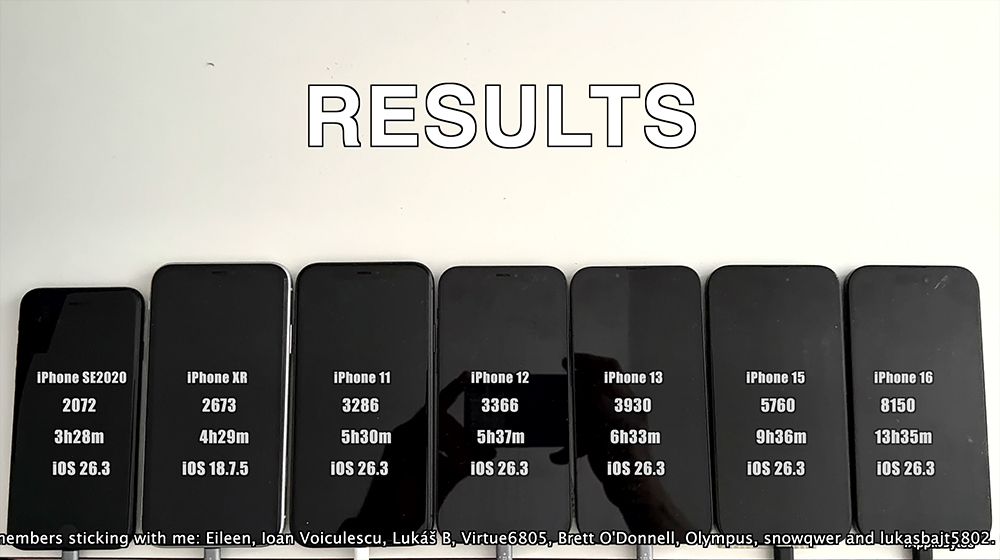
This test covers 6 iPhone models, ranging from old models that are still used by many people to new generation devices in the past two years. Let’s look at the actual battery life first:
- iPhone SE (2nd generation) 3 hours 28 minutes
- 5 hours 30 minutes for iPhone 11
- 5 hours 37 minutes for iPhone 12
- iPhone 13 is 6 hours and 14 minutes
- 9 hours 49 minutes for iPhone 15
- iPhone 16 came to 14 hours and 56 minutes
In addition, the older iPhone XR cannot be upgraded to iOS 26, so it was tested with iOS 18.7.5 and the battery life was 4 hours and 29 minutes.
A very obvious trend can be observed from the data, that is, the improvement in battery life brought about by the generation gap is considerable. In particular, the latest models have almost entered a range that can still sustain high-voltage use throughout the day.
▲Picture source:iAppleBytes (YouTube)
Battery score comparison makes it easier to see the difference
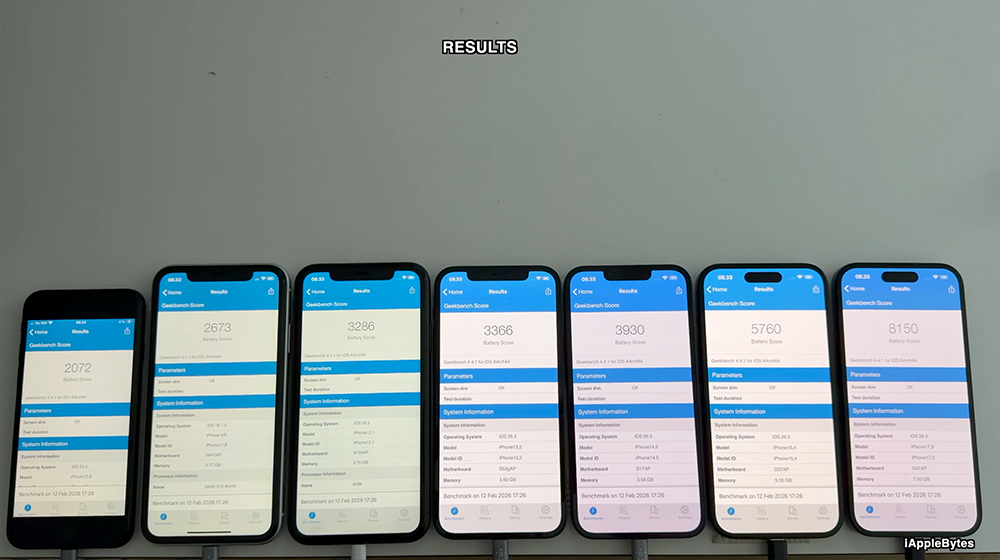
If you only look at the time, it is sometimes not easy to judge the magnitude of the difference, so the Geekbench score also provides another reference angle. The test results are as follows:
- iPhone SE 2nd generation scored 2072 points
- iPhone 11 is 3286 points
- iPhone 12 is 3366 points
- iPhone 13 is 3930 points
- iPhone 15 is 5760 points
- iPhone 16 has a score of 8150
The iPhone XR scored 2673 points under the old version of iOS 18.7.5.
▲Picture source:iAppleBytes (YouTube)
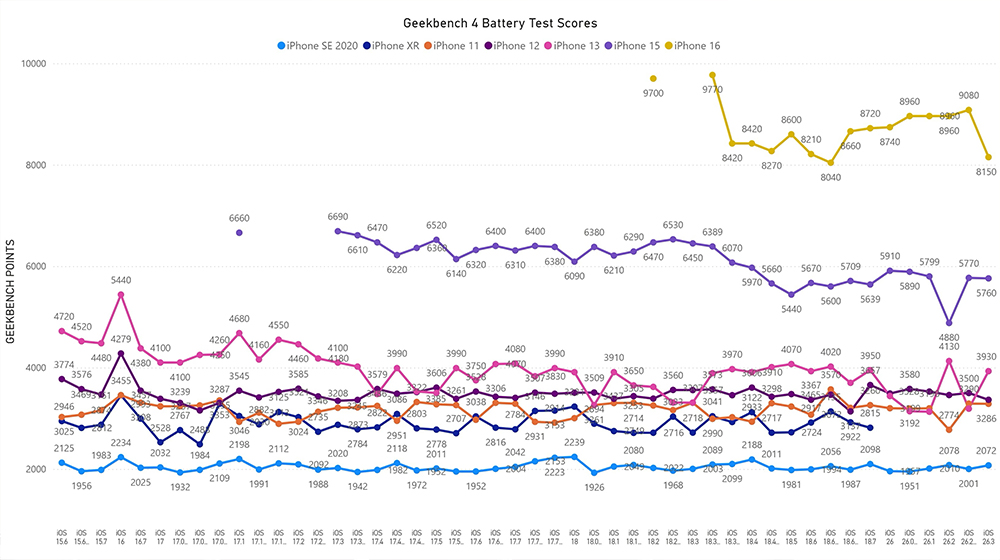
It can be found that starting from the iPhone 13, the score growth has been significantly amplified, showing that Apple has made significant progress in chip energy efficiency and power management. In particular, iPhone 16 is almost 4 times faster than iPhone SE (2nd generation). This is not just a matter of battery capacity, but also involves an overall improvement in process and processor efficiency.
▲Picture source:iAppleBytes (YouTube)
It should be noted that this type of testing is an extreme use case. Most people are unlikely to keep their CPU fully loaded for long periods of time in their daily lives, so users’ actual usage time is usually longer. However, the value of stress testing is to establish a level playing field so that different devices can be compared directly and energy efficiency gaps can be more easily seen. For people who are considering switching phones, this kind of data is more reference than subjective body feeling.
Further reading:
Source: KOCPC Chinese