


Shortly after Xiaomi unveiled its Mimo-V2 large model last month, the company has now suddenly released a newer and more powerful version. MiMo-V2.5 The large model series has unveiled four models in one go: MiMo-V2.5, MiMo-V2.5-Pro, MiMo-V2.5-TTS Series, and MiMo-V2.5-ASR. Among them, MiMo-V2.5 and MiMo-V2.5-Pro have also been announced for global availability.open source, licensed under the MIT license. The news immediately sparked heated discussion in the AI community: MiMo-V2.5-Pro topped multiple global authoritative benchmark tests, becoming tied for first place in the comprehensive intelligence index for open-source large models.
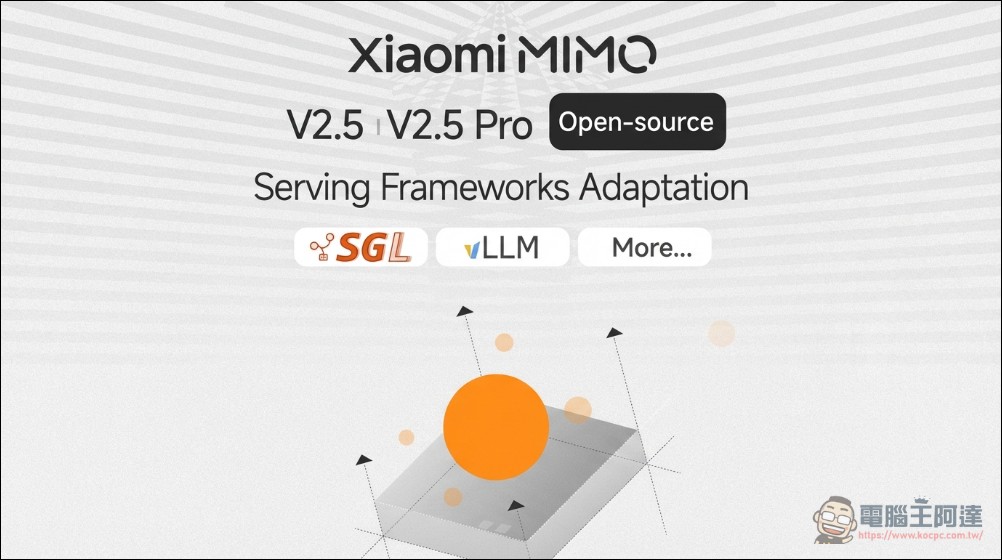
Four models unveiled simultaneously as open-source lineup targets global market
This time, the MiMo-V2.5 series released four models at once, covering core areas such as language understanding, multimodal reasoning, text-to-speech (TTS), and automatic speech recognition (ASR). Among them, MiMo-V2.5 is a multimodal agent model with native visual and audio understanding capabilities, enabling seamless reasoning switching between different modalities; MiMo-V2.5-Pro is positioned for advanced reasoning and agent tool calling, serving as the flagship version.
MiMo-V2.5-Pro uses a Mixture-of-Experts (MoE) architecture, with 1 trillion total parameters and 42 billion active parameters, and supports a maximum context length of up to 1 million tokens. This figure ranks at the top among open-source models, making it sufficient to tackle extremely long-horizon reasoning tasks and complex document analysis.
MiMo-V2.5-Pro Tops the Global Open Source Leaderboard
According to Xiaomi’s officially released test results, MiMo-V2.5-Pro delivered excellent performance across multiple authoritative global benchmarks, ranking first among open-source models in the Agent-specific index and breaking into the top tier of the overall global large model leaderboard, surpassing the just-announced Deepseek V4。
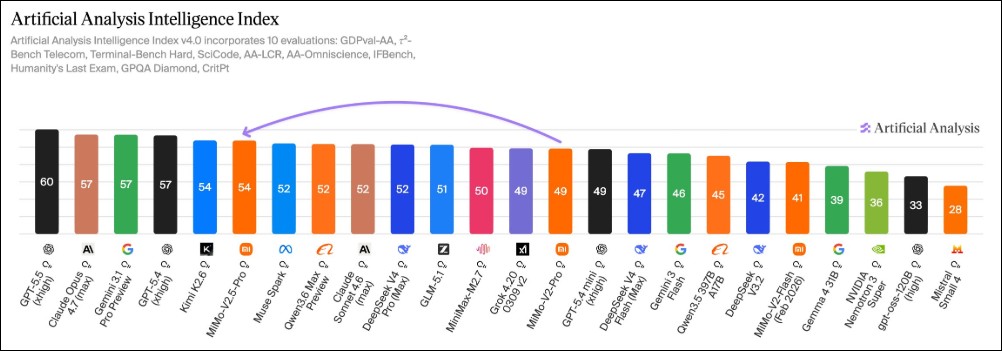
Compared to its contemporaries—China’s leading model Kimi K2.6 and the US’s Claude Opus 4.6—MiMo-V2.5-Pro holds its own across all metrics.
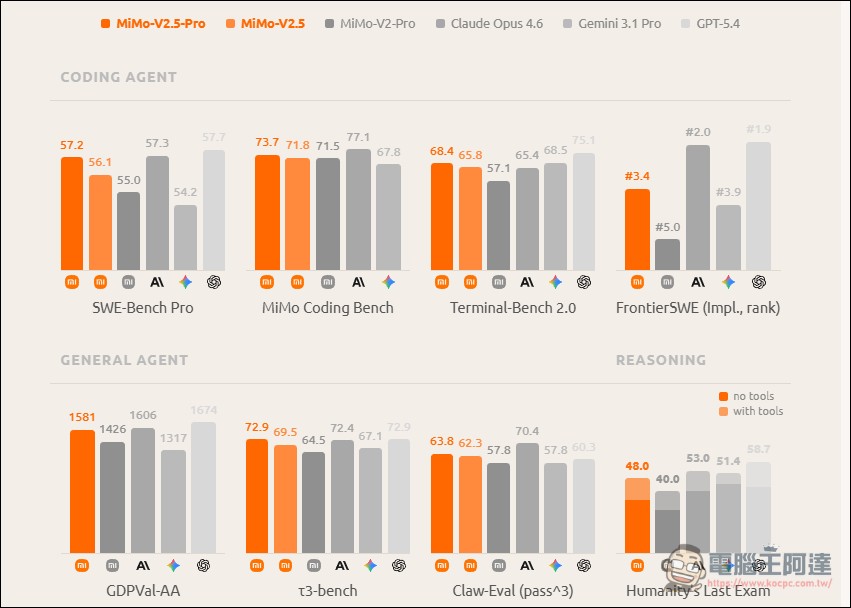
In real-world applications, MiMo-V2.5-Pro’s output efficiency has also drawn attention. According to user feedback, the model performed strongly in programming and software engineering benchmarks such as SWE-bench Pro, handling high-complexity code generation and Agent tasks. However, some early testers noted that there is still room to optimize speed and stability under ultra-long-context conditions. In the official example, MiMo-V2.5-Pro delivered a fully functional desktop application with just a few simple prompts: a multi-track timeline, clip trimming, crossfade, audio mixing, and an export workflow. The final version includes 8192 lines of code ,在
Translation: , in
Wait we need return only translation. No heading. Let me output only “, in”., in 11.5 hoursduring the independent development process, more than… were called upon/used. 1868 sub-tools 。
Launch the Orbit 100 Trillion Token Initiative
In addition to the open-source models, Xiaomi has also launched the “Orbit 100 Trillion Token Program,” offering a total of 100 trillion tokens in free credits to developers and creators worldwide over a one-month period (April 28 to May 28, 2026). Developers can apply through 100t.xiaomimimo.com, hoping to attract more developers to experience the MiMo series’ features firsthand.
We believe open source is more than releasing weights — it’s about building ecosystems.
Today, we’re introducing MiMo Orbit.
A program to support builders, frameworks, and the next wave of AI applications.MiMo Orbit includes:
1️⃣ 100T Token Grant for Builders
We’re making 100… pic.twitter.com/qj7TgecysF— Xiaomi MiMo (@XiaomiMiMo) April 27, 2026
Model weights for the MiMo-V2.5 series are now available on Hugging Face (Xiaomi-MiMo), developers can freely download, fine-tune, and use it for commercial purposes. This open strategy reflects Xiaomi’s positioning in the global AI open-source ecosystem, as it seeks to attract more developers by lowering the barrier to entry.
Source: KOCPC Chinese