


A few days ago Apple Launched a new laptop priced at only NT$19,900 MacBook Neo , triggering a lot of discussion. For the first time, this new product targeting the entry-level market uses the iPhone-level A18 Pro chip instead of the M-series chip used in traditional Macs. Therefore, many people are curious about which level its actual performance falls.
Recently, the first test results of MacBook Neo have appeared in the Geekbench database, allowing the outside world to finally get a glimpse of this cheapest machine. Mac performance. Judging from the current data, it is even close to the M series Mac in some projects, but the overall positioning is still clearly different from the traditional MacBook.

▲Picture source:Apple
MacBook Neo’s first performance benchmark is released! Comparable to M1 MacBook Air
According to a test data that appeared in the Geekbench database, the results of MacBook Neo equipped with A18 Pro chip. Among them, the single-core test scored 3,461 points, the multi-core test scored 8,668 points, and the Metal graphics test scored 31,286 points. If you just look at the numbers, this performance is actually not low, and some projects are even close to the newer Apple Silicon Mac.
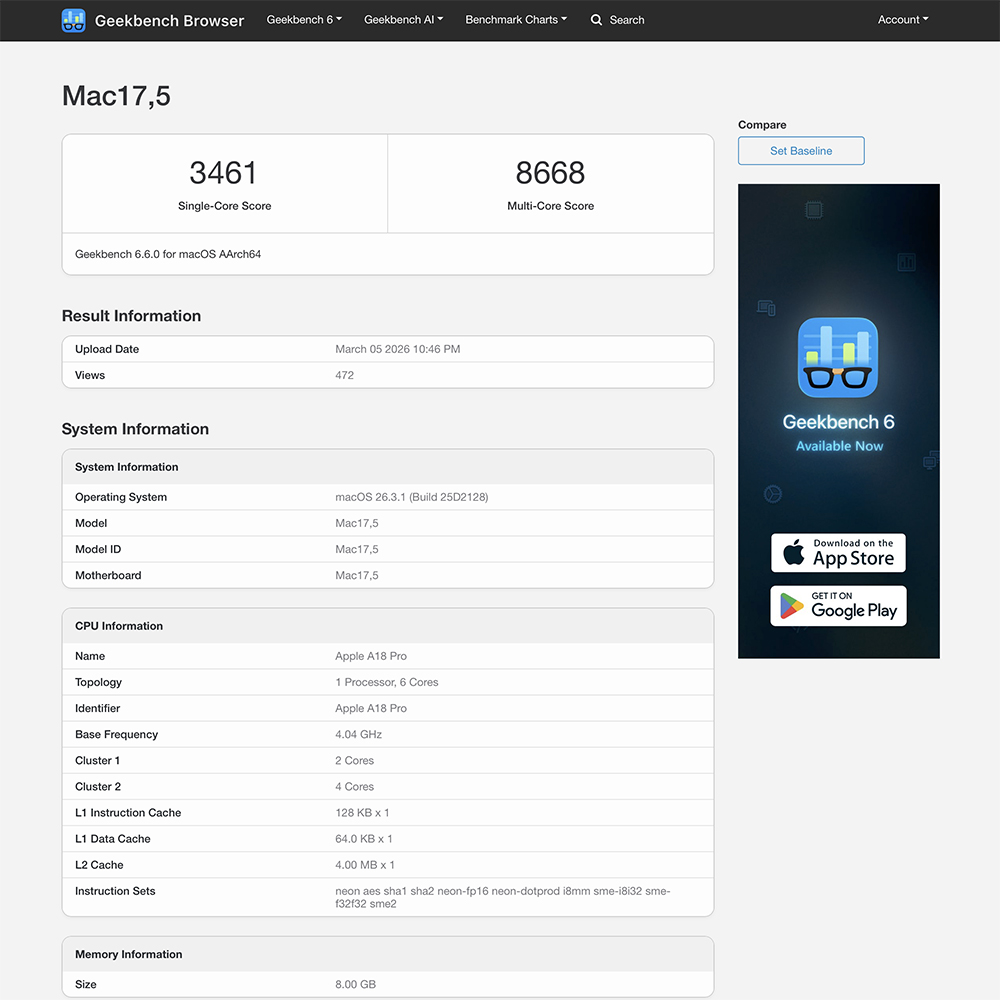
▲Picture source:Geekbench
If you just look at the numbers, this performance is actually not low, and some projects are even close to the newer Apple Silicon Mac. Currently, there is only one test data for MacBook Neo in the Geekbench database, so this cannot be regarded as the final average performance. As more users start testing, the results may fluctuate. However, judging from the current data, these results are actually in line with expectations. The performance of the A18 Pro is already on par with the iPhone 16 Pro, and it is not surprising to see similar results in the MacBook Neo.
In order to understand its positioning more clearly, it can also be compared with several common Apple devices. Here are the Geekbench scores for several relevant devices:
|
|
single core |
multi-core |
Metal graphics test |
|
MacBook Neo |
3,461 points |
8,668 points |
31,286 points |
|
iPhone 16 Pro |
3,445 points |
8,624 points |
32,575 points |
|
M1 MacBook Air |
2,346 points |
8,342 points |
33,148 points |
|
M4 MacBook Air |
3,696 points |
14,370 points |
54,630 points |
|
M3 iPad Air |
3,048 points |
11,678 points |
44,395 points |
|
iPad 11 |
2,587 points |
6,306 points |
19,395 points |
|
Source: Geekbench |
|||
It can be seen from these data that the performance of MacBook Neo is actually very close to that of iPhone 16 Pro. This isn’t surprising, as both are powered by an A18 Pro chip, it’s just that the MacBook Neo’s GPU has one less core, so the Metal graphics score is slightly lower.
If you look closely at the Geekbench Metal graphics test scores, the MacBook Neo’s graphics score is 31,286 points, which is slightly lower than the iPhone 16 Pro’s 32,575 points. The reason is actually very simple. The A18 Pro GPU used in the MacBook Neo has one less core, so the graphics processing power is slightly reduced.
Such a difference may not be noticeable to the average user, but it may still have some impact in 3D games or GPU-accelerated applications. However, considering the product positioning of MacBook Neo, this configuration is actually reasonable.
Positioning relationship between MacBook Neo and M1 MacBook Air
If you compare MacBook Neo with early Apple Silicon Macs, the most representative one is the M1 MacBook Air. In the Geekbench test, the MacBook Neo’s multi-core score of 8,668 is almost at the same level as the M1 MacBook Air’s 8,342, and the difference is actually not that big. In other words, in tasks that require multi-core processing, the performance of the Neo can be roughly considered to be close to that of the M1 MacBook Air.

▲Picture source:Apple
But single-core performance is completely different. The MacBook Neo’s single-core score reached 3,461 points, while the M1 MacBook Air only scored 2,346 points. The gap is actually quite obvious. This means that Neo’s single-core computing power is much stronger than that of earlier M series Macs, and is even close to the newer M3 or M4 series.
This is also one of the biggest advantages of A-series chips in recent years. Apple continues to enhance single-core performance on iPhone chips, so it will have a very smooth experience in daily operations.
Many people were surprised when they first saw that MacBook Neo used A-series chips, because Mac computers usually use M-series chips. However, from a positioning perspective, this choice is actually quite reasonable.
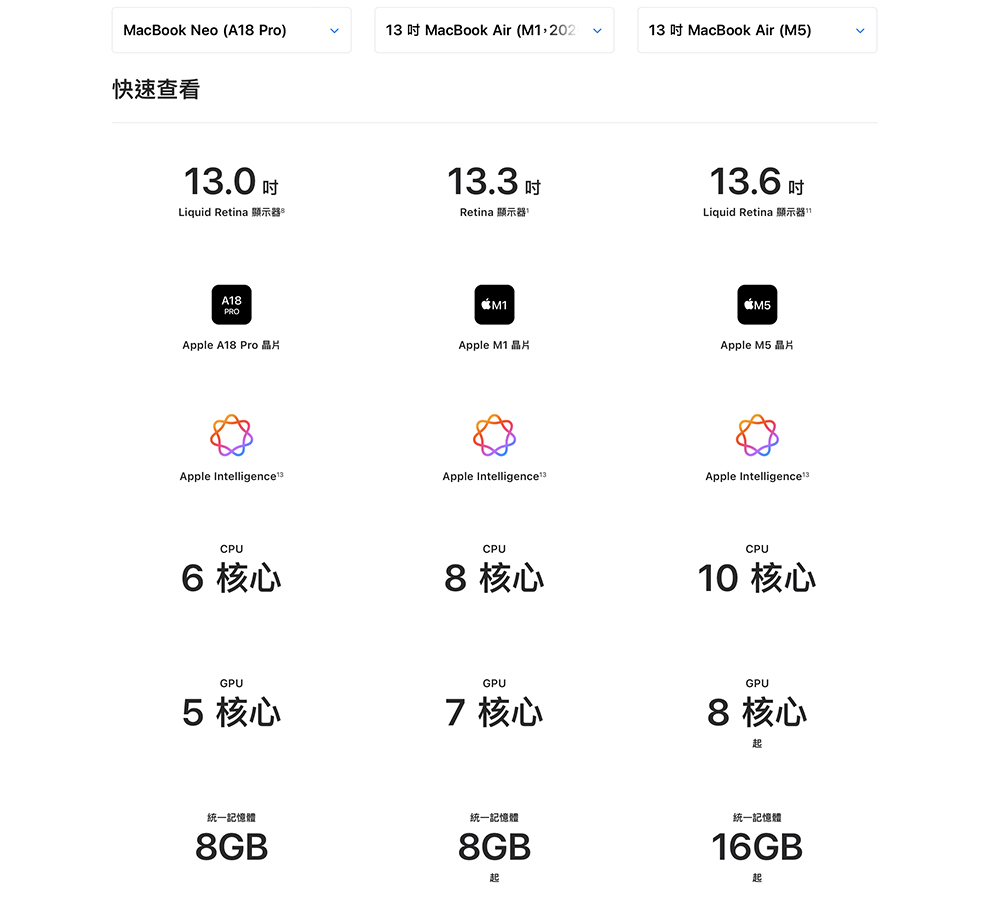
▲Picture source:Apple
The A18 Pro’s single-core performance is very strong, and its multi-core performance can also reach M1 levels. For average users, many common operations actually rely more on single-core performance, such as web browsing, document editing, streaming video playback, and light office work. These daily usage scenarios don’t require a lot of multi-core computing, so the A18 Pro is more than enough.
On the other hand, professional tasks such as video editing, music production, 3D modeling, and program compilation rely more on multi-core performance. This is why Apple still retains the M series MacBook Air and MacBook Pro product lines. In other words, the MacBook Neo was never designed for serious creators from the start.
Competing with Windows entry-level laptops
Apple rarely makes direct comparisons between MacBook Neo and other Macs in its official promotions. The real target of this product is actually the entry-level laptop market. In many markets, a Windows laptop or Chromebook priced around $20,000 is a very common choice. Apple hopes to bring Mac into this price range with MacBook Neo.

▲Picture source:momo shopping network
According to Apple, the A18 Pro can be up to 50% faster than popular PCs powered by Intel Core Ultra 5 in everyday tasks. In addition, in terms of local AI computing, MacBook Neo can be up to 3 times faster, and photo editing speed can also be increased up to 2 times. These data show that the positioning of MacBook Neo is actually very clear, which is to make Mac an option for more students and entry-level users.
Conclusion
Judging from the Geekbench scores currently exposed, the performance positioning of MacBook Neo is actually quite clear. It’s quite strong in single-core performance, even close to the newer M-series chips, while multi-core performance falls roughly at the level of the M1 MacBook Air. This combination is actually very sufficient for daily use and can also bring a smooth operating experience.
However, the Neo is not designed to replace the existing MacBook Air or MacBook Pro, but to provide a cheaper Mac option for the entry-level market. It might be enough for students or light users, but for users who need high-performance creative work, M-series Macs are still a better choice. As more test data emerges, the actual positioning of MacBook Neo will become clearer.
Further reading:
Source: KOCPC Chinese