


Now AI Not only are large language models getting stronger, but small models are also gradually closing the gap. Earlier, Alibaba officially launched a new Qwen3.5 The full lineup of small models has impressed many people, with even Elon Musk himself commenting below, praising the “incredible intelligence density.” The key focus of this new model is “more intelligence, less computation.” The 9-billion parameter Qwen3.5-9B model approaches or even surpasses OpenAI’s GPT-OSS-120B model, which has more than 13 times the parameters, across multiple third-party benchmark tests—and can even run smoothly on an ordinary laptop.
Image source:pandaily
Alibaba’s Qwen3.5 Small Open-Source Model Series Debuts: 9B Version Rivals GPT-OSS-120B
This time, the Qwen 3.5 small model series includes four open-weight models, namely:
- Qwen3.5-0.8B (800 million parameters)
- Qwen3.5-2B (2 billion parameters)
- Qwen3.5-4B (40 billion parameters)
- Qwen3.5-9B (90 billion parameters)
On the technical side, the Qwen3.5 series employs a hybrid attention architecture that combines Gated DeltaNet linear attention mechanism with Gated Attention, alternating usage in a 3:1 ratio within every 8 blocks, which can effectively enhance inference throughput and reduce memory consumption. More importantly, all four models natively support multimodal capabilities, enabling simultaneous processing of text, images, and video. The native context length is 262,144 tokens, with the 4B and 9B variants expandable to 1,010,000 tokens.
It also has Agent capabilities, natively supports tool calling, multi-turn reasoning, and visual agent tasks such as desktop operation, document parsing, or autonomous code generation, and after reinforcement learning optimization, is suitable for building lightweight intelligent agents.
In actual performance tests, Qwen3.5-9B truly stands out.
On the graduate-level scientific reasoning benchmark GPQA Diamond, the 9B model scores 81.7, higher than GPT-OSS-120B’s 80.1. The multilingual knowledge benchmark MMMLU reaches 81.2, also leading the competition. For visual reasoning, MMMU-Pro scores 70.1, surpassing Gemini 2.5 Flash-Lite (59.7) and the previous generation Qwen3-VL-30B-A3B (63.0); Video-MME (with subtitles) for video understanding scores 84.5; the math benchmark HMMT scores 83.2; and OmniDocBench for document processing scores 87.7.
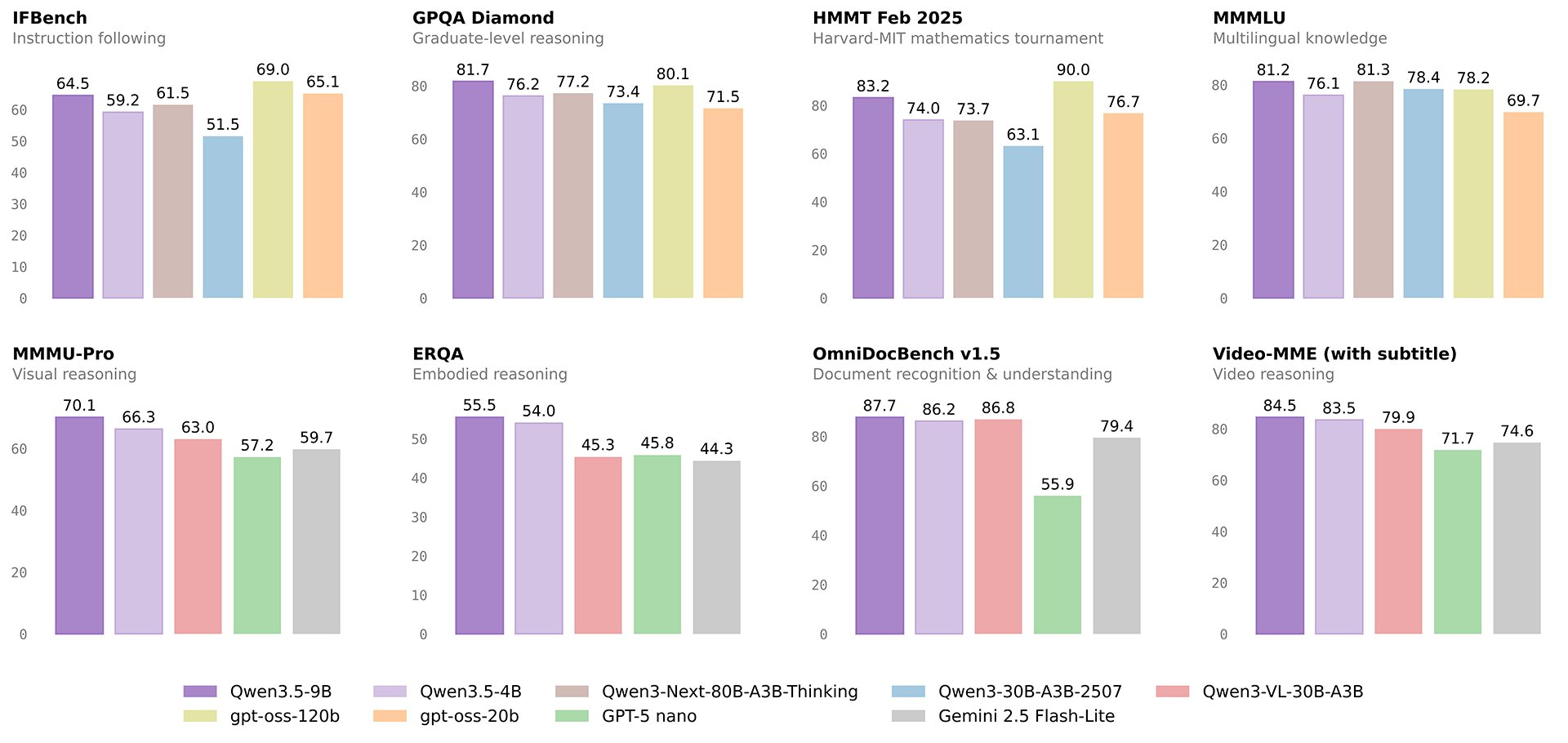
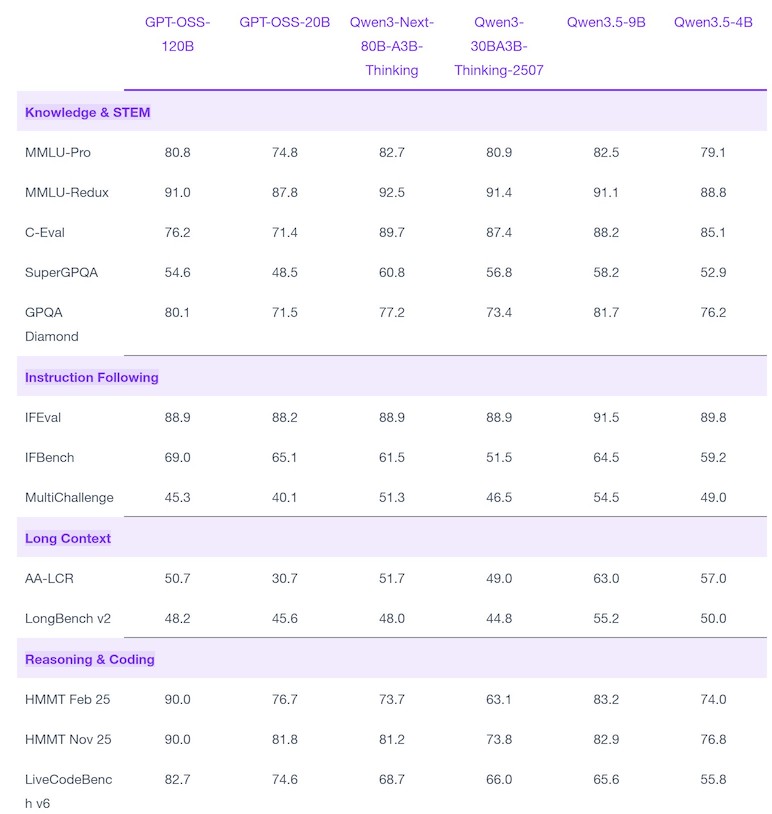
Compared to the previous generation Qwen3 series, Qwen3.5-4B already rivals the previous 80B A3B model in performance, while the 9B version comprehensively outperforms the 3x larger Qwen3-30B across benchmarks like GPQA, IFEval, and LongBench v2—truly impressive.
Below is the hardware environment suitable for each model:
- The 0.8B and 2B versions have extremely low memory requirements and can run on smartphones, edge devices, or IoT devices.
- The 4B version runs smoothly on standard laptops, M1 MacBook Air, and even web browsers, making it suitable for lightweight agent applications.
- After 4-bit quantization, the 9B version can run on GPUs with 12–24GB of memory or even regular laptops.
Developers abroad have already gotten the 2B version running on the iPhone 17 Pro:
For those interested, can Hugging Face orAlibaba ModelScope Download and use
With the release of Alibaba’s Qwen3.5 small model series, the traditional belief that “bigger parameters mean stronger performance” has been shattered. It proves that through hybrid architecture, native multimodal design, and reinforcement learning, small models can also deliver top-tier reasoning, visual understanding, and agent capabilities. I highly recommend giving it a try.
Source: KOCPC Chinese