


Recently, Google quietly launched a brand new voice input application on the iOS platform calledGoogle AI Edge EloquentThis tool features “offline-first” voice recognition capabilities, clearly positioning itself to compete with similar applications like Wispr Flow, SuperWhisper, and Willow that have rapidly gained popularity in recent years, aiming to secure a place in the competitive speech-to-text market.
Google AI Edge Eloquent, an offline-capable AI voice recognition app, quietly launches on iOS
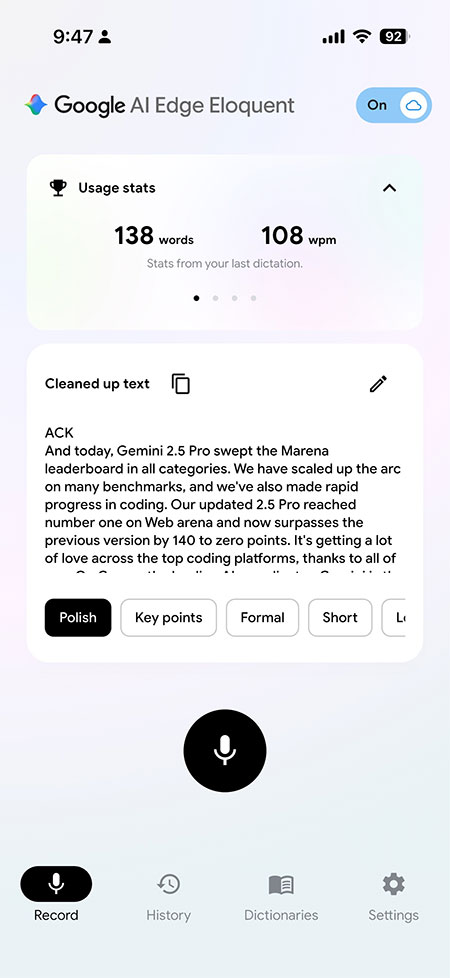
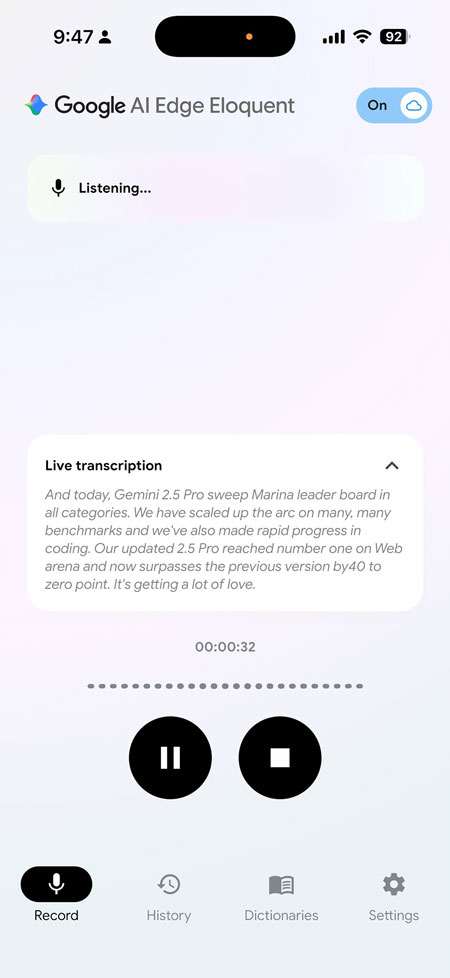
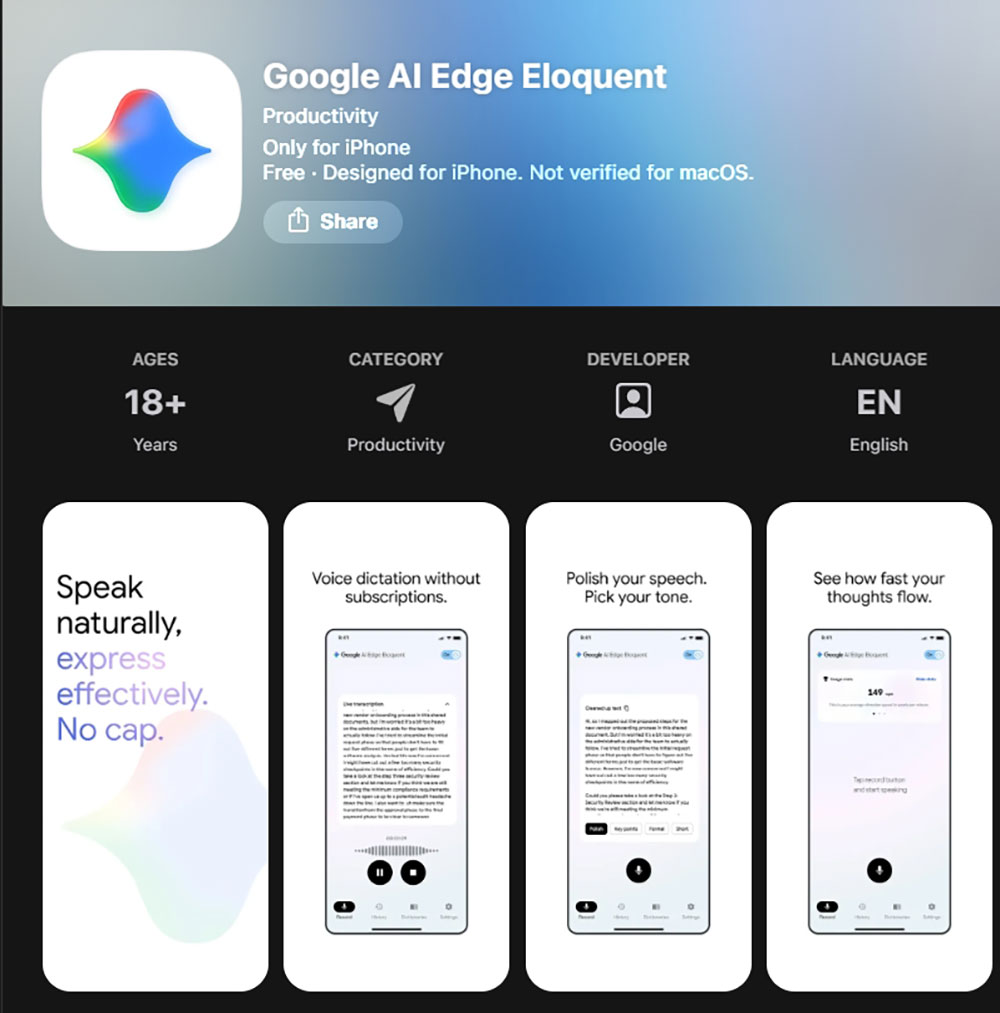
Eloquent is free to download, and after installation, users only need to download an additional Gemma-based automatic speech recognition (ASR) model to enable direct voice input on their phone locally. The app displays the transcription in real time as you speak, and when you stop, the system automatically cleans up the text by removing filler words like “uh” and “um,” and correcting common self-corrections, making the output more like natural, complete written text.
Below the transcription results, Eloquent offers multiple text style options, including modes like “Key Points,” “Formal,” “Concise,” and “Complete,” allowing users to quickly adjust the tone and length according to their needs. This is especially useful for users who need to organize meeting notes, draft emails, or quickly generate summaries.
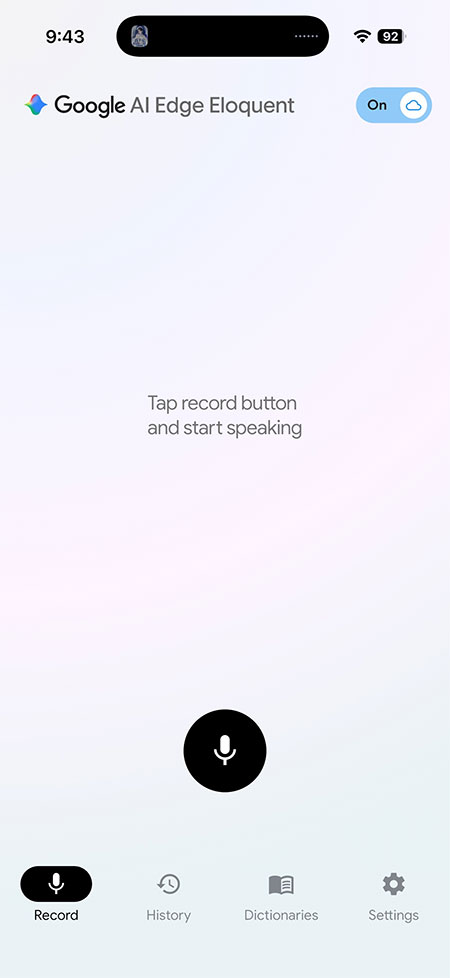
It’s worth noting that Eloquent supports fully offline operation. If users choose to disable cloud mode, all voice processing is completed locally, with no voice data uploaded to servers. When cloud mode is enabled, the Gemini model is activated for more advanced text cleanup and semantic adjustments, providing higher quality output. Google also allows users to import commonly used keywords, proper nouns, and contact names from their Gmail accounts, and to manually add custom vocabulary to improve recognition accuracy.
Eloquent also comes with built-in full transcription history, allowing users to browse all past conversations and quickly find specific content through search. The app displays word count statistics for each conversation, words per minute (WPM) input speed, and cumulative word counts, making it particularly useful for tracking work efficiency or voice input habits.
Google’s description on the App Store emphasizes that Eloquent’s goal isn’t merely to transcribe word-for-word, but to “bridge the gap between natural speech and ready-to-use professional text.” The company states that traditional speech recognition tools tend to faithfully record pauses, stutters, and filler words in spoken language, while Eloquent uses AI models to understand semantics and polish sentences, making the output text closer to what the user actually wants to express.
Currently, Eloquent is only available on iOS, but the App Store listing clearly mentions that an Android version is in development. Google says the Android version will support “seamless integration,” allowing users to set Eloquent as their default keyboard and enable speech-to-text directly in any text input field. Additionally, the Android version will also include a floating button feature similar to Wispr Flow, allowing users to quickly start transcription from any screen.
As voice-to-text model quality has improved dramatically, voice input tools are gradually becoming part of many people’s daily workflows. From meeting minutes and interview transcriptions to quickly drafting messages or notes, AI-powered speech transcription applications are rapidly gaining popularity. Google’s launch of Eloquent clearly signals its intent to carve out its own product positioning in this growing trend. If this experimental app receives positive feedback on iOS, Google may not rule out integrating it into the Android system level in the future, making voice input a more natural and accessible method of interaction.
Source: KOCPC Chinese