


The well-received Chinese AI startup MiniMax (Xiyu Tech) in the open-source community officially Hugging Face open-sourcing our latest MiniMax M2.7 This is MiniMax’s most powerful open-source large language model to date, and also the company’s first “self-evolving” model capable of deeply participating in its own development process. According to official benchmark data, M2.7 has achieved breakthrough performance in three major areas: software engineering, professional office work, and multi-agent collaboration, with some metrics now on par with the world’s top closed-source models.
We’re delighted to announce that MiniMax M2.7 is now officially open source.
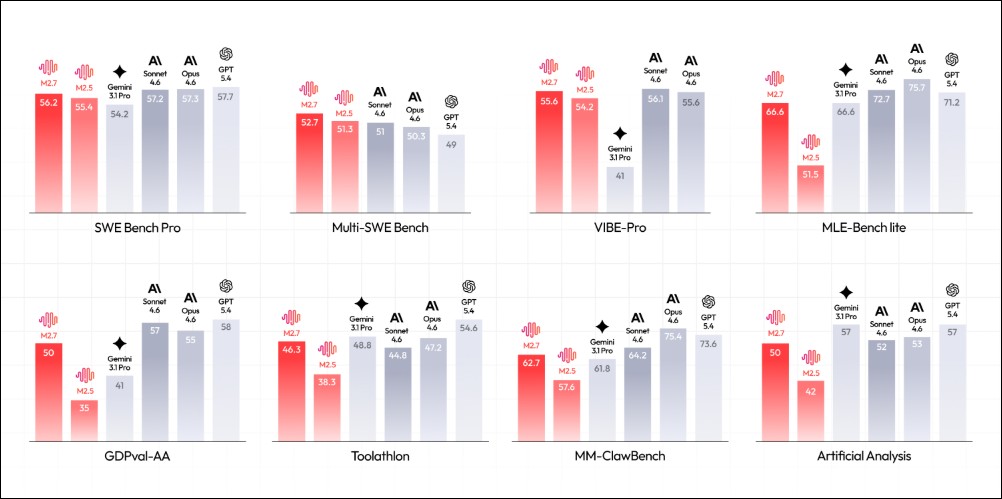
With SOTA performance in SWE-Pro (56.22%) and Terminal Bench 2 (57.0%).You can find it on Hugging Face now. Enjoy!🤗
huggingface:https://t.co/lyDLCyPqsy
Blog: https://t.co/tTzoxgUTud
MiniMax API:… pic.twitter.com/qzIW5fX8X7— MiniMax (official) (@MiniMax_AI) April 12, 2026
Powered by MoE architecture: activating only the necessary expert neurons
M2.7 adopts a Mixture-of-Experts (MoE) architecture, dynamically activating only the required expert neuron blocks instead of running the full model, significantly reducing inference cost and latency. This design allows M2.7 to maintain high performance while offering more competitive deployment costs.
SWE-Pro Benchmark: 56.22%, on par with GPT-5.3-Codex
In the most prestigious SWE-Pro benchmark in software engineering, M2.7 achieved 56.22% its accuracy rate, claiming to be on par with GPT-5.3-Codex. SWE-Pro covers tasks such as log analysis, bug investigation, code security review, and machine learning debugging, making it more closely aligned with real production environments than typical algorithm problem-solving.
In other key evaluations:
- Terminal Bench 2 (Complex Systems Understanding): 57.0%
- VIBE-Pro (Complete Project Delivery): 55.6%nearly on par with Opus 4.6
- SWE Multilingual:76.5%
- Multi SWE Bench:52.7%
Production Environment Benchmark: Fault Recovery Time Cut to Under 3 Minutes
M2.7’s capabilities go beyond benchmarks. The MiniMax team has documented the model’s performance in real production environments: when the system emits monitoring alerts, M2.7 can automatically correlate monitoring metrics with deployment timelines, perform causal reasoning, execute statistical analysis on trace data and formulate hypotheses, proactively connect to databases to verify root causes, identify missing index migration files in the code, and use non-blocking index creation to stop the bleeding. After completing the entire workflow, it submits a merge request. MiniMax noted that the model has multiple times reduced the time to fix production incidents to within 3 minutes。
Autonomous Evolution: 100 Optimization Cycles, 30% Performance Improvement
M2.7’s most notable characteristic is its “self-evolution” capability. The MiniMax team had M2.7 take charge of optimizing the model’s programming performance: the model executes this optimization loop in a completely autonomous manner—”analyzing failure traces → planning changes → modifying framework code → running evaluation → comparing results → deciding to keep or rollback”—running for over a total of 100 wheels。
During this process, M2.7 automatically discovered several effective optimization strategies: systematically searching for the optimal combination of sampling parameters such as temperature, frequency penalty, and presence penalty; designing more precise workflow instructions (e.g., after fixing a bug, automatically searching for the same problem pattern in other files within the same project); adding cycle detection mechanisms for agent loops. Ultimately, M2.7 achieved 30% efficiency improvement。
In MiniMax’s own reinforcement learning research workflow, M2.7 can currently independently complete 30%–50% Handles end-to-end work autonomously, with human researchers only participating in decision-making and discussion at critical stages.
MiniMax Project lead Skyler Miao said on X: We deliberately trained the model to perform better in planning and user requirement confirmation. The next step is to introduce more complex user simulators to further expand this capability.
Great observation. We intentionally trained the model to be better at planning and at clarifying requirements with the user. Next step is a more complex user simulator to push this even further. https://t.co/JwT4UifJ98
— Skyler Miao (@SkylerMiao7) March 18, 2026
MLE Bench Lite: Machine Learning Competition Medal Rate 66.6%
The MiniMax team also put M2.7 through MLE Bench Lite testing: this is an open-source evaluation suite from OpenAI containing 22 machine learning competitions that can run on a single A30 GPU, covering almost all ML workflow stages.
The experimental design is extremely minimal: it only includes three components—short-term memory, self-feedback, and self-optimization. At the end of each iteration, the agent generates short-term memory marker files, performs self-critique of current results, and provides optimization directions for the next round. Three independent experiments, each given 24 hours of iterative evolution time.
Final result: Best single run clinched 9 Gold, 5 Silver, 1 BronzeThe average medal-winning rate across three experiments is 66.6%, second only to Opus 4.6 (75.7%) and GPT-5.4 (71.2%), on par with Google Gemini 3.1.
Professional Performance: Hallucination Rate Reduced to 34%
M2.7 achieved on GDPval-AA in the professional office domain ELO 1495 pointsthe highest score among all currently available open-source accessible models
M2.7 also showed significant progress in hallucination control: the AA-Omniscience Index jumped from the previous generation M2.5’s negative 40 points to positive 1 point; hallucination rate only 34%, lower than Claude Sonnet 4.6’s 46% and Gemini 3.1 Pro Preview’s 50%.
Agent Teams: Native Multi-Agent Collaboration Framework
M2.7 supports the Agent Teams framework proposed by MiniMax, enabling native multi-agent collaboration. The model can construct complex Agent frameworks, combining dynamic tool search with complex skill invocation to accomplish highly specialized productivity tasks.
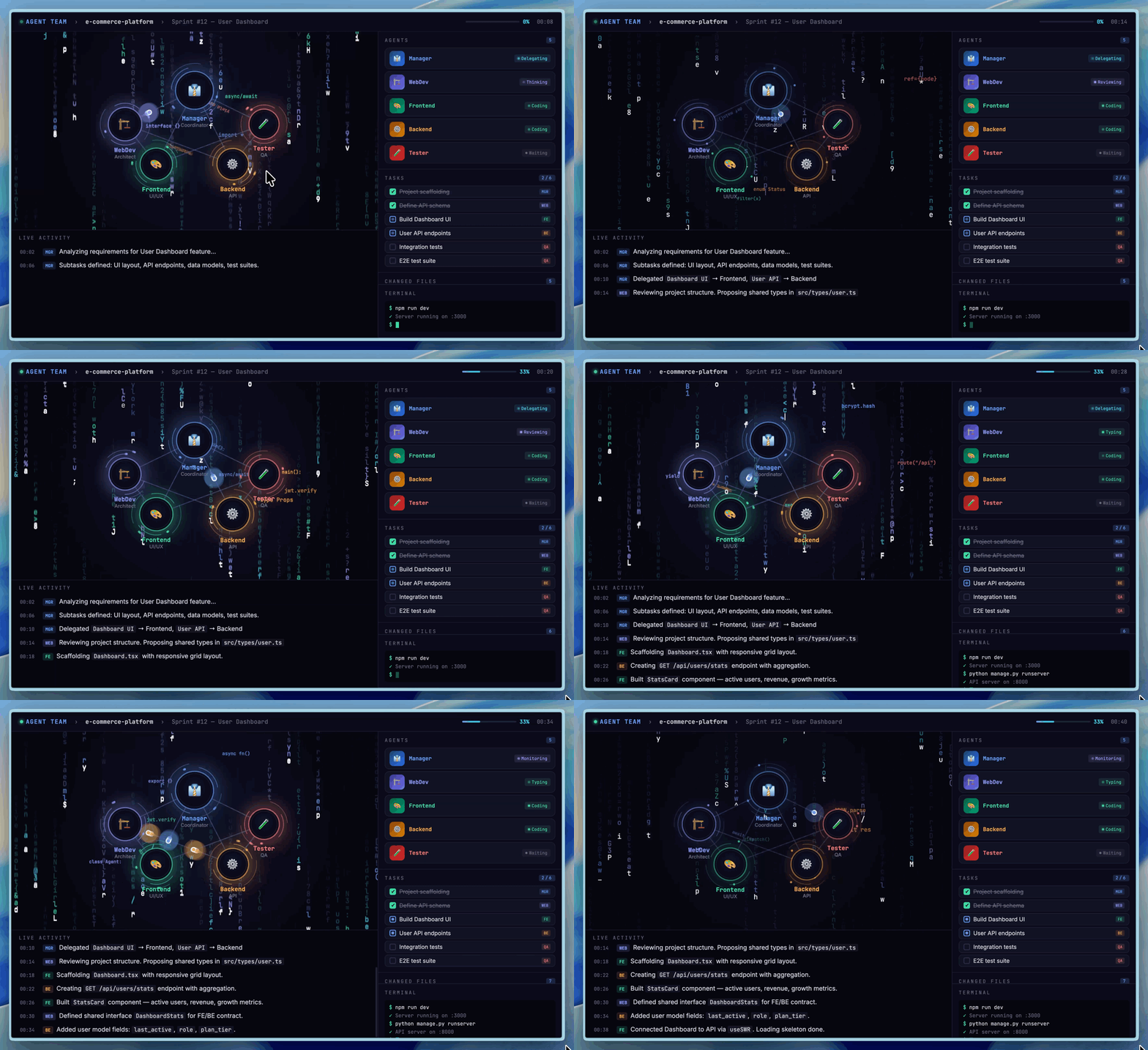
Additionally, the model is also equipped with the OpenRoom interactive system, extending AI interaction from pure text to a visual interface, supporting real-time scene feedback and high scalability.
Model acquisition method
M2.7 is now open source, model weights have been Hugging Face It’s open source, and qualified users can try deploying it themselves, while it can also be used through the MiniMax API.
Source: KOCPC Chinese