


For a long time, speech synthesis technology has mostly relied on discretizing sound by breaking it into “tokens”. While this approach solved transmission and computation challenges, it also lost the subtle emotional nuances and acoustic details present in human voices. However, the open-source model recently released by the OpenBMB team VoxCPM2Using a brand-new “Tokenizer-Free” architecture, it completely shatters this ceiling, requiring only an ordinary consumer-grade GPU with 8GB of VRAM to run, bringing “cinema-grade” voice cloning into the homes of ordinary people.
VoxCPM2: Open-source Voice Cloning Tool That Runs on Just 8GB VRAM
Demystifying the Technical Advantages of Tokenizer-Free
Traditional TTS systems (such as early versions or other mainstream models) typically use a tokenizer to convert speech into discrete codes before performing language modeling. The drawback of this approach is that the “digitization” process causes severe loss of acoustic details, resulting in synthesized speech that, while clear, carries a lingering “machine-like” quality.
VoxCPM2 adopts an end-to-end approachDiffusion Autoregressive ArchitectureCombining multiple advanced technologies including LocEnc, TSLM, RALM, and LocDiT, its core breakthrough lies in completely bypassing the discretization step and directly processing continuous acoustic features. This means the model can capture breath sounds, nasal tones, and even subtle trembles during speech, achieving true authenticity that’s virtually indistinguishable from real.
According to official benchmarks and the demo page, VoxCPM2 has already surpassed many commercial-grade closed-source API models in terms of Mandarin (Putonghua) pronunciation accuracy and emotional expressiveness.
Ultimate Cloning: AI Can Sound Like You with Just 3 Seconds of Audio
For creators, the most compelling feature of VoxCPM2 is none other than itsUltimate CloningUnlike previous voice cloning technologies that require hours of training data, VoxCPM2 only needs 3 to 10 seconds of reference audio to capture the speaker’s voice characteristics, speaking rate, and intonation style in an extremely short time.
Even more powerful is its Context-Aware capability. When you input text with emotional labels, the model automatically adjusts the tone based on context. For example, when the text describes anger, the generated speech not only increases volume but also changes the speaking rhythm and articulation intensity accordingly—this is an extremely rare achievement in the current open-source community.
The Lightweight Myth: Running on Consumer GPUs with Just 8GB VRAM
In the past, running high-quality 2B (2 billion) parameter-level speech models often required top-tier workstation hardware like A100 or RTX 4090 GPUs. However, VoxCPM2 demonstrates astonishing lightweight advantages through architectural optimization. For general users and AI enthusiasts, there’s no longer a need to pay expensive subscription fees to OpenAI or ElevenLabs—just a mid-range RTX 3060 or 4060 graphics card (priced at approximately NT$9,000 to 13,000) is enough to build a private voice-over studio locally.
Multilingual Support: A Communication Bridge Across 30 Languages
Although VoxCPM2 performs best in Mandarin, it also supports multiple languages. The model was trained on over 2 million hours of multilingual speech data and supports 30 major languages including Chinese, English, Japanese, Korean, French, and more.
What’s even more surprising is that VoxCPM2 hascross-lingual cloningYou can feed in a recording of your own voice speaking Chinese, then have AI use your voice to speak fluent German or Arabic. This technology has enormous commercial value in cross-border e-commerce, international education, and the overseas expansion of film and TV content.
Where to begin? From Hugging Face to ComfyUI
The VoxCPM2 ecosystem is growing rapidly, and there are already several ways for users to experience this open-source model:
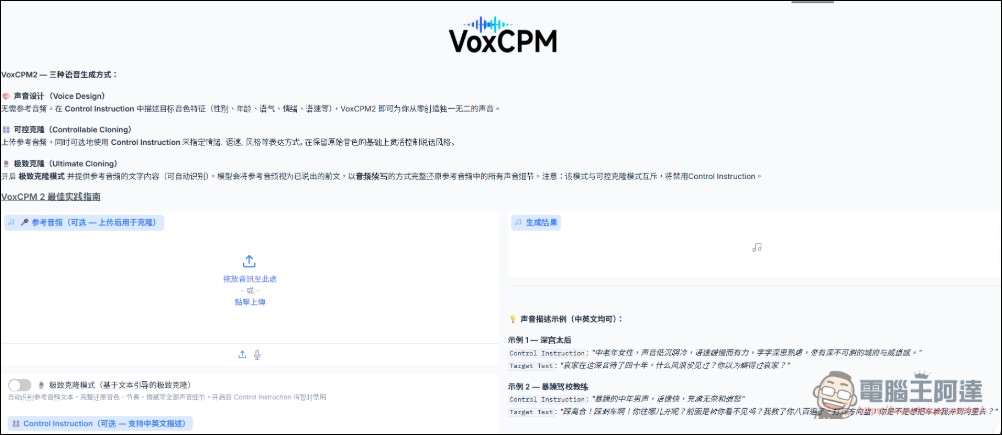
- Hugging Face Online Demo: The officials have already deployed on Hugging Face Spaces. Live DemoUsers can directly upload audio for testing.
- Local deployment Developers can
pip install voxcpmQuick installation. For Mac users, the Hugging Face community has even released versions optimized specifically for Apple Silicon (M1/M2/M3). MLX Version (8-bit Compression), further lowering the hardware barrier - ComfyUI Integration: For creators who prefer graphical interfaces, various tools have already appeared on GitHub.
ComfyUI-VoxCPMA plugin that lets you seamlessly integrate voice generation into AI image or video generation workflows.
Source: KOCPC Chinese