


If there’s one of the most critical questions in the AI industry in 2026, it’s probably: how long can Nvidia’s moat hold? As Google’s TPUs continue to grow, Anthropic partners with Broadcom to develop custom chips, and major cloud providers become increasingly capable of building their own AI infrastructure, the market naturally begins to ask whether Nvidia’s current high margins, high market share, and strong pricing power represent a long-term advantage or merely a阶段性 outcome driven by the AI boom. Recently, NVIDIA CEO Jensen Huang sat down for an exclusive interview with well-known YouTuber and podcast host Dwarkesh Patel, where he fielded almost every core question the outside world has been asking about Nvidia—from supply chain lock-in and competition with Google’s TPU, to CUDA ecosystem advantages, Anthropic investment opportunities, chip allocation logic, and China’s export controls—all laid out directly. The conversation was quite sharp and compelling.
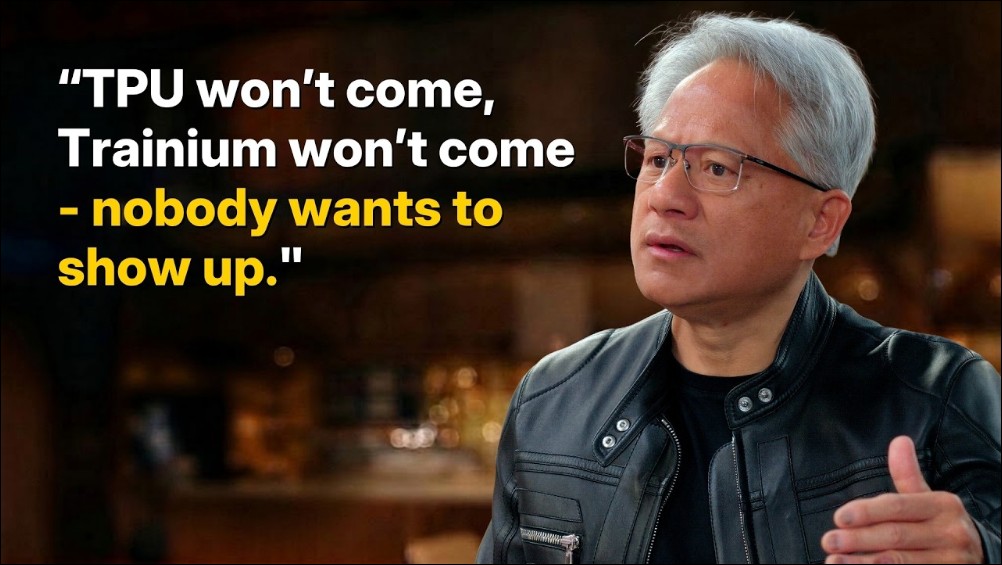
Nvidia doesn’t really sell chips—it sells the ability to convert electrons into tokens.
At the start of the interview, the host immediately raised one of the most sensitive questions. Since Nvidia doesn’t build its own fabs, with logic chips produced by TSMC, HBM coming from SK Hynix, Micron, and Samsung, and everything ultimately assembled by ODMs and various supply chain partners, is Nvidia essentially just a company that packages design and software beautifully? If AI truly commoditizes much of the software, could Nvidia also end up being commoditized?
Huang’s response is highly representative. He believes Nvidia’s core mission is to “transform electricity into tokens”—and this isn’t simply about selling chips, but rather a complex process involving architecture design, manufacturing, packaging, networking, software, computational efficiency, and application deployment. In other words, Nvidia isn’t selling a single component, but an entire system capability that transforms computing power into usable AI output.
This also explains why he doesn’t fully embrace the single-layered view that “Nvidia is just a high-margin chip company.” According to him, the AI world is like a five-layer cake, and Nvidia has partners and ecosystems at almost every layer—it handles the essential core parts itself while partners fill in the rest. This “do less, but make the parts you do so difficult that others can’t replicate them” strategy is why Nvidia believes it’s not easily commoditized.
Supply chain lock-in isn’t a nice-to-have advantage—it’s now one of Nvidia’s most important moats.
In an interview, Jensen Huang acknowledged that Nvidia has indeed made substantial upstream commitments, and these commitments go beyond the procurement figures visible in financial reports. During the conversation, Dwarkesh Patel noted that Nvidia’s wafer, memory, and advanced packaging procurement commitments in recent years have approached $100 billion, with outside estimates projecting an even larger scale in the future.
To outsiders, the most straightforward way to interpret this scale is that Nvidia’s success isn’t just about having superior products—it’s about “securing scarce resources first.” Even if competitors could design AI accelerators, they might not be able to secure enough advanced process capacity, HBM memory, or CoWoS packaging resources. But the more critical point is that Jensen Huang doesn’t frame this as simply cornering the market on materials. Instead, he presents it as a coordination capability. He persuades supply chain partners to believe in the future market size, getting upstream players to invest early—because he has sufficiently strong downstream demand to absorb all that capacity.
This means Nvidia’s supply chain advantage isn’t actually about “I have more money so I buy first,” but rather “the entire industry believes I can see further ahead, and I can actually turn future demand into current shipments.” This ability will cause supply chain resources to continue tilting toward it, and it transforms Nvidia from a chip supplier into something of an AI infrastructure coordinator.
This is also why Jensen Huang speaks with relative confidence when it comes to CoWoS and HBM. According to him, while these bottlenecks do exist, as long as demand signals remain strong and the entire industry collectively ramps up investment, they can be gradually eased within two to three years through coordinated effort. What’s really proving stubborn has shifted from the chips themselves to further downstream concerns—land, power, construction, workforce, and the speed of AI factory construction.
TPU and homegrown ASICs are indeed threats, but Jensen Huang has expanded the battlefield.
One of the most compelling parts of the interview was the direct confrontation between Google’s TPU and various custom ASICs. The host pointed out that Claude and Gemini, two of the world’s most powerful models, are already being trained on TPUs, meaning Nvidia is not irreplaceable. This question sits at the heart of what most investors care about, as it relates to whether Nvidia’s high margins will be gradually eroded by custom silicon.
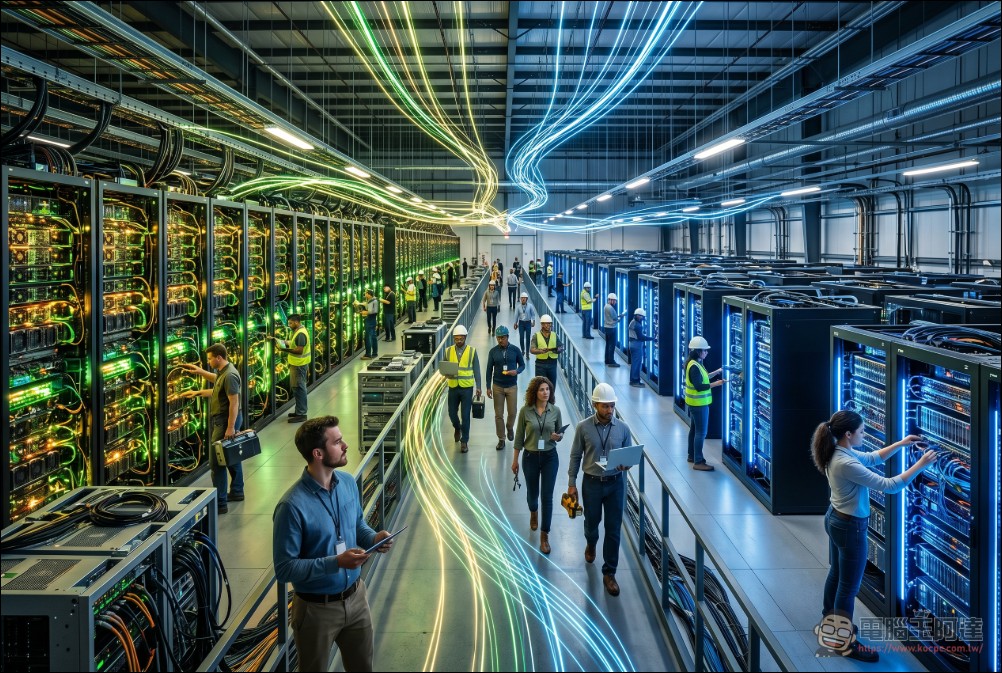
Jensen Huang did not deny the value of TPU’s existence, but his response wasn’t about comparing individual benchmarks with the TPU. Instead, he redefined the rules of the game. He believes Nvidia is not building a single tensor processing unit, but rather a broader accelerated computing platform. This platform, beyond AI training and inference, also covers molecular dynamics, quantum chromodynamics, fluid simulation, data processing, scientific computing, and many other non-AI scenarios. In other words, the TPU may be very strong on specific workloads, but Nvidia wants to dominate the larger overall computing market.
Whether this argument can fully convince the market is debatable, but it at least points to one thing—Nvidia doesn’t want to box itself into the framework of “whose training chip is stronger.” Because as long as the battlefield is limited to certain matrix computation tasks, self-developed ASICs theoretically have a chance to break in. But if the battlefield expands to encompass complete platforms, full software stacks, and cross-workload portability, Nvidia’s overall advantage will be significantly amplified.
Regarding Anthropic’s partnership with Broadcom, Jensen Huang even directly stated that Anthropic is a special case and does not represent broader industry trends. While this statement is certainly defensive in nature, it also reflects another reality: AI computing demand has grown so massive that no single supplier could possibly absorb it all. From this perspective, TPU growth may not necessarily mean Nvidia is being displaced, but rather that the entire market has expanded to the point where multiple platforms must coexist.
CUDA remains important, but what truly can’t be copied is its install base and portability.
When it comes to Nvidia’s classic moat, CUDA remains central. However, Jensen Huang’s current framing is relatively more mature and better aligned with industry realities. Because right now, large AI labs and hyperscale cloud providers genuinely have the capability to write their own kernels, modify their own compilation pipelines, and even use tools like Triton for more granular optimization. In other words, CUDA is no longer the kind of absolute barrier where “you can’t do AI without it.”
However, the key point Jensen Huang emphasized is that CUDA’s value lies not just in the API or toolchain itself, but in the massive installed base and complete ecosystem behind it. When developers write software, a model, or a set of tools, what they care most about is often not the theoretical peak performance of a particular architecture, but whether the thing can actually run directly across a wide range of different GPUs, different cloud platforms, and different environments. This portability is actually critical for the commercial world.
This is also why Jensen Huang would say that one of Nvidia’s greatest treasures is actually the installed base that has already been deployed. From the A series and H series to the L series, across GPUs in different data centers and edge devices, developers can essentially tap into a massive pool of existing computing resources as long as they build on the CUDA ecosystem. For teams looking to quickly commercialize products or deploy AI at scale, this remains an advantage that is hard to ignore.
He admitted missing out on Anthropic, and also revealed that Nvidia wasn’t good at external investments in the past.
Another memorable aspect of this interview was Jensen Huang’s rare acknowledgment that he missed the early investment opportunity in Anthropic. This kind of candor is quite uncommon, because for Nvidia today, Anthropic is not just a star AI startup, but a highly symbolic name in the large model supply chain and computing power landscape.
Jensen Huang’s explanation is that Nvidia was not good at making such external investments in the past, nor did it develop a mature investment culture, so it failed to make timely bets at the time. This statement somewhat reveals that Nvidia has long been more of an engineering company focused on product and platform evolution, rather than a tech giant that controls industry direction through investment and capital operations.
But in today’s AI competitive landscape, this situation has clearly changed. The interconnection between compute, cloud, model companies, and the application layer is tighter than ever before. Who invests in whom, who ties down whom, and who can first carve out a position in future demand has become a critical aspect of industry competition. From this angle, Jensen Huang proactively bringing up this mistake is essentially signaling to the market that Nvidia’s current understanding of industry control chains is no longer what it was back when it was simply focused on making GPUs.
Jensen Huang’s stance on China’s chip export controls is more direct than expected
The most controversial part of the entire interview was undoubtedly China’s chip export controls. In the interview, Jensen Huang very directly expressed his disagreement with the restriction policies, stating that China itself already possesses considerable chip manufacturing capabilities and energy infrastructure, and that relying solely on export restrictions may not truly alter the direction of technological advancement, but instead could accelerate the maturation of local alternatives.
This passage is sensitive because it’s not merely a statement of commercial interests. Nvidia certainly has obvious considerations regarding the Chinese market, but Jensen Huang’s remarks are actually closer to an industry observation: as AI has become a global infrastructure competition, relying solely on restrictions to slow down competitors may not be as effective as policymakers assume. Especially when China’s domestic industry chain, data center construction, and alternative chip development are all advancing in parallel, external restrictions may actually become an internal accelerator.
However, this argument naturally invites skepticism, as the US export restrictions on advanced AI chips are essentially a policy choice intertwined with technology, national security, and geopolitics. Jensen Huang’s approach from an industry and market perspective doesn’t necessarily mean policymakers will accept this logic. But one thing is certain: Nvidia is no longer just an AI beneficiary—it has become a core player that cannot be ignored in the US-China tech rivalry.
Even without the AI revolution, Jensen Huang still believes Nvidia will win
There’s a noteworthy detail at the end of the interview. When the conversation returned to Nvidia’s long-term positioning, Jensen Huang said that even if today’s generative AI revolution hadn’t happened, he still believes Nvidia would continue to grow through accelerated computing in graphics processing, scientific research, and various traditional high-performance computing scenarios.
On the surface, this sounds like typical CEO bravado, but it carries real weight. It signals that Jensen Huang isn’t tying Nvidia’s future entirely to the current large language model hype cycle. Rather, he sees AI as just the latest and most visible segment of a much broader path—accelerated computing. In his worldview, AI isn’t a lucky trend Nvidia stumbled upon; it’s a natural peak that emerged from years of driving computing architecture evolution.
This is crucial for Nvidia because it’s trying to answer the market’s deepest question: if large model hype eventually cools down, training spending slows, and inference efficiency improves dramatically, what does Nvidia have left? Jensen Huang’s answer is clear—Nvidia’s remaining strength is a complete set of capabilities that make all kinds of high-density computing more efficient, not just a single application like AI.
Friends who are interested can check it out themselves.Exclusive interviewOver an hour and a half, but the process was quite impressive. I’ve also made a bilingual side-by-side translation:
What this interview really shows is that Nvidia’s battlefield is bigger than people realize.
In summary, what makes this interview truly valuable isn’t giving Jensen Huang another platform to defend Nvidia, but rather laying his strategic vision bare for the market to see. For him, Nvidia’s moat has long ceased to be about how much faster one GPU is than another, how many developers are locked into CUDA, or how much HBM or CoWoS capacity they’ve secured first. The real core is this: as AI evolves from model competition toward industrialization, infrastructure, and energy demands, whoever can coordinate the supply chain, integrate developer ecosystems, and get model companies, cloud providers, equipment suppliers, and policy environments working in concert—that’s who will be the true winner of the next phase. From this perspective, Huang is working to redefine Nvidia from “the world’s most powerful AI chip company” into “the master orchestration platform for the AI world.”
As for whether this moat can ultimately be defended, the market may not have an answer today. Because Google, Amazon, Microsoft, and a host of model companies clearly aren’t going to sit back and watch Nvidia maintain its current dominant position forever. But at least in this interview, Jensen Huang has made his answer clear: he doesn’t think Nvidia’s advantage is eroding—if anything, he believes the larger the scale and the greater the complexity of the AI era, the more it highlights the value of Nvidia’s integrated system.
And this, perhaps, is the real question the market should be grappling with next—not how long Nvidia’s GPUs can keep selling, but whether anyone other than Nvidia can truly bear the weight of this enormous AI industrial ecosystem right now.
Source: KOCPC Chinese