


Since Japan, like Taiwan, is facing the challenges of late marriage and declining birth rates among young people, local governments are actively seeking various solutions. Recently, the Kochi Prefecture government announced it will provide subsidies of up to 20,000 yen (approximately NT$4,340) per year for eligible single adult residents aged 20 to 39, specifically to cover monthly fees for qualifying online matchmaking services. Following Miyazaki Prefecture’s similar initiative launched in 2025, this represents the latest case of a Japanese local government using public funds to encourage citizens to use dating apps and promote marriage, highlighting Japan’s increasing willingness to turn to technology and digital platforms in addressing its population crisis.

Kochi Prefecture: One of Japan’s least populated prefectures
Kochi Prefecture is located on the southern coast of Shikoku Island, a prefecture on Shikoku, the smallest of Japan’s four main islands. The prefecture has a population of approximately 650,000, the vast majority of whom are concentrated in Kochi City, the prefectural capital, making it one of the least densely populated prefectures in Japan.
Against the backdrop of Japan’s declining birthrate and shrinking population, local governments like Kochi Prefecture face particularly heavy pressure. The newly launched subsidy program targets single adult residents aged 20 to 39 during the 2026 fiscal year (April to March of the following year), and the dating apps used must be government-certified as “internet marriage introduction services.” Since eligible apps typically charge annual fees slightly above 20,000 yen, applicants will still need to cover a portion of the cost themselves.
Kochi Prefecture had already in December last year partnered with Japan’s largest dating app Tapple(with over 20 million users) established a partnership to promote local safe online matchmaking services. Although this subsidy announcement did not name Tapple, it is widely believed to be one of the government-approved services.

Precedent: Miyazaki Prefecture piloted this in 2025
Kochi Prefecture is not the first case. Last year, Miyazaki Prefecture (population approximately 1.02 million), located in Kyushu, offered subsidies of up to 10,000 yen (approximately NT$2,170) to help people pay for membership fees on dating apps.
This trend aligns closely with the data. According to a 2024 survey by Japan’s Children and Households Agency, among married people under 40,one quarterFor the first time, dating apps have surpassed the workplace and school as the primary way young people meet their partners and get married. This figure not only demonstrates that dating apps have become deeply embedded in Japanese young people’s romantic lives, but also provides a compelling policy justification for local government subsidies.
Tokyo Deploys AI, Local Governments Offer Subsidies
Local government subsidy policies are merely a microcosm of the Japanese government’s multifaceted approach to combating the declining birth rate. In September 2024, the Tokyo Metropolitan Government officially launched an AI matchmaking app calledTokyo EnmusubiThis is part of the “Tokyo Futari Story” (Tokyo Two-Person Story) program. Users must submit single status certificates, sign a declaration of intent to marry, and provide tax documentation. They must also fill out 15 items of personal information including height, education, and occupation, and undergo interviews with official personnel. The Tokyo Metropolitan Government allocated 200 million yen (approximately NT$43.4 million) for this initiative in 2023, and added another 300 million yen (approximately NT$65.1 million) in 2024.
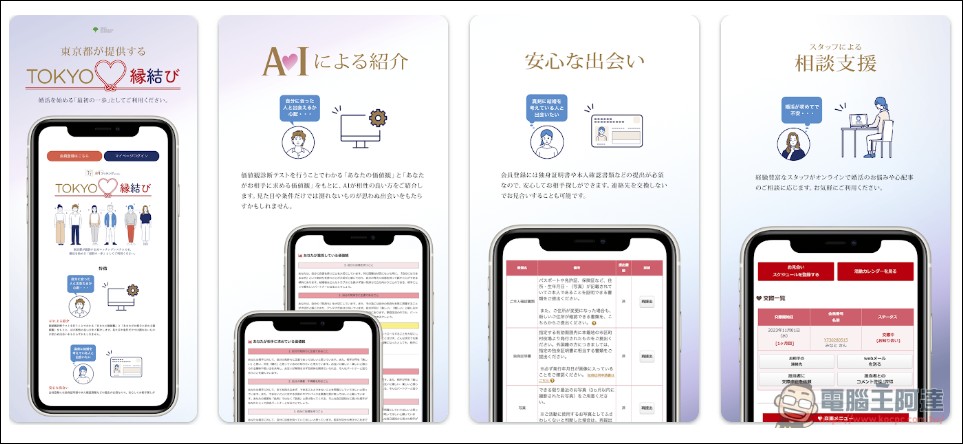
On a broader policy level, the Japanese central government has since 2015 implemented “konkatsu” (marriage activities) policies, expanding childcare support and paternity leave, deploying “marriage support coordinators” across all 47 prefectures, with the central government covering 75% of the costs. Local governments have adopted diverse approaches: Fukui Prefecture launched online matchmaking services as early as 2010; Hiroshima Prefecture organized matchmaking events in 2023 that resulted in 15 newlyweds; Saitama Prefecture’s online matchmaking service launched in 2018 has accumulated 20,000 users and facilitated 458 marriages as of March 2024; Miyagi Prefecture has introduced AI matchmaking, and Ehime Prefecture utilizes big data analysis.
A fertility rate of 1.15, the lowest on record
Behind these varied policies lies a set of alarming numbers. In 2024, Japan’s total fertility rate fell to 1.15%hitting a record low, marking the ninth consecutive year of decline, far below the 2.1 needed for generational replacement. That same year, the national population dropped by over 850,000 from the previous year, to 123.79 million. The 2023 figures were equally grim: the national birth count was only 727,277, with 474,717 marriage registrations—the lowest on record since 1933.
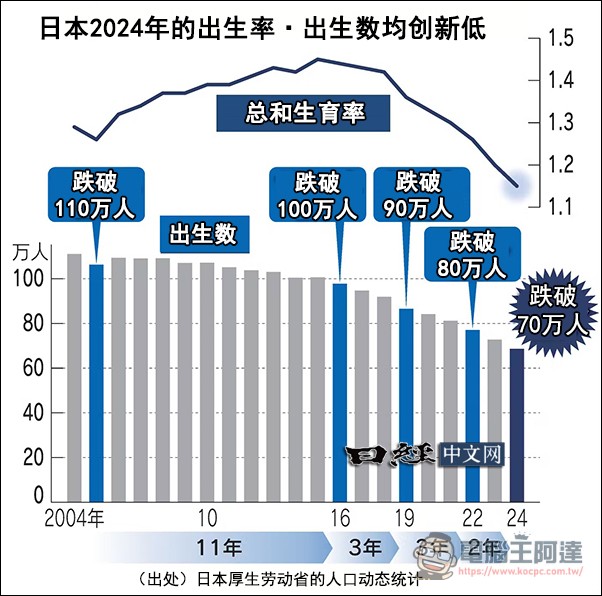
Amid this sense of crisis, Kochi Prefecture’s dating app subsidies may sound somewhat naive, but they also demonstrate exactly how the Japanese government is trying to reverse the trend by adopting methods more in line with young people’s daily lives.
Can subsidies solve the low birth rate problem?
However, critics point out that these measures fail to address the root causes. Japan’s culture of long working hours—where leaving time often depends on when supervisors depart—curtails the time young people have to develop relationships. Traditional gender role expectations force many women to choose between career and family. Rising prices and stagnant wages make the financial burden of starting a family increasingly heavy. Scholars argue that only by dismantling Japan’s traditional “male breadwinner, female caregiver” structure can real change in demographic trends occur.
Surveys show that 54% of Japanese support government-led dating apps, with support reaching 64% among those aged 18-29 and 74% among people in their thirties. However, the same survey reveals that 57% of respondents lack confidence in the government’s overall measures to boost the birth rate. Monthly fee subsidies for dating apps might encourage more people to take the first step in finding a partner. But without addressing structural social problems, just how far this 20,000 yen subsidy can go remains an open question. After looking at Japan, Taiwan’s current fertility rate is even lower than Japan’s. It’s unclear how our government plans to handle this. If childcare support and parent assistance systems aren’t improved, Taiwan may face a “survival worse than death” situation even more severe than Japan’s in the future.
Source: KOCPC Chinese